

.svg)
.svg)
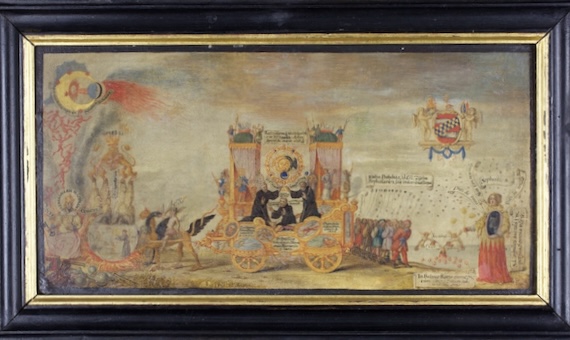
"The Triumph of Alchemy" (c. 1613), a rare German panel painting at the BPH

"The Triumph of Alchemy" (c. 1613), a rare German panel painting at the BPH

The inspiration for this piece is an illustration I came across in a 19th-century edition held by the BPH: J. Scheible, Christoph Wagner, Faust’s Famulus (Stuttgart 1846).
In addition to Faust, this thick volume—more than 1,000 pages long—from the series ‘Das Kloster, weltlich und geistlich’ covers more “Black Artists” than just Faust and his assistant: in fact, this volume contains various reprints of older magical works such as the Clavicula Salomonis (Key of Solomon) based on Luppius’s 1686 edition, Zoroaster’s Telescope (translation from the French original of 1796), the Magia divina based on the 1745 edition, and a yet-to-be-identified ‘Romanus-Büchlein’ (a word-for-word reprint of a booklet from Venice that was ‘formerly’ available at annual fairs, according to Scheible). In addition, the legend surrounding Don Juan and the appearance of his “Stone Guest” is discussed, a subject of many plays, operas, and poems, followed by some lesser-known signers of pacts with the devil and practitioners of the black arts. And in that section, Johannes Trithemius also appears, who was known as the “Black Abbot” because of his interest in magic.
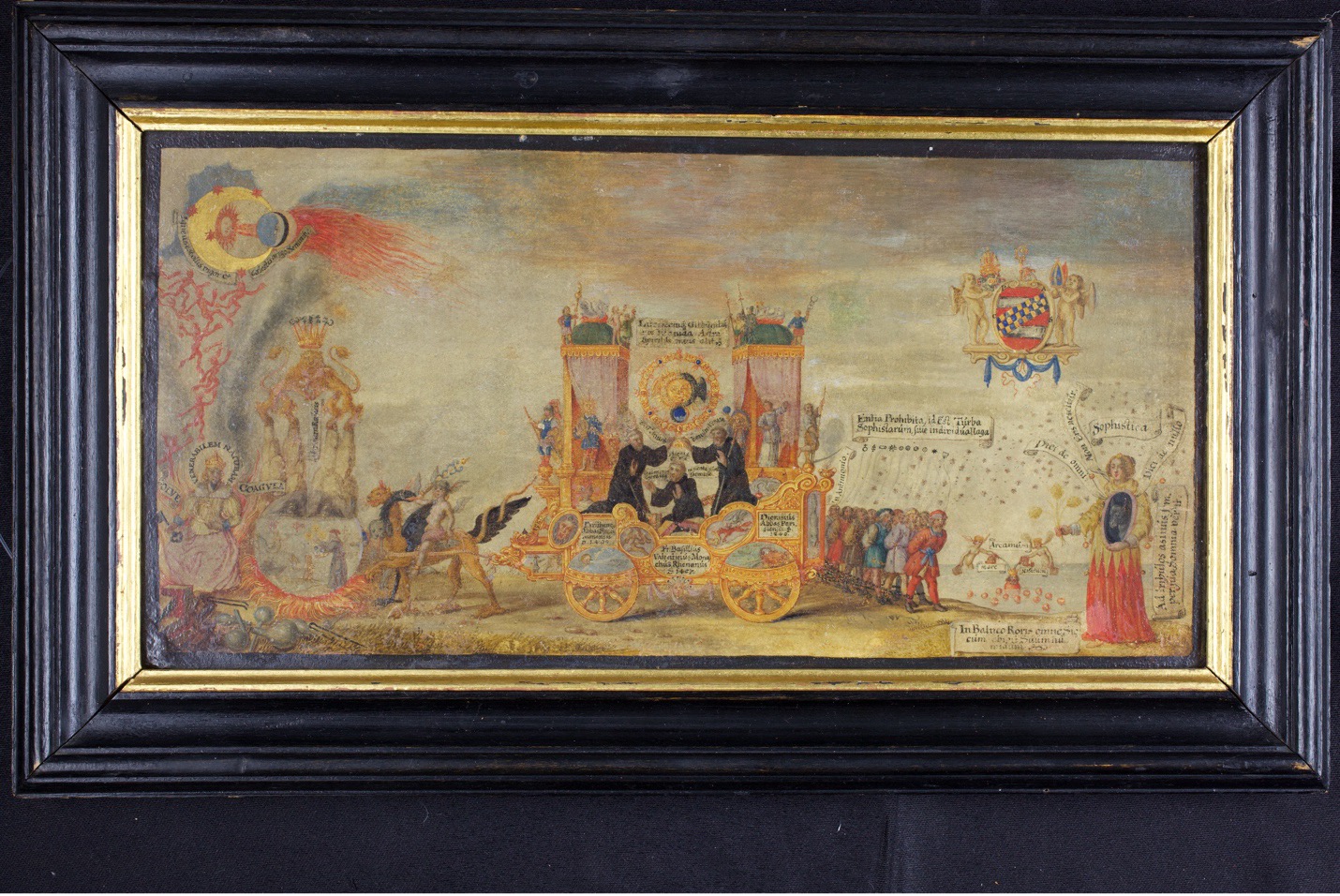
The illustration has no title but depicts “The Triumph of Alchemy,” and the central figure in the triumphal chariot is the legendary monk-alchemist Basilius Valentinus, flanked by Johannes Trithemius and Dionysius Parisiensis (presumably St. Denis, the first bishop of Paris). This illustration does not actually have a close connection to the text, except that Trithemius appears here as a minor figure in a purely alchemical setting. The other illustrations in Scheible’s varied anthology are all copies of images from the works he reproduces. In this biography of Trithemius, it would have been natural to include a portrait. But Scheible demonstrates here, just as in his choice of texts, that he has an eye for curious, forgotten, and unknown subjects: this is, in fact, a drawing based on an original painting that was located in Stuttgart at the time, in 1846 (likely in private hands), and which, as far as I could ascertain, has never been depicted in any alchemical reference work. The caption beneath the print reads “Das Original befindet sich bei Alb. Bechter in Stuttgart” (The original is located in Stuttgart at Alb. Bechter). I have not been able to identify this Bechter, but I am very familiar though with this original painting: it has been part of the BPH collection for over 25 years and is currently on display in the Rare Book Room.
Johannes Trithemius (1462–1517), a Benedictine monk and abbot of Sponheim and Würzburg, known as the “father of bibliographers,” is highly praised in the text: he was a “Wunder seiner Zeit,” an outstanding monk, devoted to his books and his studies without neglecting his monastic duties, and later an abbot who was, if possible, even more perfect. The Sponheim monastery, which had fallen into poverty, flourished under his leadership, and the library grew from 48 insignificant works into a collection of 2,000 writings that was famous throughout Germany. Trithemius, however, also had another side: he was suspected of practicing magic, and that is precisely why a chapter in this volume is dedicated to him.
As mentioned, he is not the central figure of this depiction: that is the alchemist Basilius Valentinus. The triumphal chariot was an artistic theme that developed from the classical military triumphal processions following a great victory. Since Petrarch’s Trionfi (all poems), the theme became very popular and was applied to any subject that was meant to triumph, to be the highest or the best. In the 15th century (and later as well), there were also actual triumphal processions with decorated victory chariots on the occasion of royal visits.
But there is more: the painting evokes strong associations with the title of one of Basilius Valentinus’ works: The Triumphal Chariot of Antimony, the first edition of which dates from 1604. I will not delve here into the debate regarding the age of Basilius and his works: as early as the 17th century, doubts were raised as to whether what circulated under his name actually originated in the Middle Ages—as the year 1407 on this small painting also suggests—and whether he had even truly existed. It is now established that the works attributed to him were produced in the late 16th and early 17th centuries, and that the actual author is likely Johann Thölde.
The text of Triumphwagen describes the production and (medical) use of antimony. Thanks to Paracelsus, antimony was highly regarded as a medicine for combating many diseases, but it was also highly controversial because it was so toxic.
In the small painting, which measures only 32 x 15 cm, the entire context is extremely positive: Basilius and the practice of alchemy are clearly glorified here.
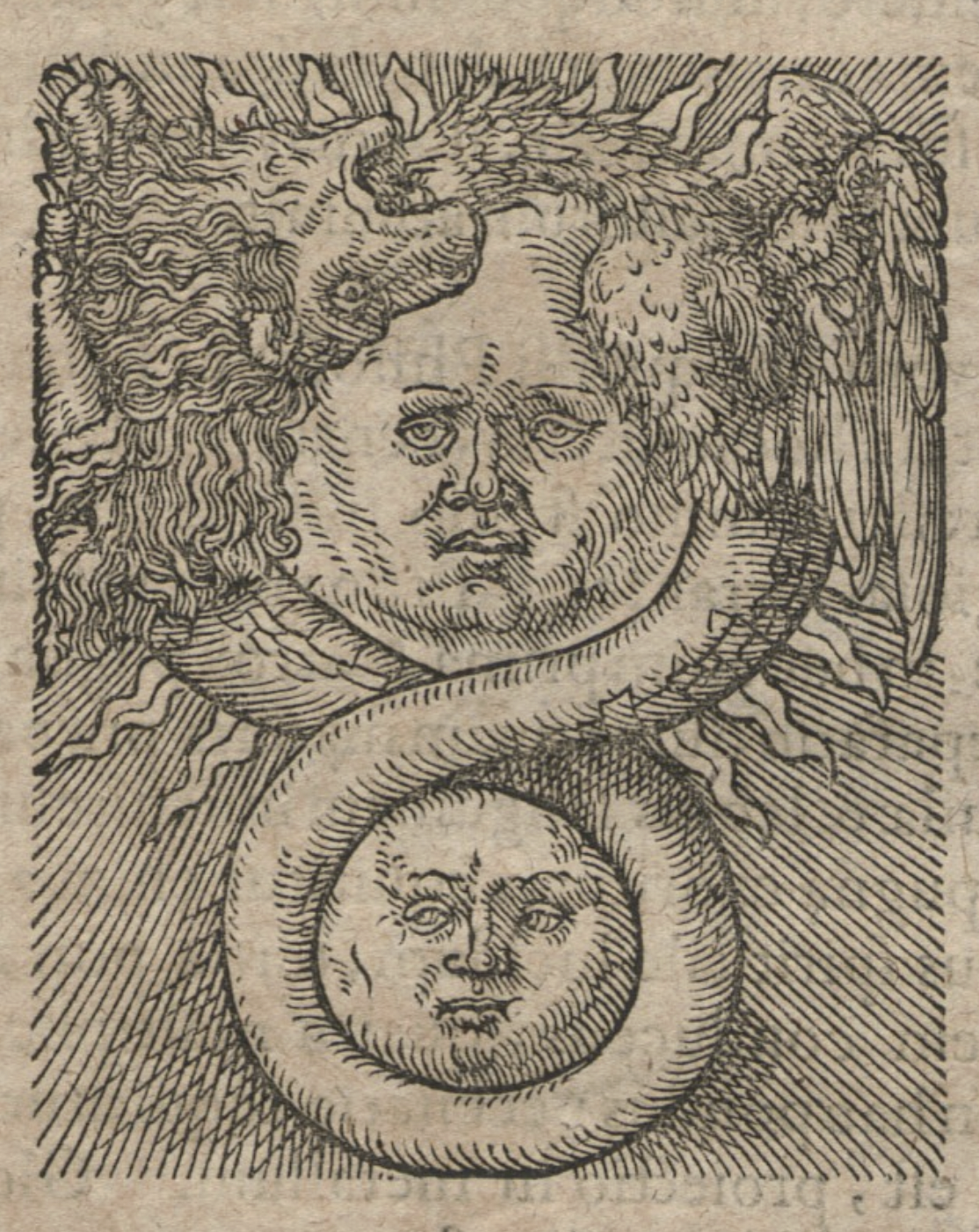
The coat of arms has not yet been identified, which could reveal something about the possible patron. We suppose it originates in Germany. The date is likely to be shortly after 1613: in the painting, above the figure of Basilius, one can see the Azoth illustration, which appears to be an exact copy of the oldest known woodcut of it, in Basilius Valentinus, Azoth, Frankfurt 1613.
Much more research is needed to fully interpret all the details on this panel!

Written by
José Bouman
Drs José Bouman has been head curator of the Bibliotheca Philosophica Hermetica since 1983. She has shaped every museum exhibition since and specialises in Dutch medieval literature.

.avif)