

.svg)
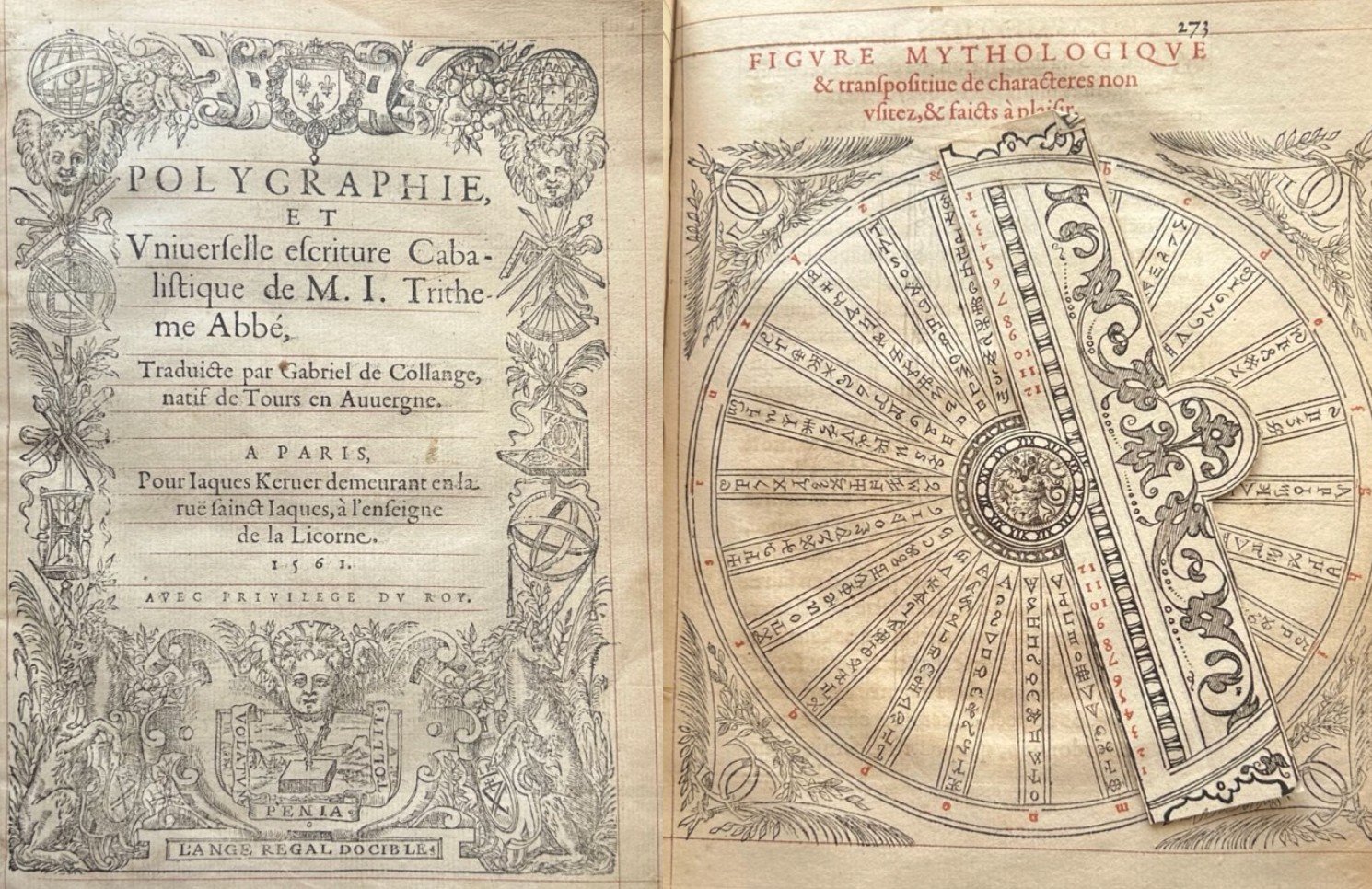
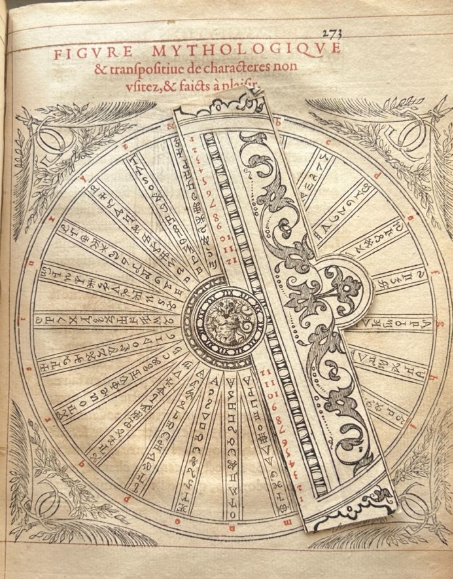
Woodcut "volvelle" from the French translation of Johannes Trithemius's Polygraphia (1561).

Ciphers and Angel Magic: The Enochiana of John Dee
Woodcut "volvelle" from the French translation of Johannes Trithemius's Polygraphia (1561).

Ciphers and Angel Magic: The Enochiana of John Dee
By
Kavi Tiwari
September 17, 2026
I began my research at the Embassy of the Free Mind with an exceedingly brief overview of Western Esotericism and exactly one word in mind: ciphers. I am an American high school student interested in Math (among other things), and so a few years ago I found myself involved with my school’s Science Olympiad team (Science Olympiad being national competitive test taking, effectively). I was placed by chance on the subteam of a test about ciphers, for which me and my teammates were required to learn several different kinds of ciphers with the goal of decrypting ciphertext without a key at speed. It’s a terrifying time with the ironically campy name “Codebusters,” but I quickly became obsessed with the subject of cryptography and (especially relevant here) its fascinating history. However, I never had the chance or resources to scratch below the surface of the exoteric.
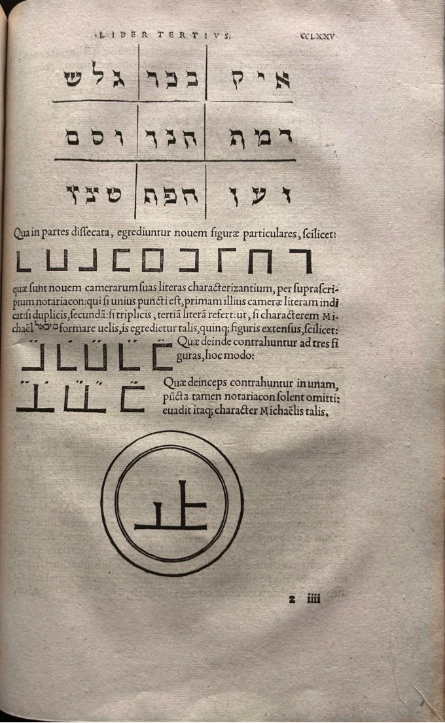
First, what is a cipher? A cipher, loosely defined, is any technique or system, often but not necessarily mathematical, used to transform the appearance but not the meaning of information. A cipher turns “plaintext,” unencrypted information, into “ciphertext.” The purpose of encryption is, as you can imagine, clandestine communication, often used for the safe transfer of political secrets or valuable information only intended for a select few. This is because ciphers tend to use “keys,” an easily explained and easily executed method for de-cryption; if you know the key, you are able to read this “secret writing” with ease (cryptos, meaning “secret” from the Greek κρυπτός; graphein meaning “to write” from the Greek γράφω). If you do not know the key, then no dice, just as intended. An example is the Pigpen cipher, invented by German Renaissance polymath and occultist Heinrich Cornelius Agrippa (1486 - 1535). Originally formulated as “The Kabbalah of the Nine Chambers,” it works by corresponding each letter of the Latin alphabet to a corner of a three-by-three or two-by-two grid.
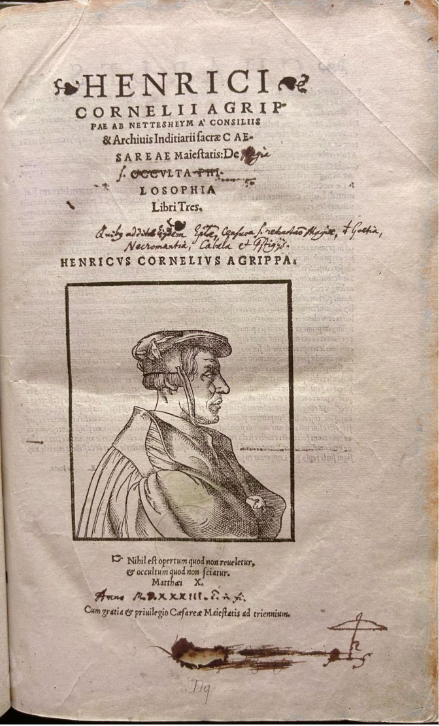
Cryptanalysis, on the other hand, is the process of decrypting ciphertext without a key, and at times without knowledge of the cipher itself. For a system as simple as the Pigpen, cryptanalysis is not difficult, and thus the cipher is fairly insecure — but this was not always the case. After the fall of Constantinople (1453), Muslim scholars fleeing to Italy carried with them not only a plethora of translated Greek texts, which would play a role in igniting the Renaissance, but also cryptographic and cryptanalytic techniques light years ahead of medieval Europe’s. Prior to this diaspora, something like the Pigpen would have worked reasonably well against the unadvanced cryptanalysis of medieval Europe. It was not so afterwards. Thus, new techniques for encipherment had to be created, and in turn new methods of cracking them, snowballing into a sort of cryptographic revolution which paralleled the Renaissance (1). Coinciding with the Renaissance meant coinciding with Renaissance religious creativity, budding Renaissance esotericism, and so ciphers became entwined with European hermetic thought.
I began my research into esoteric cryptography with Johannes Trithemius, a 15th century German abbot and a man often cited as the “father of modern cryptography,” a necromancer, and practitioner of demonic magic. Within a corpus concerned with witchcraft, black versus white magic, and alchemy, Trithemius produced two treatises on cryptography, the Steganographia (1499) and then the Polygraphia (1508; UBN 11482); here at the BPH there is a 1561 French translation of the latter. Unique to our edition, physical cipher-wheels, or “volvelles,” are included, amounting to a work which would have been both didactically and physically useful for Renaissance cryptographers.
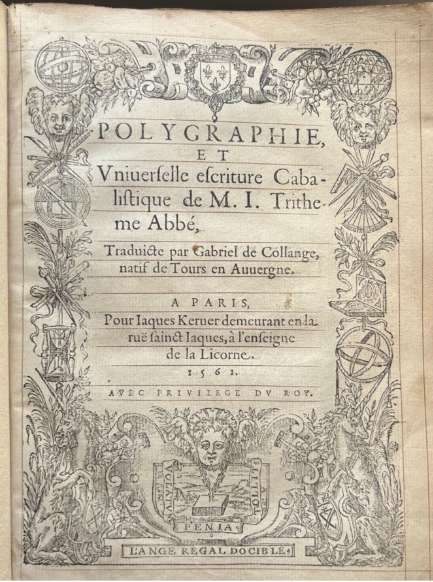
What is interesting about Trithemius’ cryptographic work is that, during his lifetime, Trithemius was not recognized as a cryptographer, and the Steganographia was not considered a treatise on cryptography. On the contrary, the Steganographia served as primary source material for his detractors to label him as a heretic and a practitioner of demonic magic! The Steganographia is a fascinating cryptographic work because it shows rather than tells: it is, on the surface, a guide on how to use angels to communicate secretly over long distances, but encrypted within its lines of supposed “spells,” the chants required to summon these helpful messengers, are secret messages which describe his innovations on the field of cryptography. Trithemius was obviously concerned that none of his contemporaries seemed to see through his trick (he did name it, after all, the Steganographia, steganos meaning “concealed” from the Greek στεγανός) and proceeded to publish a more obviously cryptographic sequel, his Polygraphia, and a preface alluding to his earlier, more controversial work as an extra clue. However, even when keys to the first two thirds of the Steganographia were published posthumously eighty years after Trithemius’ death, the elusive and seemingly non-cryptographic (thus demonic, to detractors) third section attested to his heretical malpractice. Only in 1998 did Jim Reeds, mathematician and master of esoteric cryptanalysis, discover the underlying enciphering technique for this section, revealing an early form of the Vigenère cipher, or more generally the polyalphabetic cipher. When a similar technique was invented (or rather re-invented!) by Italian cryptographer Giovan Battista Bellaso in 1553, it would remain unbreakable (dubbed the “chiffrage indéchiffrable,” meaning the “indecipherable cipher” in French) until the mid 19th-century, a testament to the high level of cryptographic ingenuity found in Renaissance hermetic activity.
To scholars of Trithemius before Reeds’ ingenious solution, the Steganographia represented how an early and influential Renaissance hermetic thinker closely conflated cryptography with the spirit world (3), but to Reeds, its decipherment proved undoubtedly that Trithemius was a cryptographer and not an occultist (4). The answer really must lie somewhere in the middle: for it would be ignorant of all his other works to say that Trithemius was not involved in esotericism, but it also would not be fair to say that Trithemius was whole-heartedly concerned with actual angel magic in the Steganographia (5). Rather, I prefer to take the stance that Trithemius packaged his revolutionary cryptography techniques in angel magic so that they could get into the hands of esoteric practitioners while simultaneously be ignored by the orthodox and uninitiated, pointing to his belief in a genuine connection between the two fields — an incredibly clever evasive method similar to that of insects which have evolved to look poisonous but are not.
Trithemius remains a pivotal character in my research, repeatedly showing up everywhere I look to the point of becoming uncanny. However, from my interest in Trithemius’ cryptography I stumbled upon Dr. John Dee, a complicated and famous 16th century Elizabethan polymath and magus who was one of the many learned men who “ate the ‘poisonous’ bug.” Dee cited Trithemius as one of his greatest influences, and the Steganographia as “a boke for which many a learned man hath long sowght, and daily doth seek” (John Dee to Sir William Cecil, 1574) (6). It is relevant that this was written before the publicization of the two initial keys, meaning that its cryptographic nature was only supported by its mention in the Polygraphia’s preface. Nonetheless, it appealed greatly to Dee as a mathematician and proto-cryptographer no doubt interested in unearthing possible encipherment, but also as a seeker of divine knowledge.
Contemporary scholars of Dee have well established that his attraction to angel magic, or “Enochian” magic, so-called because Enoch was the last in the Bible to communicate openly with angels, was merely an extension of the same motivation which drew him to the natural sciences. Dee sought universal truths by studying “The Book of Nature” — a term which described nature as a message from God akin to scripture — when he practiced and studied math, geography, and alchemy. However, he also felt that these earthly sciences were already too corrupted, too distant from God’s intention for the world, and thus turned to obtaining heavenly knowledge through direct discourse with angels, inspired by the stories of the prophets in the Bible, such as Enoch (7).
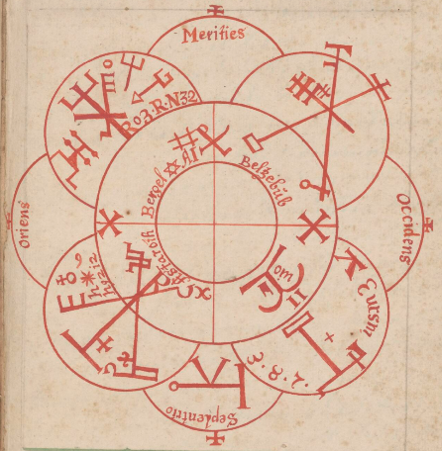
This motivation would lead him to work with several scryers, the most known of which is Edward Kelley, with whom Dee would spend several years producing a series of five books which would make up what is now recognized as a system of “Enochian magic.” Involved in this system of magic is an entire “Enochian” language, a Tabula Bonorum Angelorum (Table of Benevolent Angels, 1583), which supposedly contains “All of human knowledge” (8), and various instructions for the construction of ritualistic rings, tables, sigils, and seals. The Liber Loagaeth (1583), one of the first-produced longer works of Dee entirely in Enochian, contains dozens upon dozens of grids of letters which are similar (and at times identical!) to those of another recently decrypted cryptographic-hermeneutic text, the Liber Soyga (c. 1500), about which very little is known. The mathematics behind this mysterious Liber Soyga (Soyga being agyos reversed, which means “holy” from the Greek ἅγιος) are so intricate they, too, were only deciphered very recently (and thanks to Jim Reeds as well), and represent an early instance of a cellular automaton, a self-constructing mathematical structure similar to Conway’s Game of Life (9).
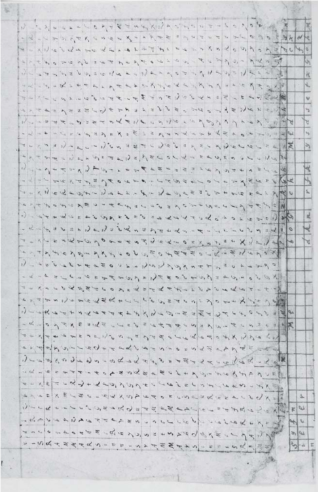
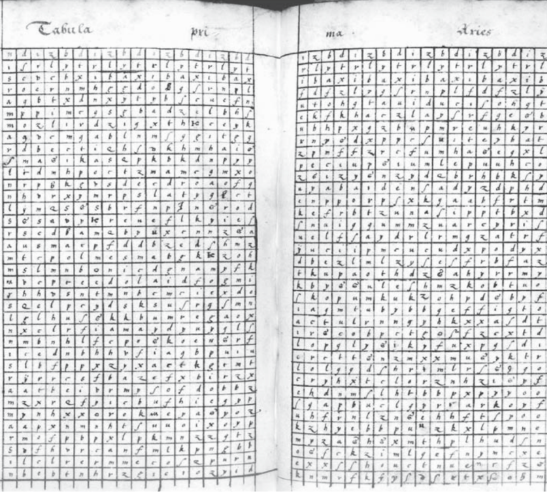
As I continue to research the “Enochiana” of Dee with reference to esoteric cryptography, I will seek to answer the question: why does Dee’s Enochian magical system look so cryptographic? Is it possible that there are ciphers in Dee and Kelley’s works? More generally, I will also try to understand the relevance and significance of cryptography in Renaissance esoteric thought. Questions like this are challenging and abundant, and I’m excited to continue thinking about and pursuing them during the remainder of my time here at the Embassy of the Free Mind.
References
1. Singh, Simon. The Code Book. Doubleday, 1999.
2. Agrippa von Nettesheim, Heinrich Cornelius, and V. Perrone Compagni. De Occulta Philosophia Libri Tres. E.J. Brill, 1992.
3. Walker, D. P. Spiritual and Demonic Magic from Ficino to Campanella. London: Warburg Institute, 1958.
4. Reeds, Jim. "Solved: The Ciphers in Book III of Trithemius' Steganographia." Cryptologia 22, no. 4 (1998).
5. Trithemius, Johannes, Stephen Skinner, and Daniel Clark. Steganographia : Books I, II, III and IV. Llewellyn Publications, 2024.
.jpg)
Written by
Kavi Tiwari
Kavi Tiwari is a highschool student based in New York City. He is currently a Research Intern at the Ritman Research Institute with the Bibliotheca Philosophica Hermetica, and is studying the Enochian Magic of John Dee and esoteric cryptography.


.avif)