

.svg)
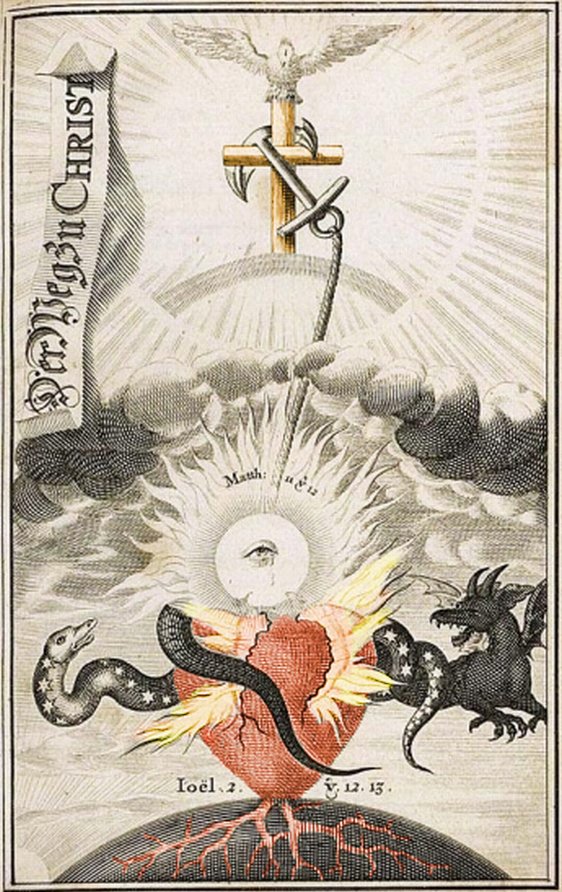
Title page of „Der Weg zu Christo, verfasset in neun Büchlein“, 1715 edition.

There is more than one Way to Christ
Title page of „Der Weg zu Christo, verfasset in neun Büchlein“, 1715 edition.

In the 1980s, the then librarian of the Houghton Library, part of Yale University, paid a visit to the BPH in Amsterdam. As a young curator, it was a great honour and a pleasure for me to show James Walsh some of our greatest treasures.
Walsh knew that we possess a large collection of and about Jacob Böhme, the visionary author who set out his highly personal view of the relationship between humankind, God and the natural world in some thirty writings. And it was precisely from that category that I had something very special to show him at the time: the only known copy of Böhme’s very first booklet to have appeared in print. It was Der Weg zu Christo (The Way to Christ), printed in Görlitz in 1624, of which, according to Werner Buddecke’s thorough and still widely used bibliography (which, admittedly, dates from 1937), not a single copy was thought to have survived. I had thought this would elicit a pleasantly surprised reaction from the American, but he actually seemed slightly disappointed! It turned out that the reason for this was that he himself had discovered a copy of this booklet in 1982, in his own library, whilst curating an exhibition of notable acquisitions (The Houghton Library 1942–1982. A fourtieth anniversary exhibition. 1982). He had actually wanted to impress us with his discovery; now we were both a little less deluded.
Since 2007, thanks to research by Carlos Gilly, librarian and historian affiliated with the BPH, we are aware that a third copy even exists, which has been sitting unnoticed for centuries at the Evangelisches Predigerseminar in Wittenberg (shelf mark I C 803). Bibliographies and catalogues are fantastic resources, but one must always bear in mind that they can never cover the entire surviving body of books. Many small and private collections fall outside their scope. In 1990, the copy held by the Houghton Library was still listed as the sole extant copy in Dünnhaupt’s bibliography (Personalbibliographien zu den Drucken des Barock); they were unaware of the BPH copy, and the one in Wittenberg.
But even with three copies having surfaced so far, Böhme’s Weg zu Christo from 1624 remains an extremely rare book and none of the copies have been digitized so far. Copies of all Böhme’s other works can be found everywhere – in translation and in many successive editions. So why not this one? A little more information may shed some light on this. Böhme, who had no theological or academic training but was an ‘ordinary’ layman, had experienced a spiritual revelation in 1600 which he set down in writing under the title Aurora oder Morgenrote im Aufgang (‘Aurora, or day spring’). This manuscript, setting out his vision of God and creation, was immediately copied by others and began to circulate. In 1613, this led to Böhme being banned from writing on grounds of heresy. Böhme’s ideas were at odds with Lutheran doctrine, and he was required to hand over his manuscript to the town hall in Görlitz, where he lived. He was no longer permitted to put anything down on paper, let alone have any of his work go to press. Böhme complied with the ban until 1618: between that year and his death in 1624, he penned some thirty new works and numerous letters, all of which were diligently copied and circulated in manuscript form amongst a circle of interested readers.
In 1624, a few months before his death, a number of his ‘followers’ decided to have a short compilation of three devotional treatises of his printed after all. The year 1622 on the title page refers to the year the text was written, not the year of printing. It was published anonymously, so that Böhme would not be discredited. The place (Görlitz) and the printer’s name (Johann Rhamba) are also omitted, so that he too would not get into trouble for printing a banned work. The print run must therefore have been very small: it was not intended to make a commercial profit, but to be circulated amongst enthusiasts. This, together with the fact that the circulation of Böhme’s work in the German lands was still being thwarted well into the 17th century, explains its rarity.
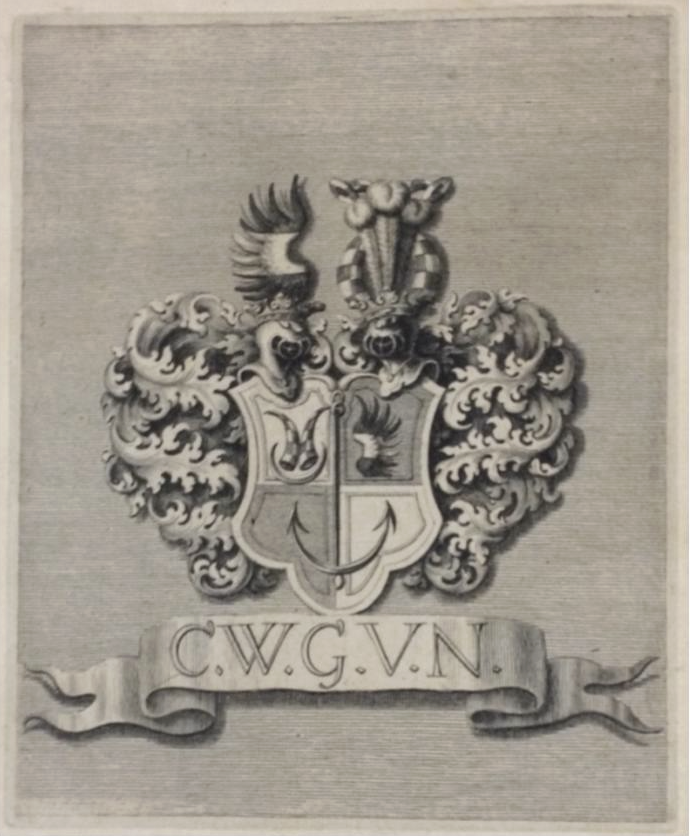
The copy held by the BPH (now in the Allard Pierson Museum in Amsterdam, as part of the Ritman Collection) bears the bookplate of Christoph Wenzel Graf von Nostitz (initials CWGVN, 1648–1712). He amassed a large collection of books and art at Lobris Castle in Lower Silesia (Luboradz in present-day Poland). Although he was not the first owner, the copy did not stray far from home initially. The castle lies 350 km as the crow flies from Görlitz. Joost Ritman purchased it for the BPH in 1978 from the Rosenthal antiquarian bookshop in Hilversum (Netherlands). It had also been sitting on the shelf there for years before it was ‘discovered’. The Jewish owner, Fritz Rosenthal, of this antiquarian bookshop – originally based in Munich – had fled to the Netherlands during the war and set up a new business in 1947 under the name of his grandfather, Ludwig Rosenthal. The BPH-copy of this rare booklet was undoubtedly part of the modest portion of the Munich stock that could be taken, for we know from the history of the firm that it had acquired the collection from Lobris Castle in the 19th century. Incidentally, around 1900, Rosenthal’s antiquarian bookshop had a collection comprising a million books from all manner of prominent historical collections – a collection larger than that of the Bavarian State Library!
We know that the American copy was purchased from William Salloch’s antiquarian bookshop in 1972. It turned up in Pennsylvania, and it is therefore thought to have been taken there by one of the European emigrants who moved there in the 17th century, including many followers of Böhme.
What I would still very much like to know is how and when a copy came to be in the hands of Jacob Böhme’s greatest opponents, at a seminary for Lutheran ministers. This is reason enough for this bibliographer to pay a visit to Wittenberg at some point.

Written by
José Bouman
Drs José Bouman has been head curator of the Bibliotheca Philosophica Hermetica since 1983. She has shaped every museum exhibition since and specialises in Dutch medieval literature.

.avif)