

.svg)

.svg)
The Strange Wisdom of The Secret Heritage (1935): Neo-Rosicrucian Propaganda from the Lost Continent of Atlantis
By
Corey D. Andrews
October 15, 2026
The Secret Heritage (1935) cover. BPH Shelf mark UBN 31115

The Strange Wisdom of The Secret Heritage (1935): Neo-Rosicrucian Propaganda from the Lost Continent of Atlantis
The Secret Heritage (1935) cover. BPH Shelf mark UBN 31115

The Strange Wisdom of The Secret Heritage (1935): Neo-Rosicrucian Propaganda from the Lost Continent of Atlantis
By
Corey D. Andrews
October 15, 2026
“Never let the truth get in the way of a good story.” We have all heard this pithy statement. My piece for Codex this month concerns the stretching of truth to tell a certain story and for a certain purpose.
As has become my monthly habit, in pursuit of inspiration I scurried to our basement depot of treasures and perused the shelves until something struck me – a large, curious white package with no label, no title, seated horizontally on the shelf, and in the Rosicrucianism section. “Hmm… what could it be?” I wondered. A large protective cardboard cassette concealing what? Secret knowledge of some kind, to be sure, but what? Upon opening, I immediately knew it would be the subject of my article this month.
Inside the package were four items – about which I will only have enough space to mention one here.
The Secret Heritage
The first item was a small booklet titled ‘The Secret Heritage’ dated to 1935 and clearly in fantastic condition. Opening the first page however, I learn that I cannot proceed to the second! It is sealed! Intentionally! Its first page is printed in such a way that it is connected with a later one, so if the reader wants to proceed, they must do so by breaking the seal and partly destroying the binding. On the first page we read the ominous warning:
Do Not Break This Seal…
Until you have deliberated and realized that within this booklet a message of importance awaits you. This booklet is not for the idly curious and its contents have been sealed for a purpose. When you have broken the seal – do not proceed until you have read the next page.

What could this ominous message of clear import be?! Everything inside me wanted to break the seal and peruse the secret contents within. Fortunately, I did not have to! Because also within the package were two other copies of the booklet with their seals already broken! Proceeding (with caution), I followed the instructions of the sealer with respect, not proceeding to the following page out of mere idle curiosity without reading the page which came before it first.
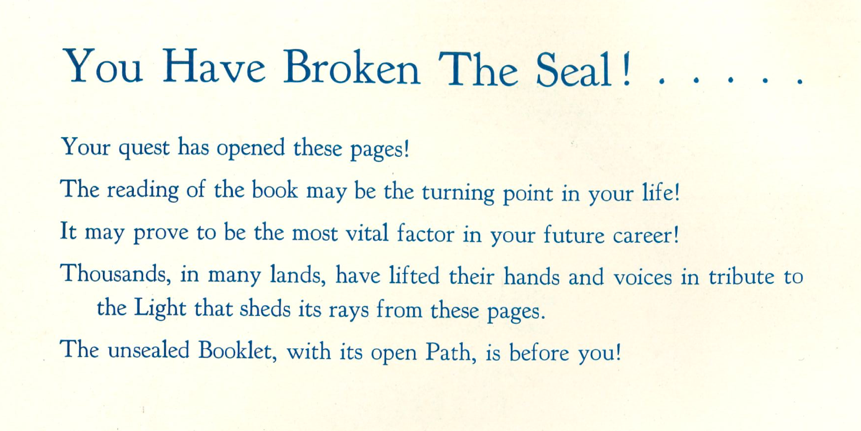
“You Have Broken the Seal!
Your quest has opened these pages!”
This is the message we are greeted with upon turning the first page. It also includes instructions for reading the whole document, such as “Place yourself in a quiet, restful mood, alone if possible, and permit the author to reveal to you the picture, the plan, the purpose leading to attainment, power, success, and – Illumination.” We also learn here that the booklet was ‘Privately Issued by Permission of the Department of Publication of the Supreme Grand Lodge of the Ancient and Mystical Order Rosae Crucis Jurisdiction of North and South America’ and printed in San José, California.
Ah I see, yes, this is from ‘A.M.O.R.C.’, or ‘the Ancient and Mystical Order of the Rosicrucians’, or in other words, an American variant of the (originally seventeenth and eighteenth century German) Rosicrucian tradition founded in 1915 by writer and occultist Harvey Spencer Lewis (1883-1939).
After reading the entire booklet, I can state that it turned out to be an exercise by AMORC in the area of evangelism to recruit members to the order – but amusing nevertheless! It tells a pseudo-historical, fantastic, literally unbelievable story of Rosicrucianism’s primordial beginnings in the fictional lands of Lemuria and Atlantis. Needless to say, there are a plethora of factual errors in the document. I am rather accustomed to - as my advisor Dr Peter Forshaw puts it, “fluff” in esoteric literature - but this went too far!

The only major article in the booklet is titled ‘The Lost Estate’, and tells the familiar esoteric-adjacent myth of the fall of Lemuria and Atlantis – two hypothesized continents of high, advanced cultures of forgotten time which became submerged in the oceans after a decadent period of attachment to “material weaknesses”, karmically necessitating their cataclysm. This follows from the well-known account of Atlantis as told through Plato in his Timaeus and Critias (c. 360 BC), where the somewhat famous quote appeared that the Atlanteans “ceased to wear their prosperity with moderation.” Thus, the implication is that moral collapse necessitates civilizational collapse – a good motif for all to commit to memory!

“According to all of the ancient legends and historical records there was a time when man was mighty in knowledge, and when men and women had attained the highest degree of mental, physical, and spiritual unfoldment, and possessed all of the wealth of happiness, material blessings, and mystical powers ever dreamed of in the hearts of human beings.”
What happened? The unnamed author claims that a “great disaster” occurred. How do we know this? They refer to a person called F. A. Michell-Hedges, a “famous explorer and archaeologist”who tells a harrowing, romantic story of the discovery of “conclusive proof that such a cataclysm occurred […,] a part of that evidence [was] unearthed by hacking through scores of miles of sweltering jungles.” Sadly, said conclusive proof was not provided in the article, so we need to take the authors word on this one.
Strange Wisdom
Delving further into the ahistorical narrative, in the section ’strange wisdom’ the author claims that this knowledge was preserved and transmitted through secret schools throughout the millennia. This was only made possible because people devoted “time and money to the continuance of the knowledge as a heritage to be passed on.” Anticipating the call for membership into the Rosicrucian order which comes later, here the author already plants subliminal seeds for the reader to unconsciously pick up on by indicating how these ‘secret schools’ who preserve this knowledge must be supported financially. This I picked up on, but put it aside for the moment and continued.
I started noticing that in the margins of the pages there were printed quotes from various historical figures. In due fashion to the booklet, I will sprinkle them also throughout this article. Many of them are actually worth considering, like this one from Albertus Magnus:
“Seek not too eagerly after the grace of devotion, sensible sweetness, and tears; but let thy chief care be to remain inwardly united to God by good will in the intellectual part of the soul. – Albertus Magnus. (A Rosicrucian).”
Ooh, nice one Albert! Though included with his name is the parenthetic qualifier that he was himself “a Rosicrucian”. “He most certainly was not!” - I internally exclaimed. Magnus lived four hundred years before the original Rosicrucian manifestos (of 1614/15/16), and even those original ‘Rosicrucians’ had no formal organization. In fact, no formally arranged Rosicrucian organization existed until the eighteenth-century quasi-Masonic Orden des Gold- und Rosenkreuz (see Christopher McIntosh’s The Rose Cross and the Age of Reason, for example). Even this letter legitimate order had no historical continuity to AMORC by the way, see e.g., the lucid article (cited in full below) by Cecile Wilson in ARIES: “Is AMORC Rosicrucian?” This was where I started questioning the – how can I put it – historical acumen and honesty of our nameless author, but we continue.
Next, the author tells a story about how the ‘First Egyptians’ were living in primitive squalor, ignorant of agriculture, architecture, astronomy, and all learned sciences. Then, “in the short span of a few years” they found all of the fundamental principles of the present-day sciences. “How came this sudden change?” the author rhetorically queries us. Simple: “our only answer is the FACT [emphasis, boldness, and capitals added by me] that just prior to this great and revolutionary change in Egypt the continent of Atlantic had disappeared.” (p. 6) These Atlanteans were then scattered to the winds, and with them “went the great heritage of secret knowledge and wisdom” [emphasis in original]. The logic follows that they then somehow arrived to Egypt and enlightened the ‘primitives.’
“The Cosmic influences are invisible, but they act upon man. Heat and light are intangible and incorporeal; nevertheless, they act upon man, and the same is true of other invisible influences. – Paracelsus. (A Rosicrucian).” [Influential figure on the later Rosicrucians sure, but he himself was not one, and lived before they existed anyway]
It continues the narrative that the same esoteric knowledge transmitted to the Egyptians then found its way through antiquity and the Middle Ages through to Europe where the Rosicrucians appeared. COINCIDENCE? I THINK NOT!
“He who knows most grieves most for wasted time. – Dante (A Rosicrucian).” [He wasn’t]
The document eviscerates the history of Rosicrucianism in fact, stating how “Tradition traces the ancestry of the Rosicrucian movement to Egypt and the mystery schools that flourished at the height of the great wisdom cycle of Egyptian power.”
Okay, no. Rosicrucianism was a literary (not organizational) polemical milieu born from early seventeenth-century protestant (specifically Lutheran) confessional culture in Tübingen Germany. Moreover, the document claims that
“In the Middle Ages we find the Rosicrucian Order [no, we don’t] flourishing in many lands with a very wide membership representing the most progressive classifications of human activity.” (p. 14)
At this point my patience (as I am sure yours) had been truly tested, and found myself in the second part of the booklet where was found its most egregious ahistorical offense yet! I encountered a portrait of English statesman and philosopher Francis Bacon (1561-1626), here labelled a “one time Imperator of the Rosicrucians.” This, unsurprisingly, is another fabrication, and they even seem to have diligently copied but edited an authentic portrait of him to feature the title “Imperator R.C.” in the encircled text panel. The original was engraved by Dutch engraver Jacobus Houbraken in 1738, was featured repeatedly in encyclopedias and other books, and of course lacked any reference to any Rosicrucian hocus pocus later applied to it by AMORC. As can be seen below, they kept the scepter, removed the child and placed a document resembling an initiatic charter in its place, added a ‘Rosicrucian’ compass, put a collection of esoteric symbols on the open book on the left side, and dropped a pyramid on top of the books which were also added in the bottom left quadrant.


The remaining pages (which is the bulk of the booklet) contains a formal invitation to become a member of the AMORC order, testimonials from current members, lists of benefits from becoming a member, and specifics regarding their methods of instruction.
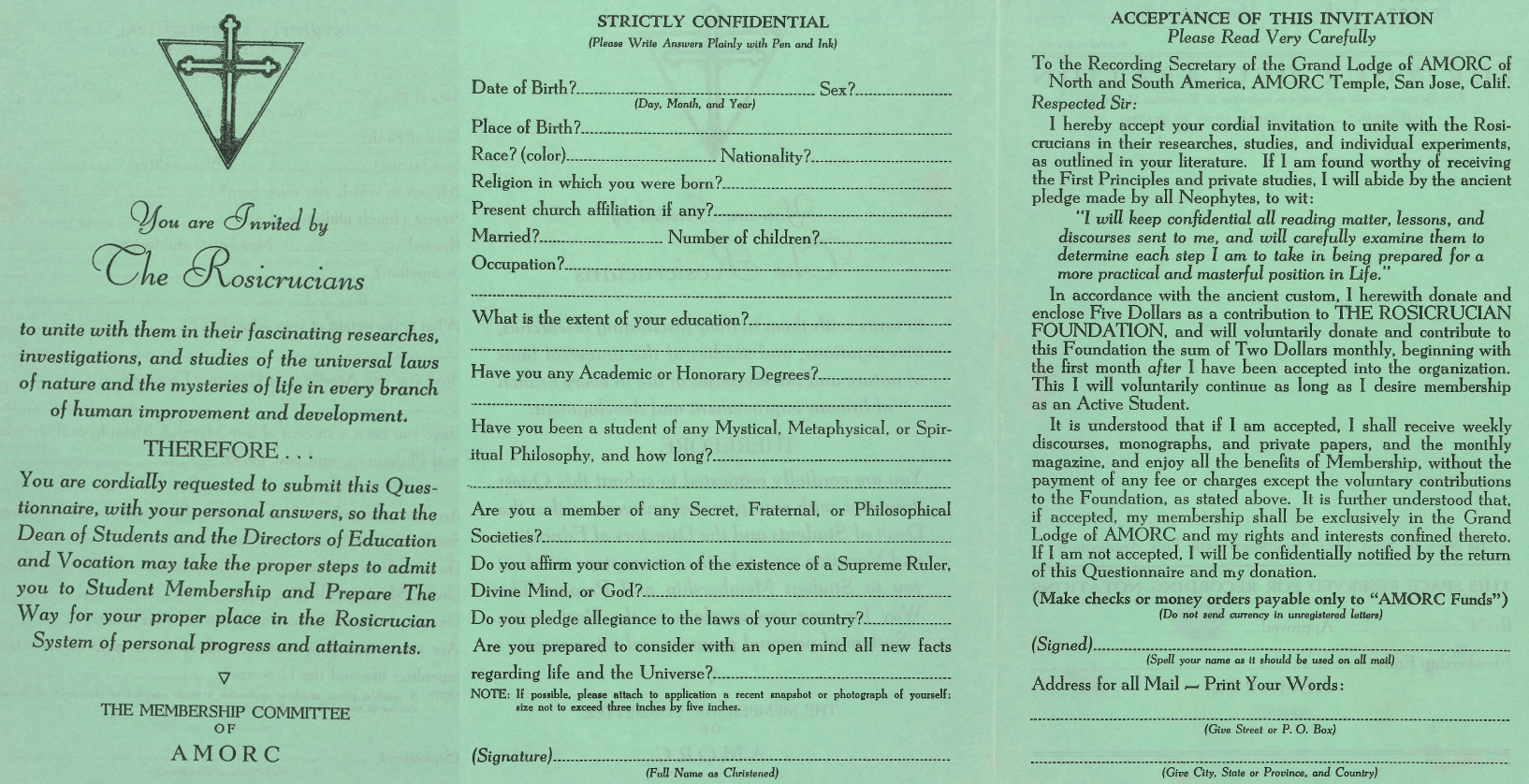
That is basically it. You might think I have been pretty hard on AMORC here, but in my view the actual history of these matters is interesting enough, no additional fictional romanticizing about these topics needs to be done! It should also be noted that besides this early-to-mid twentieth-century recruitment document, AMORC also has an enormous corpus of philosophical and mystical publications which are absolutely worth reading. Their Rosicrucian Digest, for example, a bi-annual periodical has been published by them continuously since 1915 and is filled with deep, often very learned meditations on esoteric material.
URL Link to digitized Rosicrucian Digests: https://rosicrucian.org/rosicrucian-digest
Not wanting to conclude on a critical note, I did appreciate several of the quotes they included in the booklet, see a few others by these definitely-not Rosicrucians:
“God operates by His work; heaven by Angels, and on earth by men.” – Eliphas Levi.
“In proportion as you detach yourself from things, in that same proportion, not one degree more or less, will God enter in which all that is His.” – Meister Eckhart.
“True happiness consists not in the knowledge of good things, but in good life; not in understanding but in living understandingly. Neither is it great learning but good will that joins men to God.” – Cornelius Agrippa.
The Secret Heritage was printed and distributed at a time (1930s) when information did not travel as fast as it does now. One was not even able to find information in an encyclopedia about the historical Rosicrucians, to say nothing of determining if Eckhart or Dante could be counted amongst their members. Thus, the propagandistic function to the project could go unchecked and this presumably had some effect on the membership numbers. I would like to think our ease of access to reliable information on such matters now has made such efforts obsolete – and to be sure, to some degree it has – though perhaps it has only evolved. These matters work (like all others), to use one phrase from The Secret Heritage, like the secret knowledge of Atlantis and Lemuria, “as in a chart of cycles.”
Written by
Corey D. Andrews
Corey D. Andrews is a PhD candidate at the University of Amsterdam and a researcher working for the Ritman Research Institute. His research focuses primarily on 17th and 18th century Rosicrucianism and the life and works of Jan Amos Comenius (1592-1670).

.avif)