

.svg)
The All-Seeing Eye: An Early 20th Century Esoteric Periodical by the Great Manly P. Hall
By
Corey Andrews
June 15, 2026
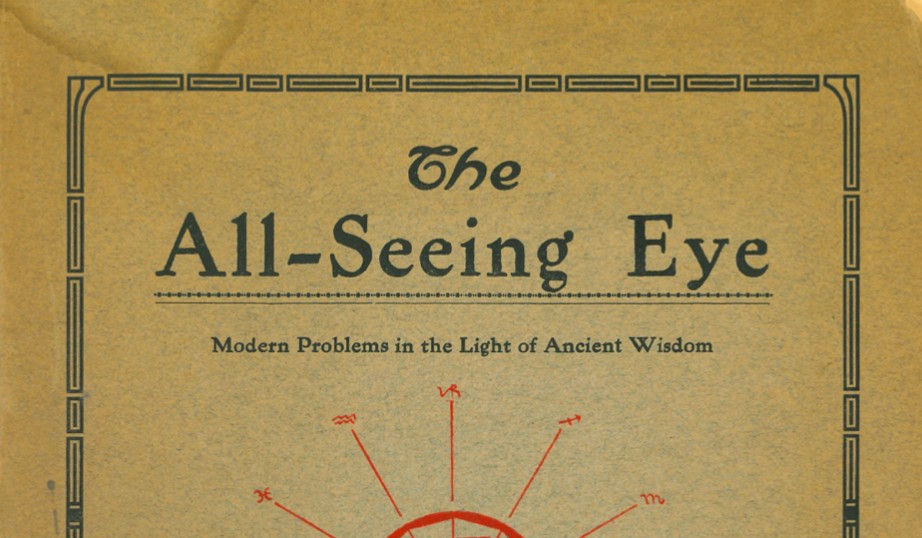
Front page of Manly Hall’s The All-Seeing Eye: Modern Problems in the Light of Ancient Wisdom

The All-Seeing Eye: An Early 20th Century Esoteric Periodical by the Great Manly P. Hall
Front page of Manly Hall’s The All-Seeing Eye: Modern Problems in the Light of Ancient Wisdom

The All-Seeing Eye: An Early 20th Century Esoteric Periodical by the Great Manly P. Hall
By
Corey Andrews
June 15, 2026
Ancient wisdom has solutions to modern problems. At least that was the view expressed in the subtitle of one of Manly P Hall’s first foray into esoteric writing.
The great Manly Palmer Hall (1901-1990), few persons are more important in the history of the study of esoteric philosophy. Over the course of his long life, the Canadian lecturer, writer, astrologer, and mystic gave thousands of public talks and authored over 150 volumes. Perhaps most famously, Hall compiled and published the vast Secret Teachings of All Ages, the definitive classic encyclopedic compendium of all esoteric teachings from around the globe – to be sure a must-have for all readers of the Codex (and a great gift idea!).

Continuing Tradition
Continuing what has become a bit of a tradition for my Codex contributions, my piece this month concerns an extremely rare esoteric periodical. Previously, we looked at A.E. Waite’s The Unknown World and Gnosis: Journal for the Study of the Western Inner Traditions. We continue this investigation this month with Hall’s The All-Seeing Eye: Modern Problems in the Light of Ancient Wisdom. The All-Seeing Eye was a monthly magazine edited by Hall between 1923 and 1931, and was dedicated to applying esoteric philosophy, comparative religion, and ancient principles to contemporary challenges. It explored themes such as mystical philosophy, astrology, Freemasonry, Rosicrucianism, Hindu cosmology, and esoteric Christianity. The publication emphasized that ancient wisdom, often overlooked, holds keys to unlocking modern problems.
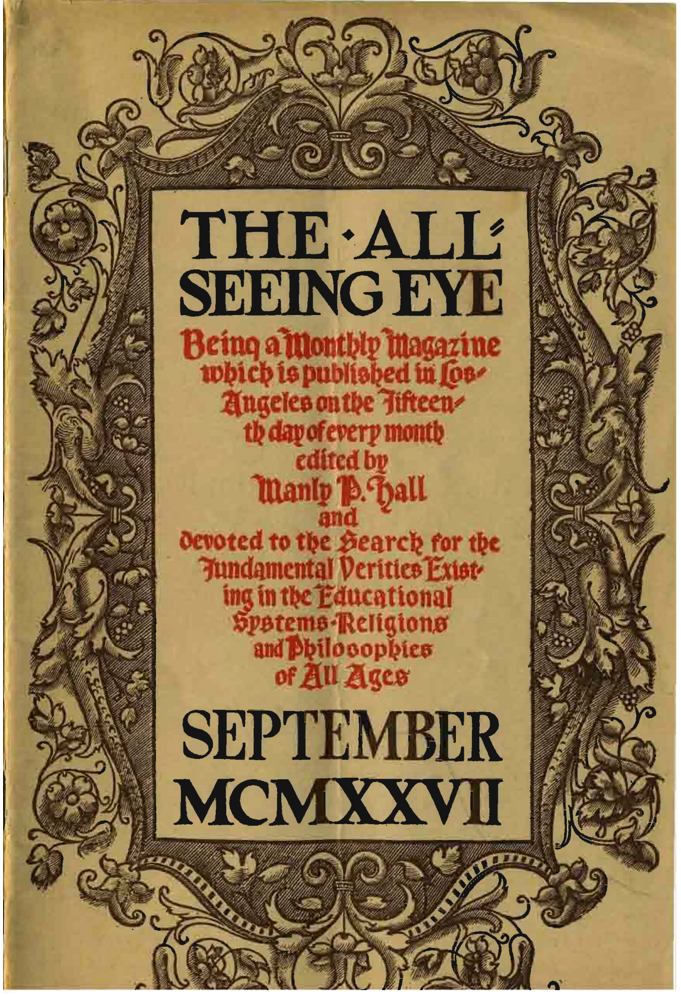
Like our Codex, The All-Seeing Eye was a monthly periodical, and also like our Codex, was later distributed on the 15th of every month(!) as the text on the cover of the September 1927 issue testifies. Amazingly, Hall was only 22 years old when he launched the magazine in 1923. It ran for about 8.5 years and later evolved into a more formal periodical under the Hall Publishing Company.
I have a monthly habit of journeying into our basement in search of inspiration for Codex contributions. Walking through the lines of shelves, glancing around at some of the thousands of titles, it never takes me long to find a few strong candidates. As is by now evident, I am especially attracted to our extensive periodical and journal section. This is where I located just two of these slim magazines nestled alongside Rays of the Rosy Cross, another beautiful 20th century esoteric periodical of the Rosicrucian tradition which has made many appearances on our Instagram page (@theritmanlibrary) thanks to Sarah. I will likely feature this magazine in a future Codex piece, but I digress.
Wonderfully, the two issues of The All-Seeing Eye which we have are the very first and second issue of the magazine! We have the May and June 2023 issues. The cover of the very first issue makes clear that the magazine is written, edited, and compiled entirely by Hall, and has as its core content two primary items:
1. ‘Nonsense as a Factor in Soul Growth’
2. ‘Atlantis, The Lost Continent’
The table of contents actually shows it had much more contained within the issue but Hall felt these two were the only ones worth including on the cover. Furthermore, the bottom of the magazine’s cover indicates clearly in all capital letters that ‘THIS MAGAZINE IS NOT SOLD.’
Upon opening the first page we see a pasted in printed note which indicates to the ‘Dear Friend and Truth Seeker’ that "if this effort to present practical occultism before the public without commercialism is in accordance with your ideas of religion […] and would like to receive a copy of it each month, will you kindly fill out the accompanying blank and mail it to us."
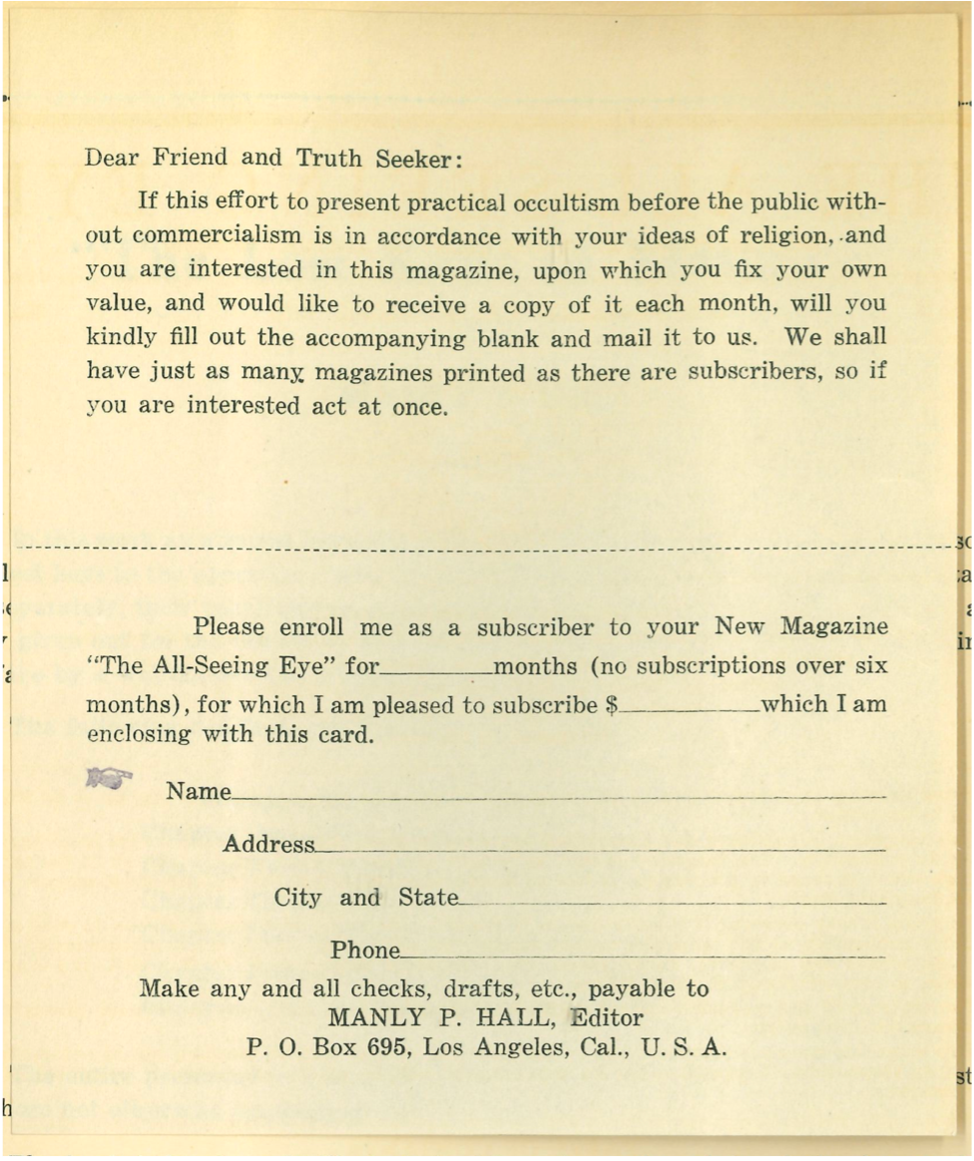
In the BPH copy of the first issue we can see that the bottom half of the above notice was removed, so it is clear that an earlier owner actually filled it out and sent it in. In our second issue however, it is still attached, and we can see that it contained a fillable section for one’s name, address, and a blank spot to indicate the amount of money they volunteer to contribute.
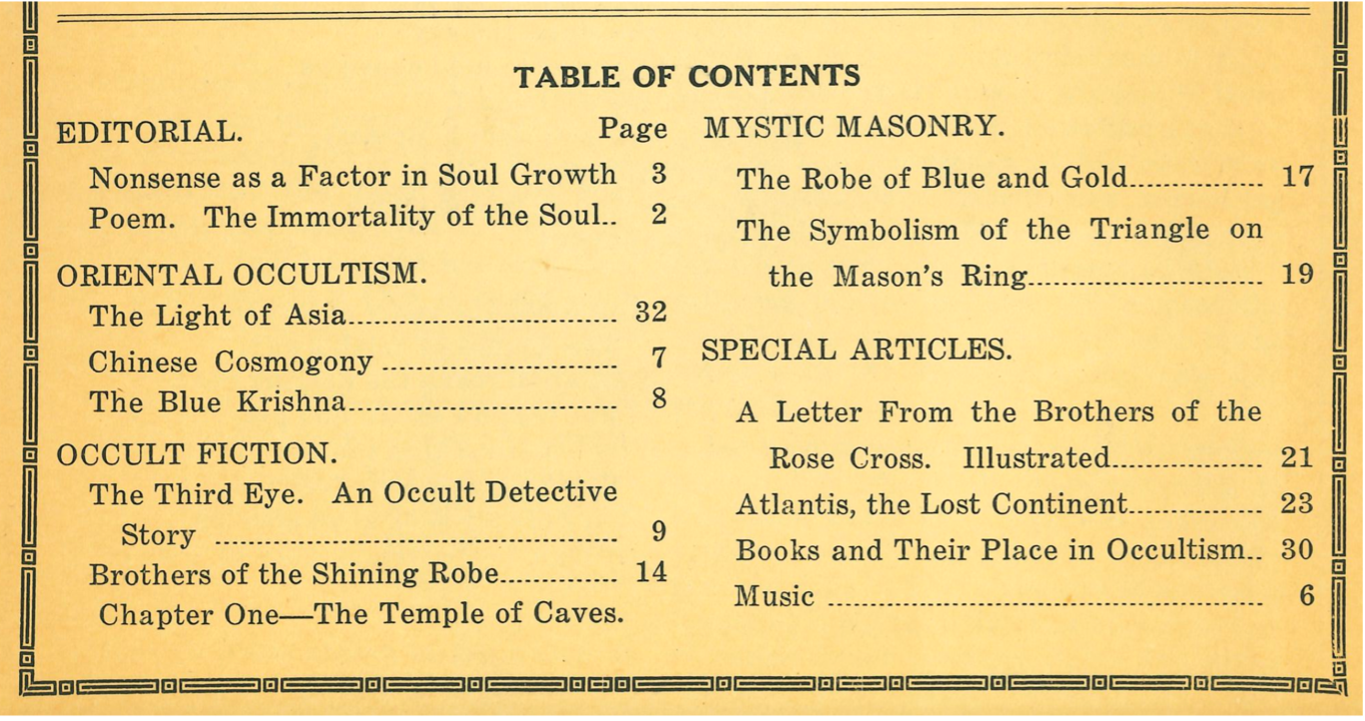
The table of contents page has a brief introductory section which indicates a couple of interesting things. Firstly, it is made clear that the magazine is not intended for commercial enterprise, i.e., Hall never initiated it with the intention to make money. The section actually has a clause that “it is quite useless to inquire concerning advertising rates […] as this magazine cannot possibly consider [this] as it is a non-commercial enterprise.” This is a big departure from the Gnosis journals we looked at in the April 2026 edition of the Codex, where throughout and especially towards the back of the journals one can find all manner of healers, psychics, and gurus paying for advertising space in order to “sell enlightenment” – a phenomenon we still encounter in infinite ways on the internet.
Hall, on the other hand, from the very beginning of his lifelong study which this periodical represents, not wanting to taint his pursuit with the ever-tempting chase of worldly financial gain, represents a sincere, virtuous approach to the spreading of secret teachings. It is also well known that for every single public lecture he gave (he gave thousands), he never charged more than a single dollar for entrance fee. Thankfully, he was diligent in taking advantage of emerging radio technology by recording many of his talks, hundreds of which can now be listened to on YouTube and still constitute for many the marrow of initiatory learning.
Secondly, the introductory section has the comforting clause that “This magazine does not represent nor promulgate any special sect or teaching but is non-sectarian in all of its improvements.” Personally, I find the explicit framing of the magazine as a neutral entity reassuring, and it is the same impulse which motivates us here in the Codex.
The Soul’s Immortality and the Value of Nonsense
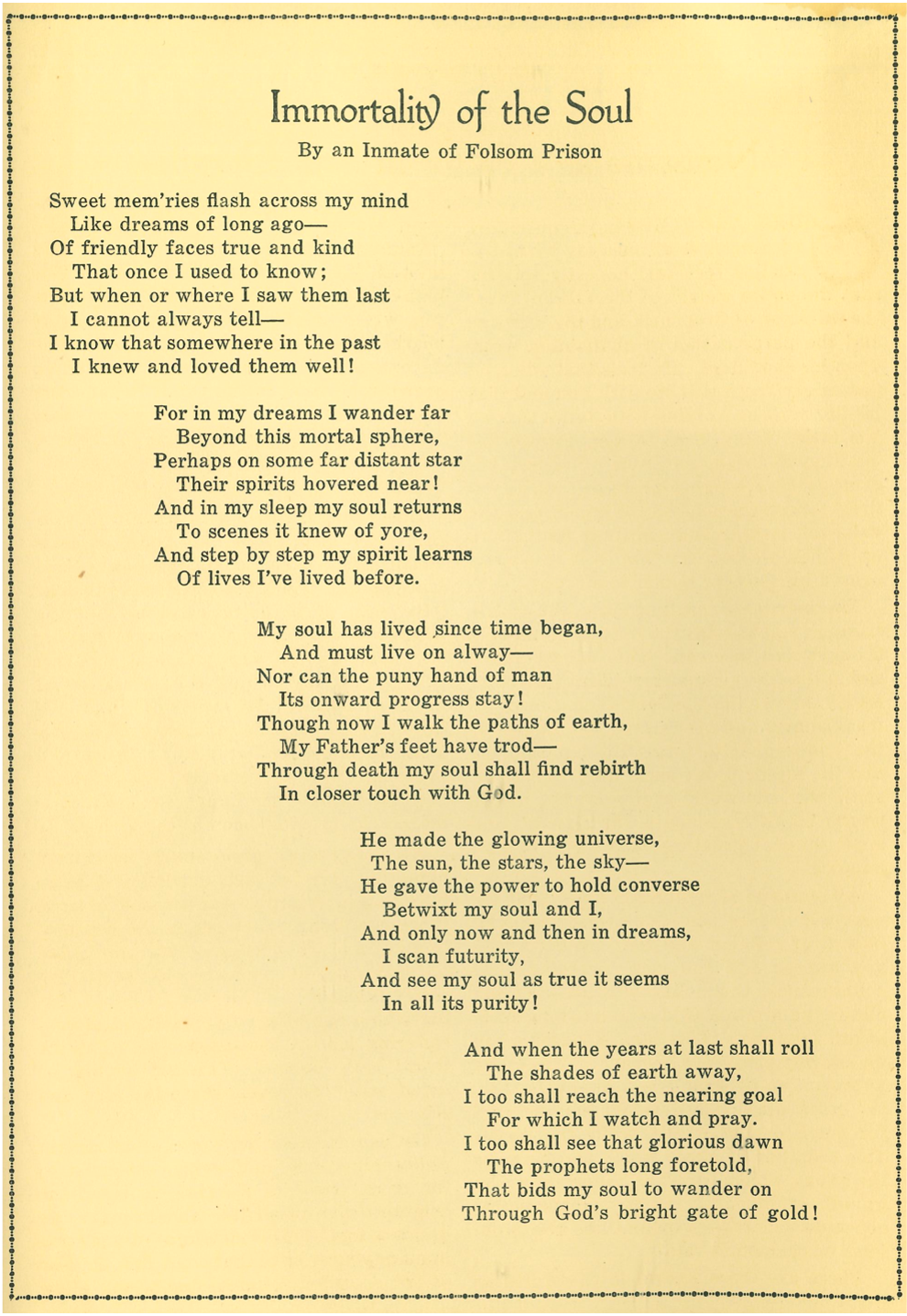
The very first piece of writing in the first issue is a short poem concerning the ‘Immortality of the Soul’ written by an anonymous inmate of Folsom prison, and is actually quite a beautifully composed piece set to rhyming couplets.
One of my favorite ideas, and definitely among the best titles for an article I have ever encountered comes in the form of the first article in the first issue, namely “Nonsense as a Factor in Soul Growth.” Oh man, let me tell you, this piece is filled with so many golden quotes, it is hard to select just one or two to include here, and I am amazed Hall wrote all of this when he was just 22 years old! I include here a few samples:
‘There are times in the unfolding of human consciousness when the student feels and honestly believes that the entire weight of the Eternal Plan, the salvation of God, man, and the universe and the perpetuation of civilization, rests upon his shoulders. He feels that […] his life must be so filled with duties, [and] religion becomes such a weighty problem that he entirely forgets the necessity of humor and the value of mental and spiritual recreation.’
‘The ability of the philosopher to forget his philosophies and the mystic to lay aside his religion and smile with the world over some hopelessly trivial bit of nonsense is the sign of true superphysical greatness and spiritual balance.’
‘The appreciation of humor is a divine faculty…’
‘If there be an exceptionally high spot in Heaven, […] we shall undoubtedly find it reserved for those mystics and philosophers, sages and seers, who have not only made man think and pray but have taught him how to laugh.’
‘When we laugh from the depths of our soul, relaxing for a moment the nerves and muscles that have so long been at a tension in fighting the battle of life, it is like a gymnasium exercise for the body and a tonic for the soul.’
‘The mystic knows that in the last analysis all opposites blend, tragedy and comedy are one, and their apparently diverse ways are united at the doorway which leads to heights immortal.’
‘Occultists and occult students must realize that when they forget how to be jovial, they lock the door of Heaven and throw away the key.’
Okay, before I get too ‘lost in the sauce’, I will simply list the titles of the various articles contained in the first issue to give an idea for the scope of the magazine’s content:
‘Immortality of the Soul, by an Inmate of Folsom Prison’
‘Nonsense as a Factor in Soul Growth’
‘Music’
‘Chinese Cosmogony’
‘The Blue Krishna’
‘Would Man Gain Anything By Living Forever In One Body?’
‘The Third Eye’
‘The Brothers of the Shining Robe’
‘Masonry: The Robe of Blue and Gold’
‘The Triangle on the Mason’s Ring’
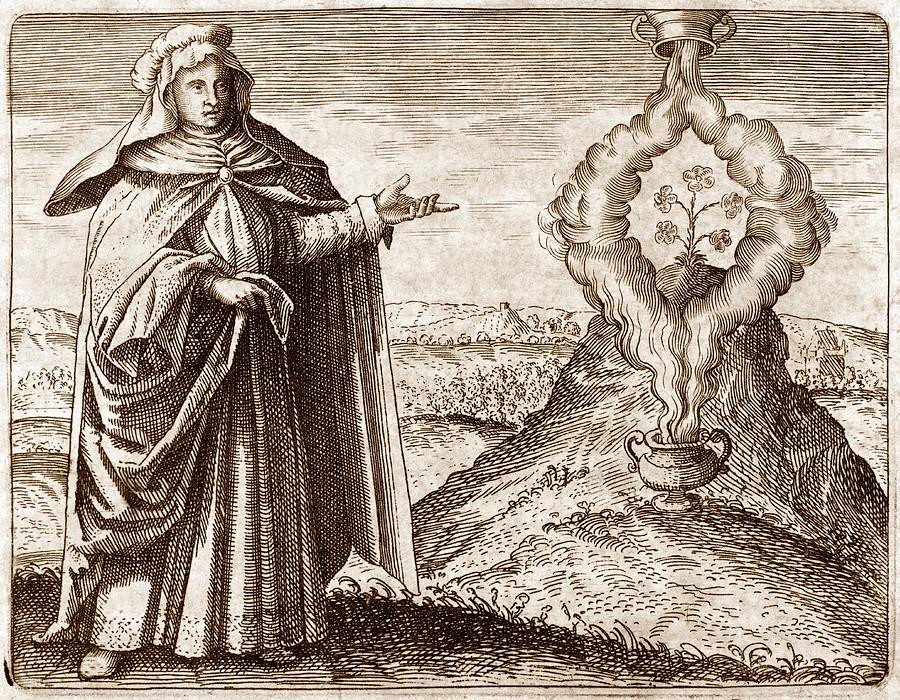
‘A Letter From the Brothers of the Rose Cross Concerning the Invisible Magical Mountain and the Treasure Therein Contained’
‘Atlantis, The Lost Continent’
‘Books and Their Place in Occultism’
‘The Light of Asia’
Conclusion
The back cover of The All-Seeing Eye’s first issue has a list of publications by the same author, all of which “are not for sale but may be secured through voluntary contribution to help meet the cost of publication.” What a joy it was to stumble upon this magazine and read some of Hall’s early yet highly precocious writing on spiritual matters, and in a manner that definitely still resonates with my modern ears more than a hundred years after his writing it. While we ourselves have not yet digitized our two copies, I can gladly inform you I found a web page that has every single issue of The All-Seeing Eye completely digitized and available, they can be accessed here.
In essence, The All-Seeing Eye, firstly represents one of the earliest attempts at a neutral survey of the various secret teachings contained within all traditions, and secondly, among Hall’s earliest ventures into presenting that content to the public in the form of a periodical. This was an auspicious effort of his which would go on to become a lifelong devotion to the public dissemination of esoteric philosophies probably unmatched by anyone in modern history. In my personal opinion, what Hall sought to do with The All-Seeing Eye was offer to the modern reader of historical and intellectual curiosities a way of maintaining continuity with those who came long before us; a way of uniting with the conclusions arrived at by our ancestors; a way of communing with whom Frances Yates once called “those infallible guides in all human activities, the ancients.” (Yates, The Art of Memory, p. 2.)

Written by
Corey Andrews
Corey Andrews is a PhD candidate at the University of Amsterdam and a researcher working for the Ritman Research Institute. His research focuses primarily on 17th and 18th century Rosicrucianism and the life and works of Jan Amos Comenius (1592-1670).


.avif)