

.svg)
.svg)
Cryptographic Confusion: Esoteric vs. Exoteric Cryptography in John Dee’s Enochian Magic
By
Kavi Tiwary
October 15, 2026
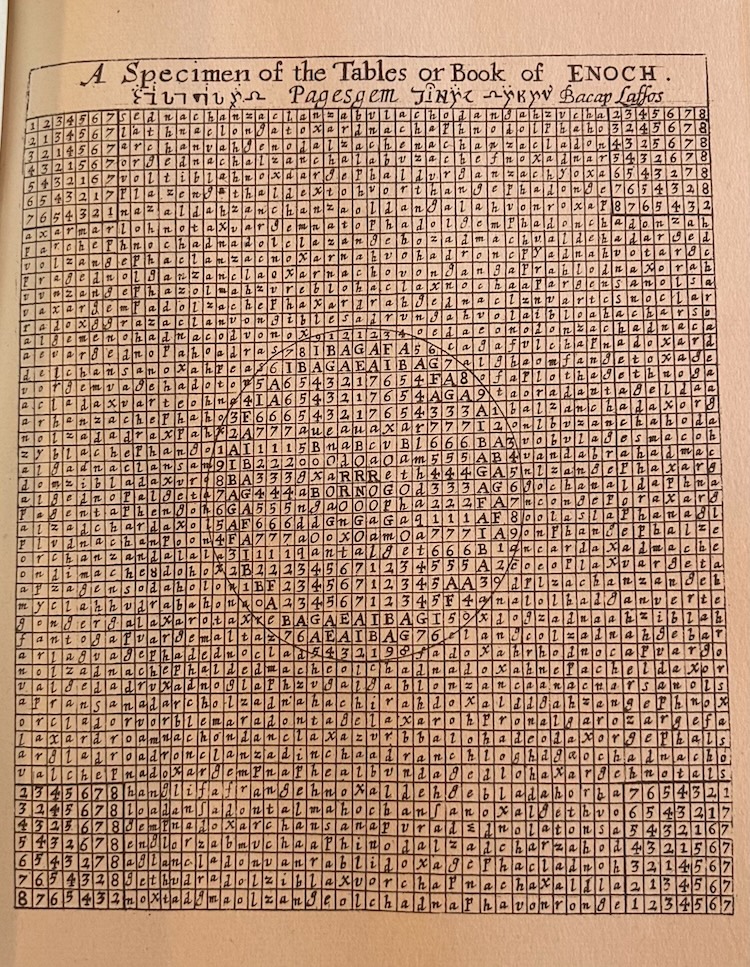
A sample table from the Liber Loagaeth given in A True & Faithful Relation (1659)

Cryptographic Confusion: Esoteric vs. Exoteric Cryptography in John Dee’s Enochian Magic
A sample table from the Liber Loagaeth given in A True & Faithful Relation (1659)

Cryptographic Confusion: Esoteric vs. Exoteric Cryptography in John Dee’s Enochian Magic
By
Kavi Tiwary
October 15, 2026
Throughout my research here at the Embassy of the Free Mind, the most pervasive and recurring concept in my research has been the difference between exoteric and esoteric cryptography.
This distinction is well formulated in the Dictionary of Gnosis & Western Esotericism (Leiden: Brill 2006), unsurprisingly one of my earliest references, where Gilles Le Pape writes that rather than “the formal characteristics of cryptographic writings,” it is “their actual purpose” which matters (Dictionary of Gnosis & Western Esotericism, Vol. 1, 288). This idea of cryptographic purpose being more important than mechanics stuck with me, as it felt so contrary to the more technical definition of cryptography. As I continued to come across works such as Elizabethan polymath John Dee’s (1527 - 1609) Liber Loagaeth (1583) or the anonymously authored Liber Soyga, which carry unanswered (or unanswerable) questions, I began to unconsciously classify genuinely non-cryptographic portions of these texts as, in a sense, esoterically cryptographic, portions which contained not even rudimentary encryption but no encryption at all. The kicker was that, by thinking of these texts as examples of cryptography, I was better able to understand them in the context of Renaissance esotericism. In this article, I want to further explore the distinction between esoteric and exoteric cryptography introduced by Le Pape, using the specific example of Dee’s system of Enochian magic to demonstrate one interesting outcome of this formalized difference.
What exactly does Le Pape mean by the "purpose" of cryptography? Consider the example of “practical,” exoteric cryptography: cryptographers who develop modern encryption are not concerned with any purpose to their work beyond the encryption itself. On the other hand, users of esoteric cryptography are much more interested in what the encryption can do for them beyond transforming plaintext into cipher text. As a matter of fact, as Le Pape defines it, esoteric cryptography very often involves no plaintext, no ciphertext, no processes of encryption in the exoteric sense at all. Rather, esoteric cryptography acts in the realm of the spiritual (in much the same way spiritual alchemy is distinct from “real” practical laboratory alchemy), and involves the clandestine transfer of heavenly or magical information. An example from Le Pape is Heinrich Cornelius Agrippa’s (1486 - 1535) planetary squares and seals from De Occulta Philosophia (1531), which communicate with the heavens via the evocation of different celestial powers.

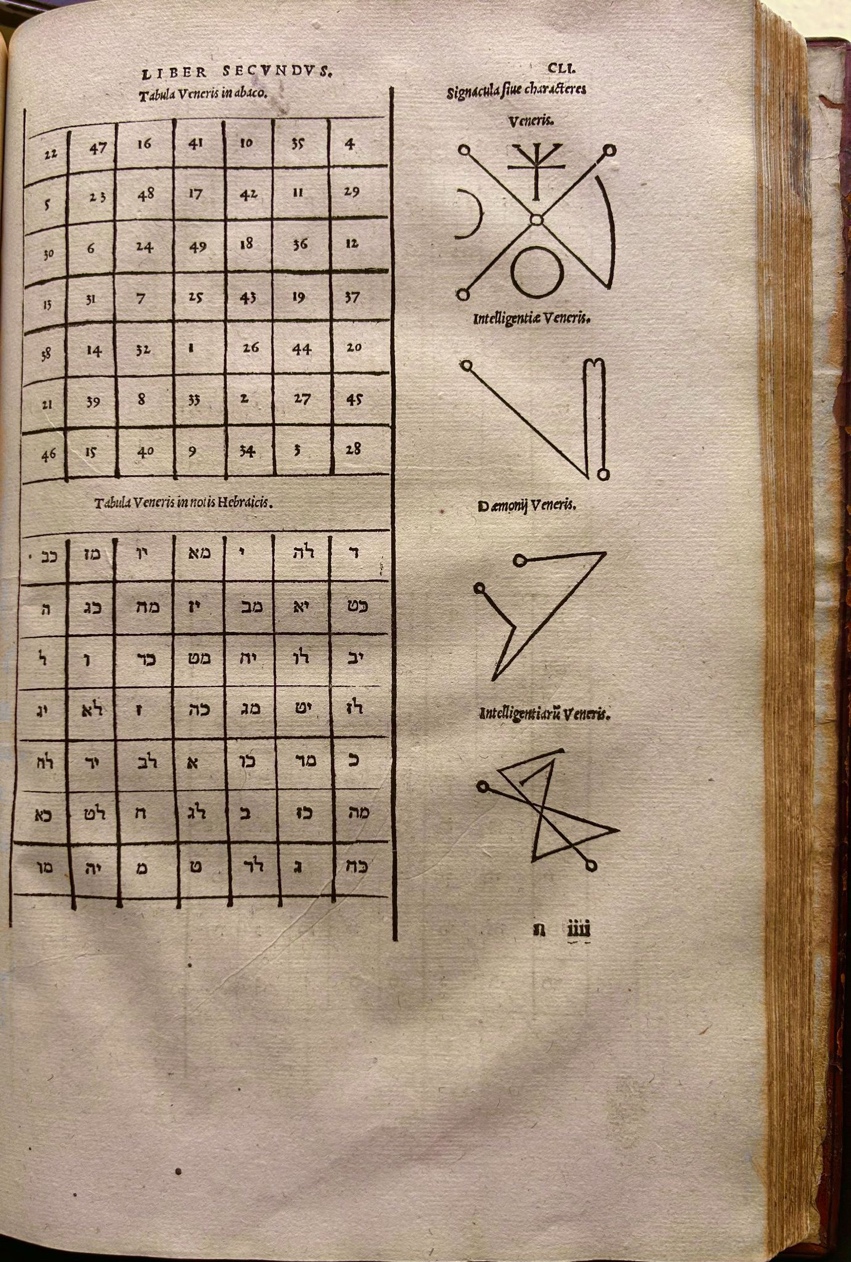
I chose this example specifically because it illustrates how esoteric cryptography should not really be thought of as another kind of encrypting tradition but as its own class of esoteric communication technology. Agrippa's sigils are an example of encryption not necessarily meant to be decrypted. The only issue with this line of thinking is that it creates a great divide between exoteric and esoteric cryptography, almost to the point of making that shared word “cryptography” seem vestigial. Le Pape’s definition becomes easily misconstrued with plain magic. Thus, I think it is beneficial to also consider the shared cryptographic language of both the esoteric and the exoteric. The main aspect of this language that I want to highlight in this article is the existence of a “key.” In the case of Agrippa’s planetary sigils, they differ from other forms of talismanic magic because they are generated with a fixed set of rules that can be thought of as a cryptographic “key,” the Cabalistic system of gematria in combination with the mathematics of magic squares (see Lehrich, Christopher, The Language of Demons and Angels, (Leiden: Brill, 2003, 103-146). This key does not have to be tangible as in the case of Agrippa, however. Agrippa’s pseudo-talasmanic cryptography magic is uniquely robust, but other cryptographic talismans need only to “operate by means of identifications,” and call only for “the necessity of knowing the affinities…which govern the relations between all parts of the universe” (Dictionary of Gnosis, 289, emphasis in quote added by me). An esoteric key can, and very often is, abstract knowledge rather than a specific procedure. Thus, it is good to think of a spiritual key to go with this spiritual cryptography. The existence of a spiritual key or a key-like system will, as I will show, be persistently important for the further classification of forms of esoteric cryptography, and works well to clarify Le Pape’s project in this esoteric/exoteric cryptographic distinction.
Now I want to introduce and offer some context for Dee’s magical system, and more generally explain how Dee’s occult activity is best understood in the tradition of esoteric cryptography. For this portion, and for a great part of my introduction into Dee scholarship, I am indebted to GyörgySzőnyi, who authored John Dee’s Occultism: Magical Exaltation Through Powerful Signs, a fantastic book on the semiotics of Dee’s esoteric activity. Szőnyi places Dee in the tradition of Western Hermetic humanist thinkers who pursued ‘exaltatio’, i.e., the elevation of man to a state equal to God. Szőnyi points to two main Renaissance polymaths and occultists from whom Dee developed his own theology of exaltatio, the aforementioned Agrippa and the famous medical reformer and physician Theophrastus Bombastus von Hohenheim, or Paracelsus (1493 - 1541). One of Szőnyi’s main points in this discussion is that Dee cannot be accurately understood as a precursor to the scientific revolution, as historians of science have tended to do in the past. Rather, Dee’s emphasis on the power of natural, experience-based science was more in line with the Renaissance occultist goal of deification through the study of the ‘Book of Nature’, the natural world viewed as scripture.
This kind of exaltation of man brought with it an inherent contradiction, however: if man could become equal to God, then the natural hierarchy of God above man is destroyed. This, of course, is heresy in the eyes of the church. Szőnyi explains how this contradiction very often led to theological crises in the frameworks of Renaissance occultists, using Agrippa as a key example. What made Dee a unique thinker, then, was his solution to this contradiction, that solution being a kind of “return to occult universalism,” a turning away from the natural sciences as inadequate towards achieving the heavenly process of exaltatio (179). If Dee couldn’t find the answers he sought in the Book of Nature, he would have to turn directly to God and the angels, as so many biblical characters did in the past. Thus, the motive behind Dee’s angelic conversations was the exact same as the one behind his investigations into mathematics, logic, and the sciences.
Parallel to the goal of human exaltatio was the pursuit of a universal, perfect language, which can be thought as a sort of linguistic exaltatio. In much the same way as Renaissance thinkers sought for man’s existence to approach that of God’s, there was an apparent mission for man’s language to approach God’s language (dubbed ‘Adamic’ or ‘Enochian’, Adam being the first to know it and Enoch being the last). The exoteric perspective of this project was more practical, considering the benefit of a shared and unbiased lingua universalis (universal language, from the Latin). To Renaissance Hermeticists, however, the sort of thinkers in pursuit of the literal deification of man, Adamic was a necessary step towards the enlightenment they sought. In a very Platonic sense, the conceptual purpose of an Adamic language was direct correspondence between words and the objects they reference. While the corrupted and terrestrial languages of man only evoked that which they were used to discuss, the language of God somehow contained the facts of the universe and was itself an essential part of the world. This is really where esoteric cryptography finds its footing in Dee’s thought.
As I mentioned before, it is productive to think of esoteric cryptography in the same intellectual vein as ‘spiritual alchemy’, and now it becomes evident why: as spiritual alchemy was viewed as the solution for the elevation of man’s soul, so esoteric cryptography was the answer for uncovering the holy language, and thus the elevation of language. As Le Pape mentions, Paracelsus highlights the similarities between an Adamic language and esoteric cryptography in Astronomia Magna (1571) when he describes how the products of encipherment are in some way essential to the things they refer to; Le Pape uses the term “inseparable vectors” (Dictionary of Gnosis, 288). Again, it is important to remember that when I say “encipherment,” I mean esoteric encipherment, the symbolic process of encryption with a symbolic key. That which is encrypted esoterically is not really meant to be decrypted. Instead, the encryption itself, the ciphertext itself and not necessarily the underlying plaintext, has spiritual significance, and shares that Platonic property of essentialism with theorized Adamic languages. Cryptography thus came to be considered a necessary means in the pursuit of exaltatio which dominated the goals of Dee’s both scientific and occult activities.
Before we look for esoteric cryptography in Dee’s system of Enochian magic, I first want to briefly highlight an earlier example of its relevance in Dee’s occult projects. The Monas Hieroglyphica, written by Dee in 1564, presents twenty four “theorems” describing the alchemical and spiritual ubiquitousness of a symbol, namely the Monas, which was apparently of his own invention. Within the book he describes not only its significance but the significance of its construction, and its relationship to all other possible symbols, invented by man or otherwise. The Monas symbol itself is a composite alchemical and astrological glyph made up of (at least), the characters of the moon, venus, the sun, mercury, Aries, the four cardinal directions & elements, et cetera.


Szőnyi notes that the symbol had a purpose beyond being “a mystical emblem for contemplation”: it could be considered, if used properly, a “geometric automaton” for the generation of equally spiritually important alphabets (173). In a sense, then, the Monas could be thought as present in the later Enochian alphabet Dee would receive, and thus an intrinsic “key” to the holy language. We know that Dee at the very least thought of this project in a mathematical light, structuring his work in terms of theorems reminiscent of Euclid’s Elements, for which he would later write an important Mathematical Preface (1570). Dee’s Monas Hieroglyphica unites mathematical language with Platonic Hermeticism, and Szőnyiincorporates it into the canon of linguistic exaltatio. Thus, with all the trappings of Renaissance esoteric cryptography, the Monas Hieroglyphica is certainly able to be understood as an example of esoterically cryptographic sensibilities incorporated into Dee’s thought, even before his angelic conversations.
Now at last it is time to address those conversations, and the intricate magical system produced from them. Before I analyze the material itself, however, I want to discuss an assumption I will be endorsing: I will be assuming that Dee’s Enochiana is, for a large part, his own invention. The reason that this position is a bit precarious, and constitutes one of the biggest issues in the scholarship of Dee’s esotericism, is that the entirety of the angelic conversations wereorchestrated through Edward Kelley (1555 - 1597), Dee’s famous scryer and medium. By its nature, scrying, visionary magic performed with crystals or reflective surfaces, can only ever be perceived by the one conducting the magic. Dee, then, playing the role of the magus, was resigned to speaking to the angels through Kelley as a translator. Kelley, in turn, had complete control over what Dee heard from the angels. Was Kelley a clever rogue, who repeatedly and constantly fooled his credulous master? Was he really speaking with angels? Maybe Kelley was insane. Not accounting for the case of real angelic contact, it seems that Dee and Kelley must have collaborated on the creation of their system of Enochian magic. Kelley, as we know, was well-read in Renaissance esotericism, having consumed many hermetic texts from Dee’s expansive library.
In addition to having come across Agrippa’s De Occulta Philosophia, Agrippa’s mentor Trithemius’ Steganographia (1499), and more works important to the formation of Dee’s esoteric framework, he also seemed to be acquainted with Dee’s own projects, such as the Monas, and brought language from his works into the séances (Clulee, Nicholas, John Dee’s Natural Philosophy: Between Science and Religion, London: Routledge, 204-220). Whether Kelley was prone to hallucination, or did in fact carefully construct those realistic-looking angels, he was nevertheless influenced not only by the authors who Dee found important but by Dee himself through the study of his earlier works. In addition, there are repeated instances of the séances being driven in directions Dee himself wanted them to go, such as the angel Uriel’s attractive description of Dee’s copy of the Liber Soyga, or the angels’ insistence on incorporating navigator Adrian Gilbert in the conversations, in whom Dee as an amateur cartographer and navigations scientist was already interested (Dee, John; Edward Fenton, The Diaries of John Dee, Oxfordshire: Day Books, 28, 50-60).
Though it is an assumption, I feel that it is reasonable to say that Dee’s works played a large role in shaping Kelley’s psyche, serving as source material for the system of magic later developed, and that Kelley for a large part steered the conversations in directions where he observed his master already wanted them.
As a result of the séances, we have five books and a language which make up the entirety of John Dee’s system of Enochian magic. Egil Asprem divides the material into four key components: The Enochian language, the Heptarchic system, the 30 Aires, and the Great Table (Asprem, Egil, Arguing with Angels: Enochian Magic and Modern Occulture, New York: State University of New York Press, 27). The Enochian language is, indeed, that desired Adamic, and within it there is the Liber Loagaeth, a book of 49 grids of Enochian characters, and 18 claves angelicae (angelic “keys”), verses in Enochian which are intended to somehow “unlock” or decrypt 18 of the Loagaeth’s grids. The Heptarchic system, outlined in De Heptarchia Mystica(1583), involves the ordering and ranking of the heavens and the angels. The 30 Aires augment the claves angelicae, and supposedly unlock another 30 of the Loagaeth tables (leaving one purposefully without a key), while also granting terrestrial power to the magus who knows how to use them. The Great Table is another grid of letters which, similarly to Loaegaeth, contains in it the means to enlightenment, exaltatio.


At its core, Dee’s Enochian magic functions like one giant piece of esoteric cryptography. Nicholas Clulee, in John Dee’s Natural Philosophy: Between Science and Religion, describes the decryptive process of unpacking the Loagaeth tables as involving the selection and arrangement of letters “according to some mystifying process involving the numerical values attached to the letters and their place in the tables.” This sounds quite similar to the gematria and magic square mathematics behind Agrippa planetary sigils, but with his Kabbalah replaced in favor of what the angels call the “cabala of nature,” the rules of which are never disclosed (213). From the diaries, however, we are told that the 18 claves angelicae and the 30 Aires are also involved in this decryptive process, though the mechanism of their use, too, is never discovered. The De Heptarchia Mystica and the Great Table, both written in English, function as standalone works. Notice that, however, all three of the texts involved with the Enochian language are intimately related to each other. Thus, I think it is productive to think of the “Enochian System” as almost a distinct subset of Dee’s magic system in its entirety, since it is really this part of the magical corpus which is cryptographic. What makes this Enochian system, however, a unique example of esoteric cryptography, is that beyond a convoluted system of spiritual encryption, there are actual keys which are intended to actually unlock the encrypted material. In Agrippa, we could call the knowledge of the encrypting system a “spiritual,” esoteric key, but in this instance, it feels almost inappropriate to call the angels’ unknown methodology an esoteric key when more literal keys are freely given. The system has, in some ways, two different sets of keys: an esoteric set, the angels’ undisclosed mystical processes, and an exoteric set, the 18 claves angelicae and the 30 Aires.

The fact that the mechanism of encipherment, the esoteric key, is not described is very typical of esoterically cryptographic texts, as I have explained above. In esoteric cryptography, it is not the mechanics, the answers, that are important, but the encrypted result itself, the questions. The existence of the exoteric keys is unique, but not necessarily problematic. If anything, it allows the whole system of Enochian magic to be interpreted as a microcosmic example of Dee’s idiosyncratic combination of scientific and Hermetic thinking manifesting in more classically occult activity, as Szőnyi discusses. What is problematic, however, is that the slew of unknowns left by the angels, the countless unexplained aspects of the system, are considered by both Dee and the angels as obstacles to surmount. What Dee should seek to do, says the angels, is continue to seek decryption; the encryption is not spiritually significant enough. Thus, Dee’s system moves contrary to the trends of esoteric cryptography, and the plaintext is rendered more spiritually significant than the ciphertext. One possible explanation for this cryptographic confusion is the following: that Dee’s magic system represents not only his failure to achieve absolute exaltatio, but also the general inability for man to ever reach the level of God.
Earlier in Dee’s life, he became convinced that exoteric science could not yield the results he sought — maybe he was eventually convinced that even esoteric pursuits were ultimately hopeless as well. Since Dee, as well as the thinkers from whom he inherited his theology, saw their esoteric activity as deeply religious and in line with scripture and the will of God, this realization would have nearly constituted a religious crisis for him. However, such crises were a natural outcome of the humanist pursuit of exaltatio, as Szőnyi described. Exaltatio made man equal to God, but if Dee couldn’t even achieve it through direct discourse with angels, the position of God becomes confused. Is God not powerful enough to grant me my exaltatio? Is it I who is fundamentally incapable of exaltatio, contrary to what I have been led to believe? This deep religious confusion is perhaps captured in the esoteric-cryptographic confusion baked into the angels’ system.
It is clear, now, how far my little assumption has carried me. If it were no’t accepted that this system of Enochian magic represented to a measurable extent a continuation of Dee’s thought, that “cryptographic confusion” could be easily explained away as Kelley’s inability to make a fully consistent system, and his desire to hide that fact. To fully understand to what extent Dee’s system of Enochian magic represents a continuation of his thought would require resources beyond the scope of this article: research into the psychology of séance, at least, but perhaps also the unearthing of more primary source material detailing Kelly and Dee’s occult activity. There is evidence against the “rogue Kelley” theory, though circumstantial: as described in the diaries, Kelley was much less enthusiastic about the séances than Dee, and in multiple instances experienced pain or troubling hallucinations that would cause him to request freedom from his task as a scryer. Was this only clever double psychology? Again, the answer to this question remains, and most likely will continue to remain, unavailable. Nevertheless, what I have described is relevant to the reception of Dee’s magic system, which became quite popular after the publication of the angel diaries in 1659 by Meric Casaubon in A True and Faithful Relation, and which was later adopted by larger-scale Hermetic orders such as the Golden Dawn. In addition, expanding the definition of esoteric cryptography appears to be productive, and could aid research into other mysterious esoterically cryptographic texts.


.jpg)
Written by
Kavi Tiwary
Kavi Tiwary is a highschool student based in New York City. He is currently a Research Intern at the Ritman Research Institute with the Bibliotheca Philosophica Hermetica, and is studying the Enochian Magic of John Dee and esoteric cryptography.


.avif)