
.svg)
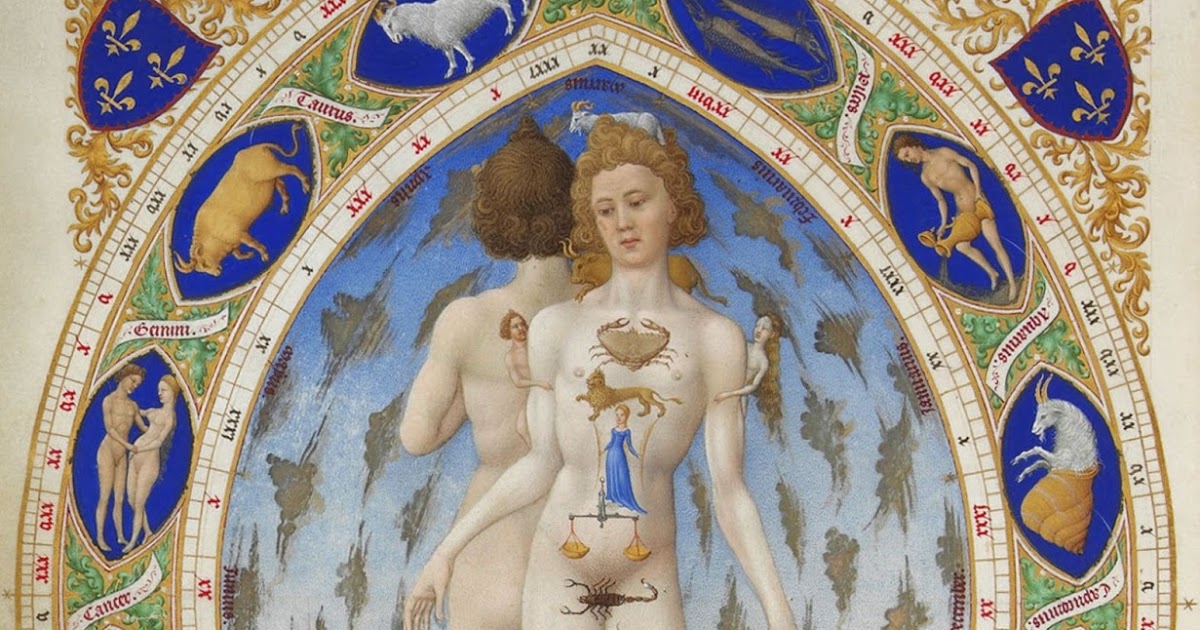
Limbourg brothers, Très Riches Heures, 1411-1416. Musée Condé, Chantilly, France. Detail.

The Stellar Rays of Pseudo-al-Kindi
Limbourg brothers, Très Riches Heures, 1411-1416. Musée Condé, Chantilly, France. Detail.

The Stellar Rays of Pseudo-al-Kindi
By
Leonardo Baldi
September 17, 2026
The De Radiis Stellarum is a treatise on theoretical magic usually attributed to the famed ninth-century philosopher al-Kindi (c. 801-873).
This short, yet widely influential book discusses stellar and elemental rays as the complex of causes that determine the existence and actuality of all things, by a process of constant weaving and undoing. Celestial and terrestrial bodies alike transmit their likenesses in every direction in the form of rays. These rays, depending on strength, angle of incidence and distance, interweave inside all things, generating motus, change, motion, kinesis. Even words, images, figures and the faculty of the imagination operate through rays. In short, rays are the bricks that make up the properties of all things: a flower bloomed at a specific time in a specific place will have the properties that all the stars and the things around it are irradiating into it at that moment. This specific configuration of rays inside the flower constitutes its occult qualities. That goes for us: the image of the sky at the moment of our birth is reflected inside of us, making up who we are.
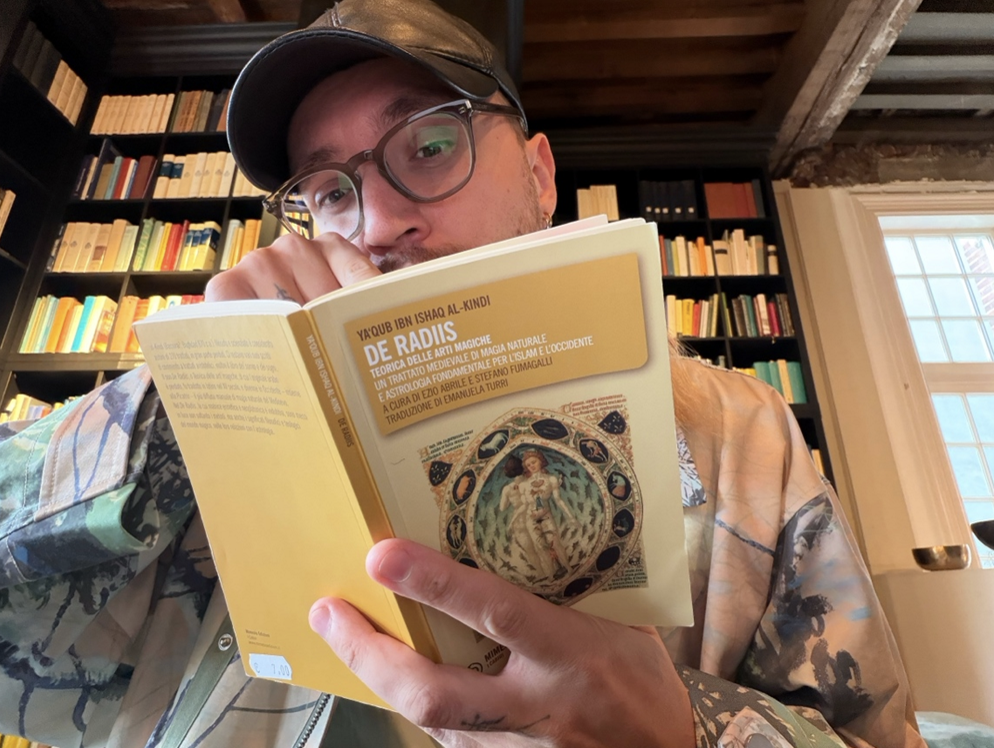
Since the publication of the first critical edition of the De Radiis, by Marie-Thérèse d'Alverny and Françoise Hudry in 1974, the paternity of the treatise has been questioned many times, with most scholars now doubting the attribution to al-Kindi. The very last line of the treatise: “Explicit Alkindus de radiis stellicis” (here ends al-Kindi’s stellar rays) should not be taken as a truth, since pseudoepigraphy, or the exquisite practice of writing as someone else, was very popular in medieval times. There is the possibility that whoever copied the treatise into the version that first surfaced, might have actually believed the treatise to have been al-Kindi’s, and added the last line. After all, the real al-Kindi did write extensively on optics and rays, so the subject matter of the book could have misled any over-zealous scribe.
There are many points that seem to suggest that the author was not al-Kindi, though. One for all, while al-Kindi argued heavily for emission theory of vision, the theory which posed that sight happens through visual rays that are shot out rectilinearly from the eyes, the author of the mysterious treatise seems to be a proponent of intromission theory. This was the theory according to which sight happens when light meets the eyes. The theory became popular in the Latin West thanks to the writings of Alhazen (c. 10th century), the first to pose explicitly that sight is a property of light itself. In the De Radiis, while there is no mention of visual rays, or visual lines, there are only two mentions of color, and they seem to suggest that color is seen when colored rays are shot out from objects into the eyes.
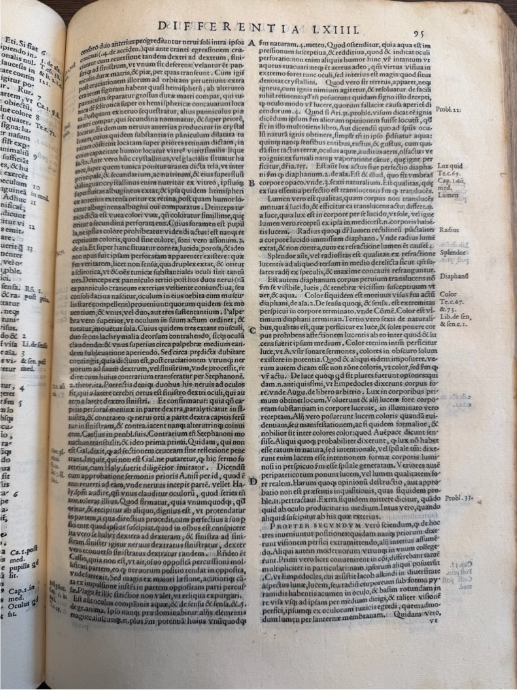
In 2023, Sylvain Matton published a study arguing that the De Radiis was not the translation of a lost Arabic work, but instead an original production of the milieu of Oxford in the 1250s or 60s. This study went against all scholarship that, while disputing the authorship, still misplaced the composition of the De Radiis to somewhere before the thirteenth century. This is poignantly relevant since many scholars, like Graziella Federici-Vescovini, Pinella Travaglia and David Lindberg, wanted to see the De Radiis as the inspiration behind the studies on light metaphysics by the bishop of Lincoln, Robert Grosseteste, who died in 1253. Notably, Grosseteste wrote a treatise on lux (source of light) and lumen (brightness), De Luce, as well as a treatise on the propagation of species, De Lineis, Angulis et Figuris. According to him, species is likeness, the form of a thing that shoots outwardly in every direction, irradiating its surroundings. Sound similar? Matton’s study, based on the grammar and themes of the De Radiis, confuted the belief that Grosseteste was inspired by the De Radiis, suggesting that the opposite might have been true. What if the author of the De Radiis, this infamous Pseudo-al-Kindi, read Grosseteste, and not the other way around? Another curiosity that I wish to bring to light, pun intended, is the tendency of contemporary academia to make the connection between rays and light, whilst radius, lux and lumen were wildly different things in this historical context. Interestingly, in the De Radiis the words lux and lumen never appear, and in Grosseteste’s De Luce the word for ‘ray’ never appears. The word species, however, is found in all of these treatises, acting as a pervasive ‘connective tissue’.
At this point I must abruptly pierce the fourth wall and say that this is precisely where my research comes into play. Does it make sense to connect rays to light in the context of the De Radiis? And most importantly, why is that relevant? Stay tuned, kind readers, as I investigate further into this mysterious matter and share my findings with you. Stay radiant.
References
1. Adamson, Peter. Al-Kindi. Oxford: Oxford University Press, 2007.
2. Al-Kindi. De Radiis: Teorica delle arti magiche. Milano: Mimesis, 2014.
3. 2Al-Kindi. On the Stellar Rays. Translated by Robert Zoller. Edited by Robert Hand. Madison: The Golden Hind Press, 1993.
4. Federici-Vescovini, Graziella. Studi sulla prospettiva medievale. Turin: Giappicchelli Editore, 1965.
5. Federici-Vescovini, Graziella. Medioevo Magico. Milan: Rusconi Libri, 2021.
6. Grosseteste, Robert. De Luce – On Light, translated by Claire C. Riedl. Milwaukee: Marquette University Press, 1942.
7. Grosseteste, Robert. De Lineis, Angulis et Figuris. Accessed Feb. 6th 2026 at https://la.wikisource.org/wiki/De_lineis_angulis
8. Hasse, Dag Nikolaus. Avicenna’s “De anima” in the Latin West : the formation of a peripatetic philosophy of the soul 1160-1300. London: The Warburg Institute, 2000.
9. Hendrix, John Shannon. ‘Neoplatonic Influence in the Writings of Robert Grosseteste.’ 2008.Retrieved from https://docs.rwu.edu/saahp_fp/6.
10. Lindberg, David C. Theories of Vision from Al-Kindi to Kepler. Chicago: The University of Chicago Press, 1976.
11. Matton, Sylvain. ‘An Irradiation of Latin Grammarians, or The De radiis is not by al-Kindī’ in Magic, Ritual, and Witchcraft 17, no. 3 (2022): 437-455.
12. Raizman-Kedar, Yael. ‘Plotinus’s conception of unity and multiplicity as the root to the medieval distinction between lux and lumen’, in Studies in History and Philosophy of Science Journal 37 (2006): 379–397.
13. Rutkin, H. Darrel. “Astrology” in The Cambridge History of Science, edited by Katharine Park and Lorraine Daston, 541-561. Cambridge: Cambridge University Press, 2006.
14. Rutkin, H. Darrel. Sapientia Astrologica: astrology, magic and natural knowledge ca. 1250-1800. Cham: Springer, 2019.
15. Saif, Liana. The Arabic Influences on Early Modern Occult Philosophy. London: Palgrave Macmillan, 2015.
16. Travaglia, Pinella. Magic, Causality and Intentionality. The Doctrine of Rays in al-Kindi. Florence: Sismel-Edizioni del Galluzzo, 1999.
17. Wang, Xiaona. Handling Occult Qualities in the Scientific Revolution: Disciplines and New Approaches to Natural Philosophy, from John Dee to Isaac Newton. Leiden: Brill, 2023.
%20(1).jpg)
Written by
Leonardo Baldi
Leonardo Baldi holds MAs in Philosophy (KCL) & Religious Studies (UvA). Researches Western esotericism and history of science, focusing on medieval/early modern light, hylomorphism & natural philosophy. Recent thesis explored stellar rays in astrology.

.avif)