

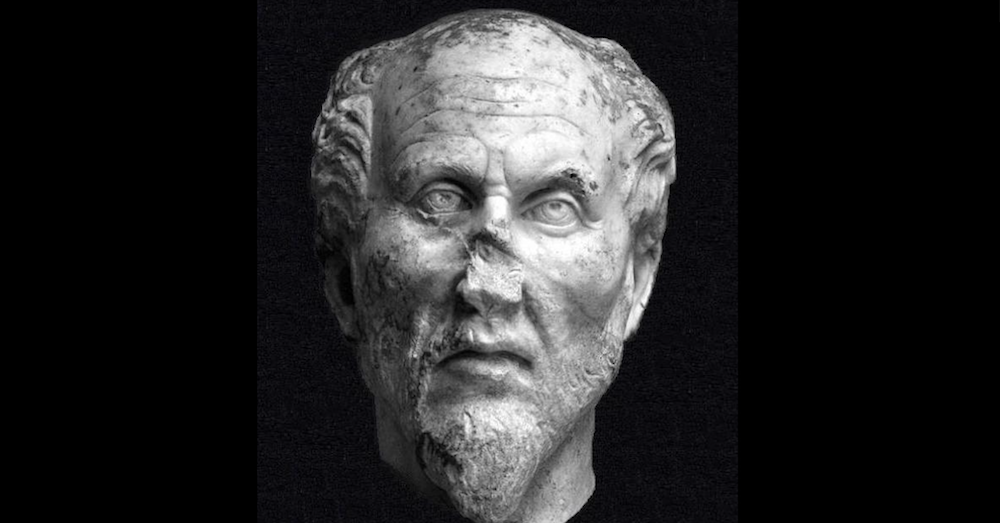

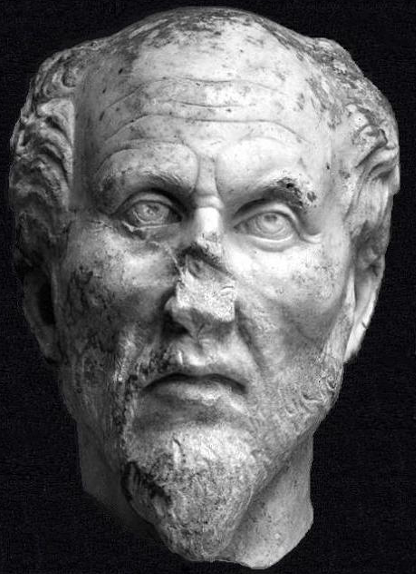
Portrait Head of a Philosopher (Possibly Plotinus), late 3rd century AD. Marble. Museo Ostiense.

Starlight… Devoid of Light?
Portrait Head of a Philosopher (Possibly Plotinus), late 3rd century AD. Marble. Museo Ostiense.

If you are an avid reader of the Embassy of the Free Mind’s newsletter, you might be aware of a previous piece, published in the recent September 2026 issue and written by yours truly, on the (in)famous De Radiis Stellarum, a treatise on stellar rays that to this day gets attributed to the Arab philosopher al-Kindi (c. 9th Century CE), but was most probably a pseudo-epi graphical work.
If you were zealous enough to actually venture into the piece itself, you might already know that, in the treatise, there is never a mention of Latin terms for ‘light’. There are many mentions of rays and mentions of species (form, likeness), which in this milieu are adjacent to some of the concepts that in modernity pertain to light, but never actual words of illumination. The De Radiis is a book on the rays of the stars but seemingly it does not talk about starlight, or maybe the concept of starlight that we envision today does not coincide with that of the past.
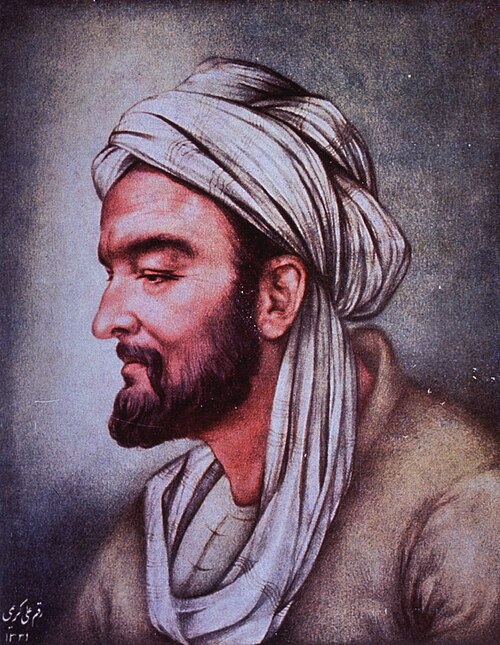
You might already be aware that in Latin there are three words to indicate light: lux, lumen and splendor. Lux is the source of light, light itself, lumen is brightness, or what we call visible light, and splendor is light as is reflected by objects. Of these three terms, I shall focus on the first two, as they are the most pertinent in this context. The distinction between lux and lumen in the Latin world is imputed to the popularity of the writings of Persian philosopher and physician Avicenna (c. 10th Century CE), one of the most influential commentators of Aristotle in the Latin West. Avicenna, in turn, might have based his distinction of two lights on the writings of ancient Greek philosopher Plotinus (c. 3rd Century CE). It is in Ennead IV that Plotinus talks about light, and precisely in Baghdad, in the ninth-century, Plotinus’s Enneads IV-VI were mistaken for Aristotelian works, and included in the ninth-century CE Arabic Theology of Aristotle. Neoplatonic ideas then spread to the Latin West from the twelfth-century, following a great translation movement, centuries before Marsilio Ficino’s translation of Plotinus’s actual writings, at the court of Cosimo de Medici in the fifteenth-century.

Lux was the source of light itself, while lumen was the brightness that shines from the source. Yael Raizman-Kedar puts it best when he says there is “an original light, corresponding to the internal energeia (activity) of every existent, and a secondary light, which is the outflow and image of the first light, existing outside of the luminous body.” (‘Plotinus’s conception of unity and multiplicity as the root to the medieval distinction between lux and lumen’: 379). In late medieval scholastic philosophy this distinction was widely embraced, although with differences. “There is hardly any Western reader who does not give an Aristotelian or Grossetestian bent to Avicenna’s concept of acquired light (lumen)” says Dag Nikolaus Hasse (Avicenna’s “De anima” in the Latin West: the formation of a peripatetic philosophy of the soul 1160-1300: 115). Robert Grosseteste (d. 1253) is the father of light metaphysics of the thirteenth century, who famously claimed in his De Luce (c. 1220s) that lux is corporeality itself. Lumen, which is commonly used to indicate the light of the celestial sphere of the fixed stars, is, instead, the vehicle that carries forms from the heavens towards the prime matter of the sublunar realm, actualizing everything into existence. Lumen is also described as the generator of all motus, motion. In Aristotelian terms: motion, or kinesis, change, is going from a state of potentiality—usually associated to the concept of matter—to a state of actuality—form. Lumen is also responsible for vision and sometimes used as almost a synonym for color, like in some passages in Albertus Magnus.
Lumen shares many characteristics with the concept of species. “Not another Latin word…what is species?” You might be asking yourself right now, and rightfully so, because this is getting quite confusing. Species is likeness, or form, as exemplified by Grosseteste (d. 1253). He says, in his De Lineis, Angulis et Figuris: “a natural agent multiplies its power from itself to the receiver, whether it acts upon the senses or matter. This power is sometimes called species, sometimes likeness […] and it will send itself equally into the faculty of sensation and into matter, or the opposite, as hotness sends itself both into the sense of touch and into cold matter.” This description sounds just like the elemental rays described by Pseudo-al-Kindi in the De Radiis. Morevoer, species and lumen have something in common, they are a kind of radiation. Rays, radii can carry much more than simple light. In fact, the stars are often described as not just sending down their light, but also their power, their virtus, and elemental correspondences.
The stellar rays of Pseudo-al-Kindi are described through the treatise as carrying information from the stars, as actualizers of matter which bring things into existence and are responsible for the generation of all things, as well as their properties, and for generating motion. So is it a coincidence that lumen shares the same properties as rays or are rays the bigger category? Is lumen just a peculiar kind of species? In the late 1270s, John Pecham (d. 1292)—another “father” of light metaphysics—writes the Perspectiva Communis, a popular work instrumental in the popularization of Alhazen and Roger Bacon’s theories of sight and light. In his treatise, when describing lumen, Pecham accosts it to “visible species” that is “diffused by the lux of the sun.” He furthermore states that “a ray is nothing else than the species of a visible thing extended in a straight line.” Visible light, or lumen, is nothing more than the species of the Sun, according to Pecham. So, in a sense, a treatise on the rays of the stars, does not need to specify its concern with concepts of lux or lumen, because in this specific historical context, in the 1250s and 1260s, rays carry information, or species, and species include lumen by definition. Think about it like this: the ray is like a train, an empty vessel that carries different kinds of passengers, which represent information. Species is the passenger, and it is the information of likeness emitted by all things indiscriminately. Lumen is one kind of species, more specifically that of those things which can shine, like the Sun or a candle.
The association of rays and light is something which now we take for granted: light travels by rays, and rays are now mostly used to describe trajectories in the realm of light particles. This was not a given in the late medieval context, where, as we have seen, things are just a little bit more complex. But if we just focus on the words found in the biggest treatises on the topic it is easier to orientate ourselves in this jungle of species, lumen and rays: for example, Robert Grosseteste makes no mention of lux and lumen in his De Lineis, Angulis et Figuris, a treatise on the propagation of species, just like Pseudo-al-Kindi does not mention lux or lumen in the De Radiis. Meanwhile Grosseteste’s influential treatise on light, De Luce, is completely devoid of mentions of rays. So should we respect the words used by these authors or group these concepts together to better adapt them to our modern framework of understanding? Food for thought.
References
Works cited & suggested reading:
Grosseteste, Robert and Claire C. Riedl (trans.). De Luce – On Light, (Milwaukee: Marquette University Press): 1942.
Grosseteste, Robert. De Lineis, Angulis et Figuris. Accessed Feb. 6th 2026 at wikisource.org
Gurtler, Gary M. ‘Plotinus on Light and Vision’, in International Journal of the Platonic Tradition 12, no. 2 (2018): 151-162.
Hasse, Dag Nikolaus. Avicenna’s “De anima” in the Latin West: the formation of a peripatetic philosophy of the soul 1160-1300, (London: The Warburg Institute): 2000.
Hasse, Dag Nikolaus. ‘Avicenna’s ‘Giver of Forms in Latin Philosophy, Especially in the Works of Albertus Magnus.’, in Amos Bertolacci and Dag Nikolaus Hasse (eds.), The Arabic, Hebrew and Latin Reception of Avicenna's Metaphysics, (Berlin: De Gruyter, 2011): 225–50.
Hasse, Dag Nikolaus. ‘Pietro d’Abano’s Conciliator and the Theory of the Soul in Paris.’, in Andreas Speer et al. Nach der Verurteilung von 1277 / After the Condemnation of 1277, (Berlin: De Gruyter): 2001.
Hendrix, Scott. ‘Albert the Great, the Speculum astronomiae, and Astrology’, in Studies in Medieval and Renaissance History 15 (2018): 151-190.
Hendrix, John Shannon. ‘Neoplatonic Influence in the Writings of Robert Grosseteste.’ 2008. Retrieved from rwu.edu.
Lindberg, David C. ‘Alkindi’s Critique of Euclid’s Theory of Vision.’, in Isis 62, no. 4 (1971): 469–489.
Lindberg, David C. Theories of Vision from Al-Kindi to Kepler, (Chicago: The University of Chicago Press): 1976.
Matton, Sylvain. ‘An Irradiation of Latin Grammarians, or The De radiis is not by al-Kindī’, in Magic, Ritual, and Witchcraft 17, no. 3 (2022): 437-455.
Pecham, John. Perspectiva Communis, (Nuremberg: Johan Petreius):1542.
Raizman-Kedar, Yael. ‘Plotinus’s conception of unity and multiplicity as the root to the medieval distinction between lux and lumen’, in Studies in History and Philosophy of Science Journal 37 (2006): 379–397.
Rutkin, H. Darrel. 'Astrology’, in Katharine Park and Lorraine Daston (eds.), The Cambridge History of Science, (Cambridge: Cambridge University Press, 2006): 541-561.
Rutkin, H. Darrel. Sapientia Astrologica: astrology, magic and natural knowledge ca. 1250-1800, (Cham: Springer): 2019.
Saif, Liana. The Arabic Influences on Early Modern Occult Philosophy, (London: Palgrave Macmillan): 2015.
Thorndike, Lynn. ‘The True Place of Astrology in the History of Science’, in Isis 46, no. 3 (1955): 273–78.
Travaglia, Pinella. Magic, Causality and Intentionality. The Doctrine of Rays in al-Kindi, (Florence: Sismel-Edizioni del Galluzzo): 1999.

Written by
Leonardo Baldi
Leonardo Baldi holds MAs in Philosophy (KCL) & Religious Studies (UvA). Researches Western esotericism and history of science, focusing on medieval/early modern light, hylomorphism & natural philosophy. Recent thesis explored stellar rays in astrology.