


The Modern Mystic: A Monthly Journal Devoted to the Study of Mysticism and the Occult Sciences (1937-1940)
By
Corey D. Andrews
November 15, 2026
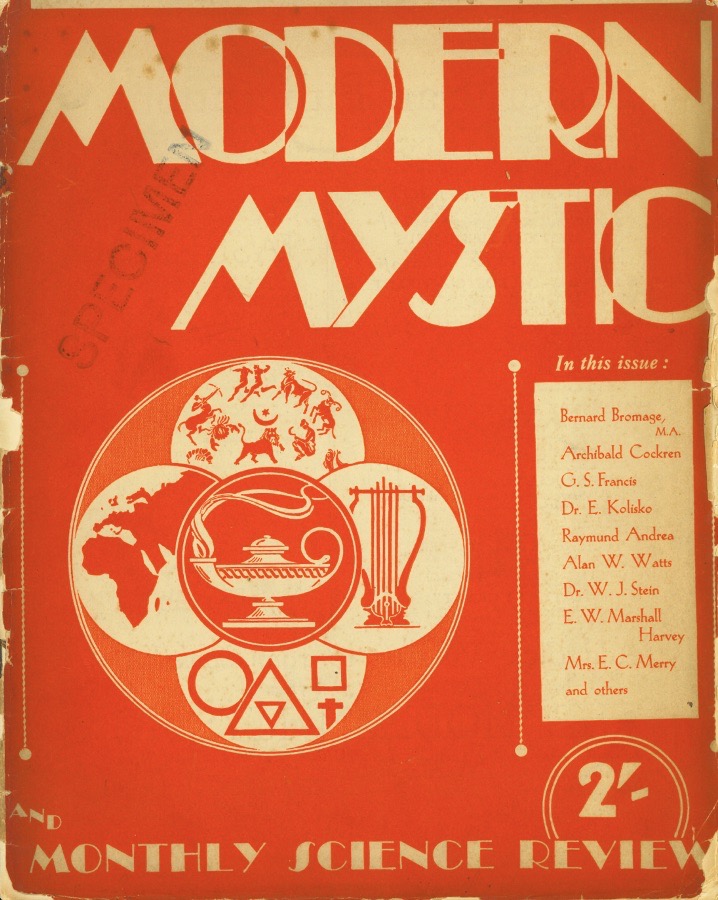
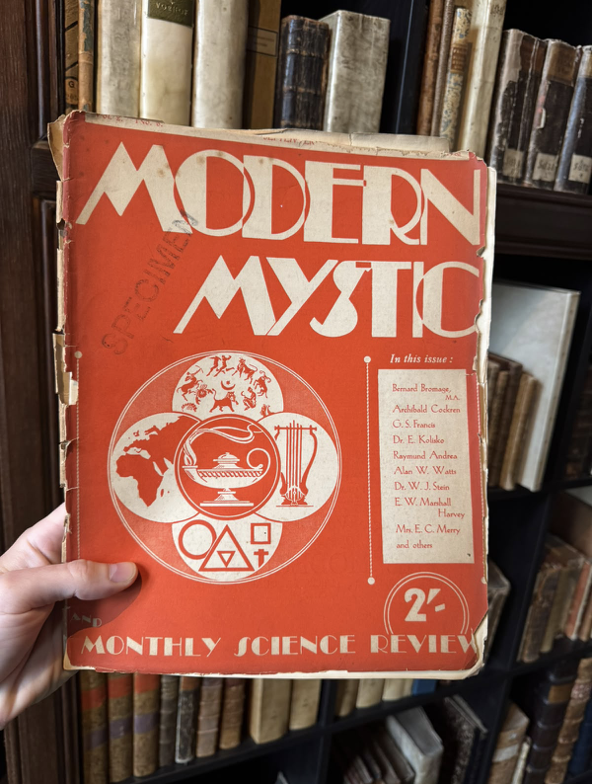
Cover page of The Modern Mystic, Vol. 2 No. 8, September 1938.

The Modern Mystic: A Monthly Journal Devoted to the Study of Mysticism and the Occult Sciences (1937-1940)
Cover page of The Modern Mystic, Vol. 2 No. 8, September 1938.

The Modern Mystic: A Monthly Journal Devoted to the Study of Mysticism and the Occult Sciences (1937-1940)
By
Corey D. Andrews
November 15, 2026
My piece for Codex this month continues a tradition of mine, namely highlighting previous periodicals devoted to esoteric lore which have emerged over the last two centuries. In last month’s piece I discussed The Secret Heritage, a highly amusing Neo-Rosicrucian propaganda booklet that I found in our basement encased within a large white cardboard cassette. I mentioned this cassette had other contents that I had not the space to discuss then, this month I will discuss another item from the mysterious package!
The Modern Mystic was a London-based monthly journal “devoted to the study of mysticism and the occult sciences” founded by mystic and journalist Norman Vincent Dagg (1897-1962) in 1937.
The journal initially run from January 1937 to January 1940, with a later phase running from 1945 to 1948 before finally being discontinued due to rising economic pressures and paper shortages brought about because of World War II. While it seems that we only have one issue of this journal in the BPH collection here, readers can find all 37 issues of the initial run digitally available via the IAPSOP website.
This gives me a chance to highlight this crucial platform as well. ‘IAPSOP’, or the ‘International Association for the Preservation of Spiritualist and Occult Periodicals’ is a priceless treasure of digitized esoteric literary heritage. I (and by extension, the Codex) have benefitted enormously from the tireless digitization efforts of this organization, and they are entirely contribution-supported, so if you also value this effort, consider contributing to them to make sure this knowledge is preserved.

The issue of Modern Mystic in the BPH holdings is the September 1938 issue. The issue features a beautiful art deco style cover, and includes 10 short articles that involve the following topics:
- ‘Introduction to Alchemy’, by Archibald Cockren
- ‘History of the Idea of Reincarnation’, by Dr. Walter J. Stein
- ‘Reflections on our Growing Consciousness of Time’, by George S. Francis
- ‘Speaking Personally’, by Alan W. Watts
- ‘Poe’, by Raymund Andrea
- ‘The Mysticism of Feruccio Busoni’, by Bernard Bromage, M.A.
- ‘The British Association’, by The Editor
- ‘Reincarnation’, by Dr. E. Kolisko
- ‘Prometheus Unbound’, by Eleanor C. Merry
- ‘The Woman Clothed with the Sun’, by E. W. Marshall Harvey
While I do not have space to summarize all of these pieces, I would like to go over two pieces this month that especially stood out to me.

Walt Disney as Magus of Animation
The first introductory section (not an entire article) is titled ‘Our Point of View’, written by Dr. Eugen Kolisko, and after some pensive discussion regarding the dangers of war (a highly relevant theme in the year 1938 when it was published), it focuses on the spiritual power and genius of the American animator and film producer Walt Disney (1901-1966). The author saw Disney as a major warlock-esque figure wielding enormous power:
“One of the most powerful spiritual influences of our time is certainly Walt Disney. (p. 322)
“He has got hold of a force which is working in the actual spiritual world: the force of metamorphosis.” (p. 322)
“What Walt Disney has introduced into the Cinema should in reality have been introduced into Science.” (p. 322)
When this issue was printed (1938), the character of Mickey Mouse had debuted just 10 years prior in the animated film Steamboat Willie in 1928. Donald Duck, Snow White and the Seven Dwarves, and other classic Disney productions followed not far behind in 1934. What Disney was doing was not mere animation, the author contends, but was operationalizing Hermetic principles in his manner of animation. For example, he states that just as the human being is the microcosm of all animal life,
“…every animal corresponds to one part of man. For instance a bird develops the nose and upper jaw; the bull, the lower jaw; the elephant the upper lip and nose. Every caricaturist knows the secret that the exaggeration of one feature will produce an animal characteristic. Walt Disney has an instinctive knowledge of these facts. Hence the enormous psychological fact of such a creation as Donald Duck.”

Disney’s creations, Mickey, Donald, Snoopy, the whole lot of them, the author claims all reside in the “elementary world”, which is “certainly known to all occultists”, and furthermore, if people made an effort to become acquainted with this world, they “would become clairvoyant.” (p. 322). Thus, the elementary world comes to us and one of its channels for communication is “the peculiar genius of Walt Disney.”
Furthermore, the author argues that the genre that Disney is drawing from in his cartoons, namely fairy tales, should not be dismissed as mere fantasy, but as the repository of deep and ancient knowledge. On this point, he saw the story of Snow White as particularly powerful:
“The climax is Snow White. It will conquer the world. But why? – People look upon fairy tales as mere rubbish. But the fairy-tales are actual ‘pictures’ existing in the spiritual world, as real as tables and chairs in this world. Since we will not go to the fairy world, the fairy world forces itself into ours.”
These stories are thus of inestimable value even today! The author drives the point home asserting that “We are of the opinion that Walt Disney is the instructor of scientists rather than the entertainer of children.” An intriguing perspective, and in my estimation quite a compelling one. One which we have not the time to dwell upon though!
Introduction to alchemy by Archibald Cockren
The first full length article in the issue concerns an introduction to alchemy. I was quite impressed by this one. First, it begins with the entire text of the Emerald Tablet, the so-called ‘Bible of the alchemists’, a short text dating to at least the ninth-century CE where we first encounter the ‘As above, So below’ idea. Then, what follows is an excellent, quite historically-sound overview of the history of alchemy, tracing its origins quite accurately to the third-century CE Egyptian Zosimos of Panopolis. The author also notes that alchemy is the “parent of modern chemistry”, as well that its symbolic language is practically impenetrable to those “who have not had some initiation into its interpretation.” (p. 323) Then, over several pages, we are taken through the ages, with the author adeptly noting some of the most central figures of alchemical history:

The legendary hermit-alchemist Morienus the Roman; early Islamic alchemist Jabir ibn Hayyan (d. c.806-816) known by the Latinized form ‘Geber’; father of early medicine in the Muslim world Ibn Sina (c. 980-1037) known in the West as ‘Avicenna’; physician and reformer Arnold of Villanova (who translated Avicenna from Arabic, c. 1240-1311); the Catalan missionary and mystic Ramon Lull (1232-1316); English polymath and philosopher Roger Bacon (c. 1219-1292); German Dominican friar and scientist Albertus Magnus (1200-1280); the influential pseudonymous alchemist Basil Valentine (c. 16th-century); English lawyer and playwright Thomas Norton (1532-1584); English Augustinian author and alchemist George Ripley (of Ripley Scroll fame, c. 1415-1490); French notary, alchemist, and alleged possessor of the Philosophers’ Stone Nicholas Flamel (of Harry Potter fame, hehe, c.1340-1418); the great Swiss-German physician and medical reformer Theophrastus Bombastus Paracelsus (1493-1541); some of the early Rosicrucians also found mention (Michael Maier, Robert Fludd, Thomas Vaughn); even the mysterious Isaac Hollandus (c. 17th-century) creator of the famous ‘hand of the mysteries’ symbol was referenced! (see my earlier article ‘De-ciphering the Hand of the Mysteries’ in November 2025 issue of Codex).
Later in the article, I encountered an idea about alchemy that I had never considered. The author states how alchemy deals with “first causes”, whereas modern chemistry deals with “the effects of the cause.” Hmm… intriguing, its true I regularly encounter ‘cosmogonic’ (i.e., concerning creation of the universe) diagrams or Latin terms referring to ‘first causes’ in Renaissance alchemical literature, often in forms such as ‘materia prima/prima materia’ (first matter/primal matter), but this can also simply refer to the beginning stage of the matter as the alchemist begins his work. Nevertheless, I cannot help but be reminded of biologist, biochemist, and parapsychological researcher Rupert Sheldrake’s (b.1942) disillusionment with his own profession which evokes a similar logic. By selecting biology as his PhD discipline, he thought he would be studying ‘life’, but when he was tasked with euthanizing mice and dissecting carcasses “which he found deeply unsettling” (Leviton, 2013), he came to the conclusion he was not studying life, but death (i.e., the ‘effects of life’ rather than life itself). This ultimately led him to turn away from science, as he thought science had turned away from life. (See Leviton, ‘Wrong Turn’ in works cited).
The author finally asserts alchemy as both a spiritual and materialist science, and names Jacob Boehme (1575-1624) as one of its chief representatives. This author knew alchemy very well, I was impressed. Even the inclusion of Boehme as a ‘spiritual alchemist’ (problematics with that term aside), is quite legitimate. Historian Mike Zuber in his recent Oxford monograph Spiritual Alchemy: From Jacob Boehme to Mary Anne Atwood (2021) meticulously demonstrated Boehme as one of the earliest examples of a ‘spiritual’ alchemist. For those interested, I recently had a review of Zuber’s book published in Correspondences: Journal for the Study of Esotericism, readable online here.
This was my first encounter with this periodical, and overall, The Modern Mystic came off as quite high quality. It struck a healthy balance between being sensitive to historical facts, but also having a compelling esoteric dimension to its content. It is a stark departure from the literally ‘fantastic’, ahistorical content from last month’s The Secret Heritage. Their publication dates, however, were just three years apart from each other! Their juxtaposition really shows the range of perspectives offered in the form of an esoteric periodical during the early-to-mid twentieth-century, and challenges the modern reader to “sort the wheat from the chaff”, as it were. I once read a definition of the project of historiography in a way that could be instructive here: “history is not the past, it is an artful arrangement of materials from the past.” On this, I would say The Modern Mystic does an excellent job.
That about exhausts what I can fit into this issue of Codex, but I would really like to synopsize two other articles in this issue. The first concerns the history of the idea of reincarnation by Walter Stein, and another article by a very young Alan Watts covering several topics related to spirituality and occultism. If you enjoyed this, and would like me to cover those articles next month, let me know! Feel free to do so by filling out the survey below, as well as submitting any feedback whatsoever, which Sarah and I are always very appreciative of. Until next month dear reader - ever yours, Corey.
References
Works cited & suggested reading:
Dagg, Norman Vincent (ed.), The Modern Mystic: A Monthly Journal Devoted to the Study of Mysticism and the Occult Sciences, Vol. 2, no. 8, September 1938.
Leviton, Mark. ‘Wrong Turn: Biologist Rupert Sheldrake On How Science Lost Its Way’, published in The Sun (February 2013, Issue 446): archive.org
Zuber, Mike. Spiritual Alchemy: From Jacob Boehme to Mary Anne Atwood (New York: Oxford University Press): 2021.
Written by
Corey D. Andrews
Corey D. Andrews is a PhD candidate at the University of Amsterdam and a researcher working for the Ritman Research Institute. His research focuses primarily on 17th and 18th century Rosicrucianism and the life and works of Jan Amos Comenius (1592-1670).