

.svg)
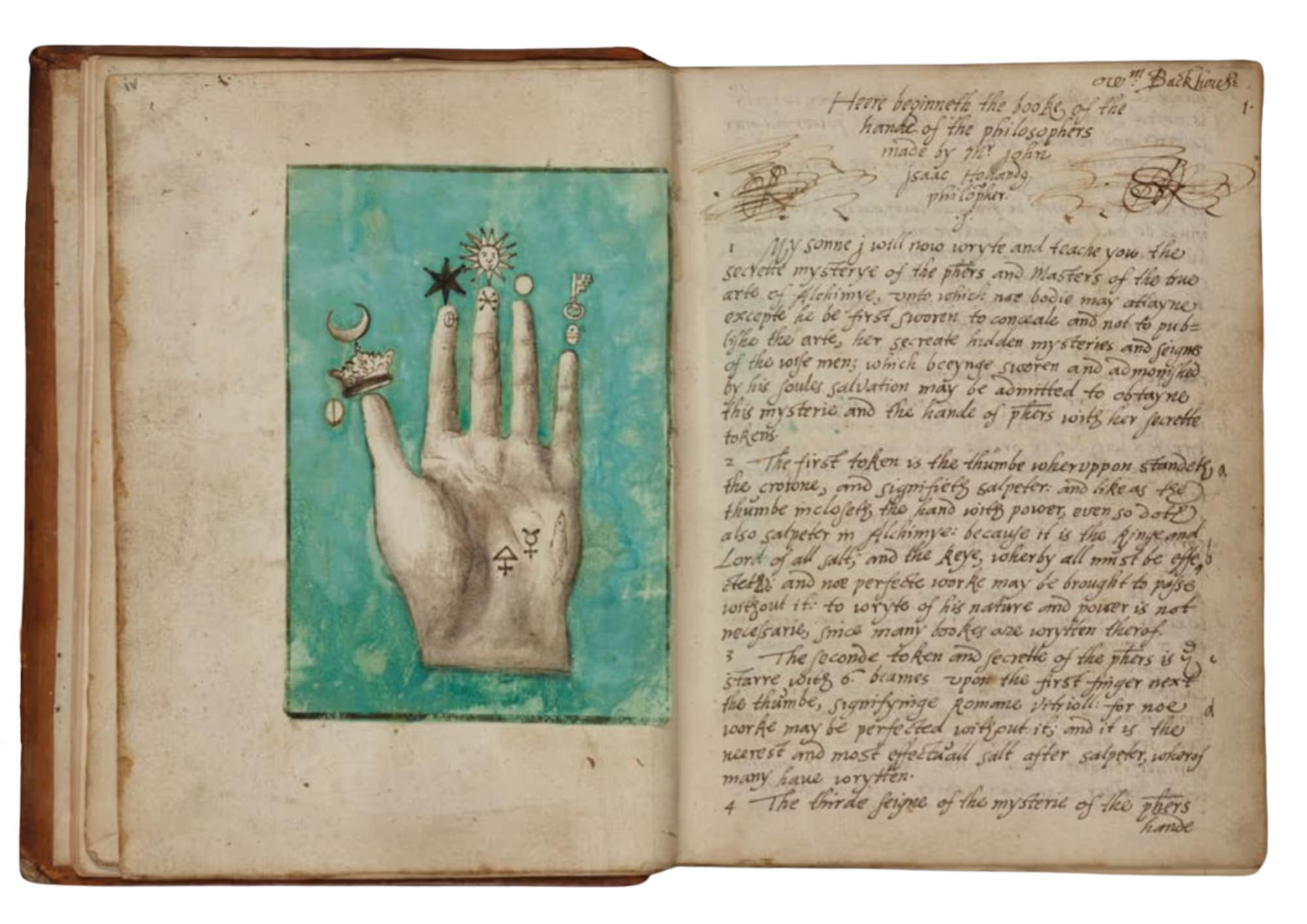
'The Hand of the Philosophers', book by Johannes Isaac Hollandus, 17th century manuscript.

De-ciphering the ‘Hand of the Mysteries’
'The Hand of the Philosophers', book by Johannes Isaac Hollandus, 17th century manuscript.

De-ciphering the ‘Hand of the Mysteries’
By
Corey Andrews
November 15, 2025
With pre-emptive apologies for the lengthy piece, I fell down a bit of a rabbit hole on this one. As an appetizer, I include here a passage from Dan Brown’s 2009 novel, The Lost Symbol:
"Peter Solomon’s severed right hand was standing upright. Three of the fingers were closed in a fist, while the thumb and index finger were fully extended, pointing up toward the soaring dome. On the thumb - a crown. On the index finger - a star. This can’t be. The two symbols registered instantly in Langdon’s mind, amplifying this already horrific scene into something almost otherworldly. These symbols had appeared together many times in history, and always in the same place - on the fingertips of a hand. It was one of the ancient world’s most coveted and secretive icons.
The Hand of the Mysteries.
The icon was rarely seen anymore, but throughout history it had symbolized a powerful call to action. Although he could not see the fingertips of the threeclenched fingers, Langdon knew these fingertips would bear their own uniquemarkings. That was the tradition. Five symbols in total. Through the millennia,the symbols on the fingertips of the Hand of the Mysteries had never changed…nor had the hand’s iconic purpose.
The Hand represents . . . an invitation.
In ancient times, the Hand of the Mysteries actually served as the most coveted invitation on earth. To receive this icon was a sacred summons to join an elite group—those who were said to guard the secret wisdom of all the ages. The invitation not only was a great honor, but it signified that a master believed you were worthy to receive this hidden wisdom. The hand of the master extended to the initiate.
Anderson [the D.C Capitol police chief] crouched down beside the hand, being careful not to touch it. He put his cheek near the floor and looked up under the clenched fingertips. “He’s right, ma’am. All of the fingertips have tattoos, although I can’t quite see what the other - A sun, a lantern, and a key,” Langdon said flatly. Langdon wished he would wake up from this nightmare. A formal invitation had just been delivered. Someone was summoning Langdon to unlock a mystical portal that would unveil a world of ancient mysteries and hidden knowledge, […] protected wisdom known only to an elite few."
Dan Brown did his research. The gruesome hand he wrote about does indeed originate in Western mystery literature. However, not from as ancient a source as his character Langdon, the ‘Harvard Symbologist’ asserts. But to be fair, in the context of this article at least, it does similarly symbolize an invitation, though not an “invitation to join an elite group unveiling a world of ancient mysteries and hidden knowledge” - wait a second, perhaps that is precisely what we are up to here in the Codex… I digress.
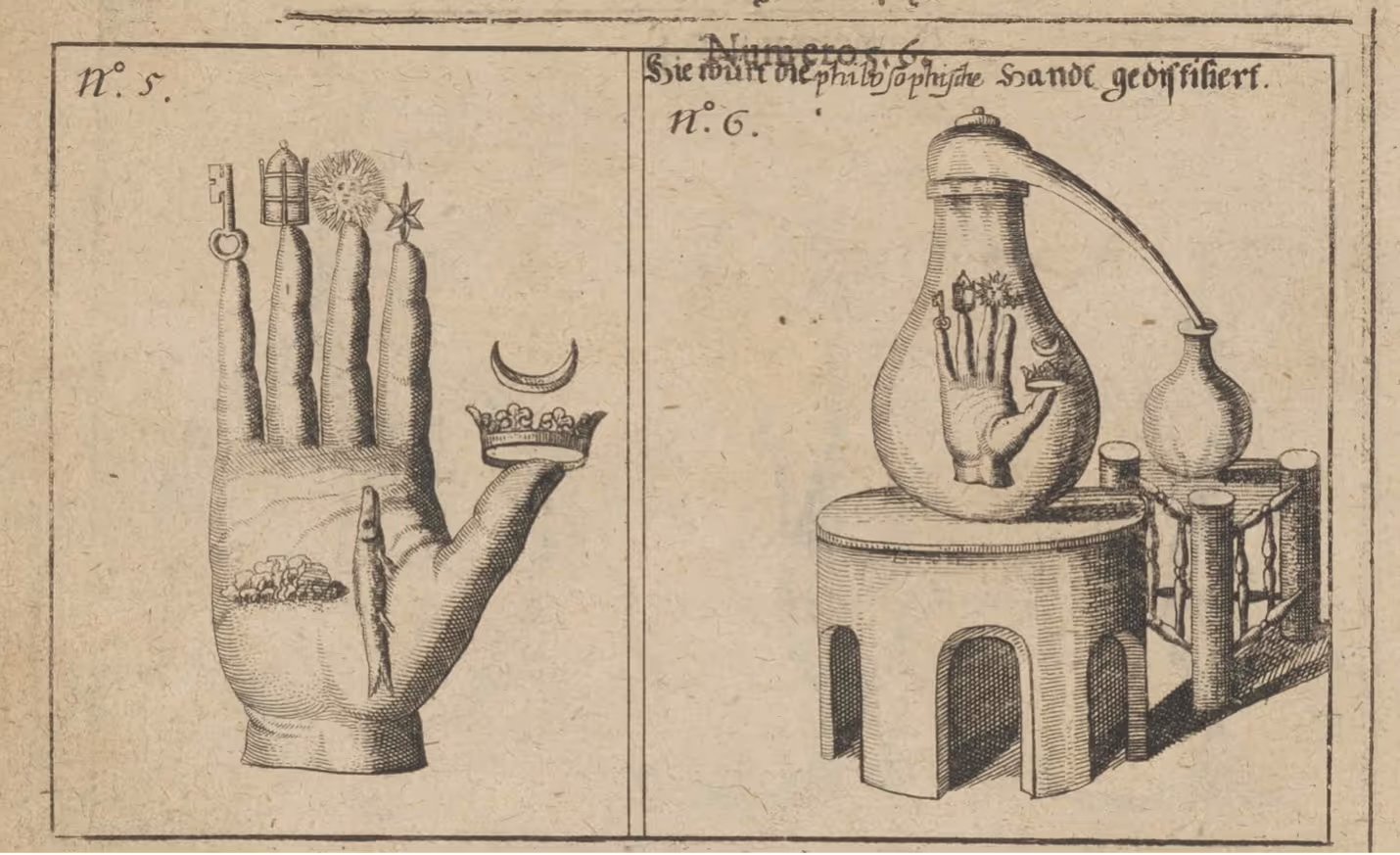
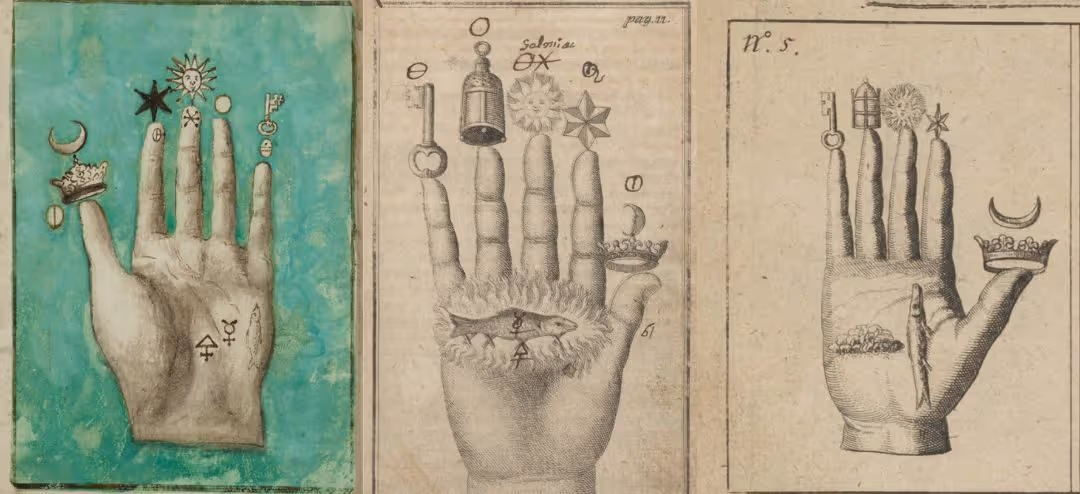
The image of this hand first appears in alchemical textual (both printed and manuscript) sources from the mid-17th century at the earliest - texts composed under the (seemingly Dutch) name ‘Johannes Isaac Hollandus’ (?-?).
But who was Hollandus?
Preliminary research into Hollandus betrays disappointingly, indeed even shockingly little. Seriously though, I was astonished at how little is known about this figure. Before you rush off to Wikipedia, don’t waste your time - I’ve looked, and the name yields nothing (yes, I also checked the German & Dutch versions of Wikipedia). Here’s the thing: even in scholarly alchemical literature there are only passing references to this stealthy figure. Just to show that I’ve looked in multiple otherwise reliable and exhaustive sources, I provide four examples here:
1. Glenn Alexander McGee (eds), Cambridge Handbook of Western Mysticism and Esotericism (Cambridge: Cambridge University Press, 2016): p. 159.
His name is mentioned exactly once in the classic Cambridge handbook where he is described as influencing the great Paracelsus(!):
“The French physician and alchemist Bernard George Penot (ca. 1530– ca. 1620) suggested at one point that there was nothing new in Paracelsus, and that Paracelsus had copied “word for word” what the alchemist Isaac Hollandus had written about the three principles and had also closely followed what the alchemical author Basil Valentine had written about the same.”
That’s it. No birth or death dates are provided for him (as is typical to include for historiographical research), his work seems to have been associated with the equally mysterious and extremely important Basil Valentine, whose identity is also still disputed by historians. Valentine composed the very influential Twelve Keys of Basil Valentine - filled with its own trove of attractive alchemical symbols borrowed (among others) by the later 18th century Geheime figuren (Secret Symbols of the Rosicrucians). I found that Hollandus’ name is even sometimes included along with the similarly enigmatic ‘Fulcanelli’, who some believe was the theoretical apprentice to Basil Valentine, and who Frank Zappa even acknowledged in the 1988 song ‘But who was Fulcanelli?’
- Henrik Bogdan & Olav Hammer (eds), Western Esotericism in Scandinavia, (Boston: Brill, 2016): p. 420.
Hollandus’ name also appears exactly once in the Brill volume on Western Esotericism in Scandinavia edited by Bogdan & Hammer, but only in reference to the fact that his books occupied the shelves of ‘The Christiania’ apothecary Hans Jochum Scharff (1649?-1703?). Here the works of Hollandus must have been useful within the context of a practical laboratory setting – more on this later.
- Jennifer M. Rampling, The Experimental Fire: Inventing English Alchemy (1300-1700), (Chicago: Chicago University Press, 2020): p. 304.
His name is also mentioned (again only once!) in a recent monograph by the Princeton scholar of George Ripley, Jennifer M. Rampling, The Experimental Fire. Here, the legendary Hollandus is referenced only in a piece of writing by the (in)famous alchemist and associate of John Dee, Edward Kelley, who lumped Hollandus together with a number of other alchemists who “attained the art after long study” such as “John Garland, Hortulanus, [George] Ripley, Isaac Hollandus, Dunstan, Brixham, and Bernard of Trevisio.” In the text, writes Rampling, Kelley “points to the many years of study necessary to acquire the secret, even for [the] great adepts…” such as “Arnald of Villanova and Raymond Lull [who] also spent many years striving for the stone before they succeeded.”
- Didier Kahn, ‘The Rosicrucian Hoax in France (1623-24)’, in William R. Newman & Anthony Grafton (eds.), Secrets of Nature: Astrology and Alchemy in Early Modern Europe, (Massachusetts: M.I.T. Press, 2001): p. 323.
His name again appears just once in the vast Secrets of Nature, where it’s indicated that a Paracelsian physician and alchemist named Théodore Mayerne (1573–1655) owned treatises penned by Hollandus:
“Among the manuscripts of Mayerne there is a text in Dutch entitled De Cabala van de philosophe Isaac den Hollander int cort. (London, British Library, MS Sloane 2097, fols. 56v–78v), but we know that only treatises of alchemy circulated with the name of Isaac Hollandus, and it is doubtful that this text would be an exception to the rule.”
In His Own Words
Okay, enough historicizing, what does Hollandus himself tell us? Fortunately, in one of the manuscripts, he tells us straightforwardly (with my clarifications in brackets) what the hand symbolizes:
"My sonne I will now wryte and teache you the secrette mysterye of the [philoso]phers and masters of the true arte of Alchimye, unto which noe bodie may attayne excepte he be first sworen [sworn] to conceale and not to publishe the arte, her secreate hidden mysteries and seignes [signs] of the wise men; which beeynge [being] swooren and admonished by his soules salvation may be admitted to obtayne this mysterie and the hande of [philoso]phers with her secrette tokens.
The first token is the thumbe wheruppon standeth the crowne, and signifieth salpeter: and like as the thumbe incloseth the hand with power, even so doth also salpeter in Alchimye: because it is the kinge and Lord of all salt, and the Keye, whereby all must be essesteth [assessed?] and noe perfecte worke may be brought to passe without it: to wryte of his nature and power is not necessarie, since many books are written therof.
The seconde token and secrette of the [philoso]phers is a starre with 6 beames upon the first finger next the thumbe, signifying vitrioll: for noe woorke may be perfected without it; and it is the nearest and most effectuall salte after salpeter, wherof many have written."

The thirde seigne [sign] of the mysterie of the [philoso]phers hande is the sunne upon the thirde finger, wherby a is noted salamoni[a]c: for it is the most powerfull after salpeter and vritrioll.
The fourth token of the [philoso]phers is the lanterne upon the 4thfinger, wherby is expressed alume de roche [An ‘alumlike’ substance, itself derived from alunite, a hydroxylated aluminium potassium sulfate mineral.
The fifth token and secrette of the [philoso]phers is the keye uppon the little finger, which is the locke of the hande, wherby is declared commone salte, and it is the key of the arte of Alchimye.
The sixt secrette of the [philoso]phers hande is the fishe, whearby is noted mercurye, because nothinge may be effected without it or the fishe: seeinge it is the beginninge, the middle, and the ende, and the priest which must conjoyne in marriage all things, it is the mom and seede, the water wher from all metalls springe, and the chiefeste of the whole arte, and the highest of all secrettes.
The seaventh token of the [philoso]phers hande is the fier [fire] wherby is expressed sulphure, which is the earth, and the beginninge of all metalls, the wise bringinge forth the fruite: for noe seede may growe unlesse it be caste first into fruitfull earth."

If you’d like to continue reading the (quite readable) manuscript, it is in English and can be accessed by following the link below.
Conclusion
There we have it, the true meaning of the symbols concern substances useful for laboratory practice, namely saltpeter, vitriol, salammoniac, alume de roche (alunite), common salt, mercury, and sulphur. Thus, a large part of Hollandus’ work consists of practical instructions that are clearly based on laboratory experience. The practice of concealing alchemical recipes in symbols was common in early modern alchemical literature – though that is not to assert that this exhausts the interpretability of all alchemical glyphs, including the ‘hand’ of Hollandus, on a purely materialistic level.
We can’t be 100% sure, but it may very well be that this hand functioned like a kind of mnemonic device. From classical Antiquity into the Renaissance, memory techniques were very popular, as a lot of knowledge was transmitted orally and books were not available to everyone. The hand served as a practical aid. In the same way as we still count with our fingers or count across the knuckles and the dips on the back of our hands to remember which of the months have 31 days and which don’t, the alchemist could count with his fingers to remember which were the most important metals and salts for him.
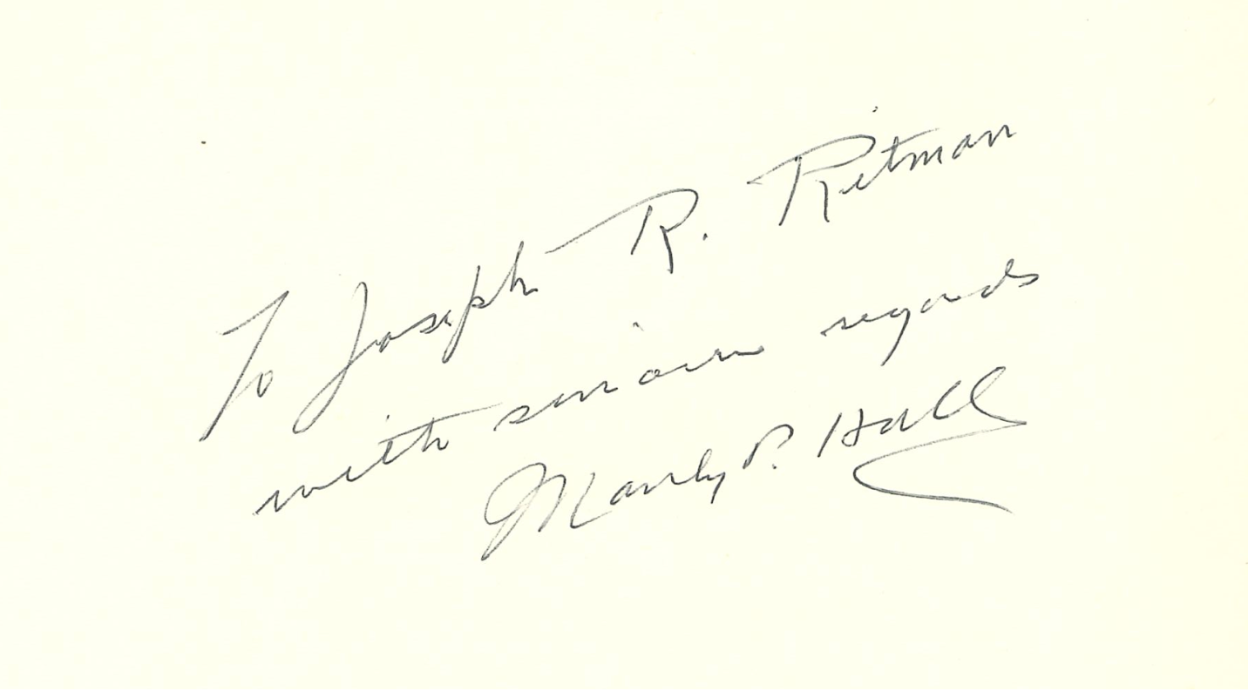
I personally believe the most likely scenario regarding the way that Brown used the hand in his book was influenced by a description which appeared in Many P. Hall’s classic compendium The Secret Teachings of all Ages (1928), which does discuss the notion that the hand is “extended to those who enter into the Mysteries”, as Brown appropriates it. In the passage we opened with, Brown himself even says that “To receive this icon was a sacred summons to join an elite group—those who were said to guard the secret wisdom of all the ages.” The final clause there being, in my view, a rather ‘on the nose’ nod to Hall’s anthology of secret knowledge.
However, as much as I adore Hall, his immortal contributions, and his prolific oeuvre and lectures (hundreds of which can still be found on YouTube), he often took excessive liberalities with interpretation - which I have no problem tolerating when reading casually, though these liberalities must be attended to if reading him with a historian’s lens.
We may never know who Hollandus was, the same goes for Valentine and Fulcanelli for that matter – just like I may never know who you are, faceless, nameless Codex reader, but perhaps their spirits would be glad we’ve devoted the slightest concern for them even now, centuries later. So too that mine is glad that you’ve again accompanied me down one of the many rabbit holes of this exquisite collection - until next month.
*P.S. Last year the hand was also featured on the cover of my PhD advisor Peter Forshaw’s book Occult: Decoding the Visual Culture of Mysticism, Magic and Divination (Thames & Hudson, 2024) – a highly recommended read!
Written by
Corey Andrews
Corey Andrews is a PhD candidate at the University of Amsterdam and a researcher working for the Ritman Research Institute. His research focuses primarily on 17th and 18th century Rosicrucianism and the life and works of Jan Amos Comenius (1592-1670).

.avif)