


.svg)
Empires of the Stars: The Long Life of Hellenistic Astrology
By
Charlotte Zhu
November 15, 2025
'Dendera Zodiac', Temple of Hathor at Dendera, Ptolemaic period, c. 50 BCE.

Empires of the Stars: The Long Life of Hellenistic Astrology
'Dendera Zodiac', Temple of Hathor at Dendera, Ptolemaic period, c. 50 BCE.

Empires of the Stars: The Long Life of Hellenistic Astrology
By
Charlotte Zhu
November 15, 2025
In my previous piece, I traced how astrology was born from the meeting of Mesopotamian, Egyptian, and Greek traditions during the Hellenistic era. But that was only the beginning. Over the following centuries, astrology continued to evolve — carried by empires, scholars, and translators across continents.
Its ideas were embraced, challenged, and reshaped through encounters with new religions and philosophies, creating a continuous thread of knowledge that stretched for more than a thousand years.
The Greco-Roman Era (1st century BCE – 6th century CE)
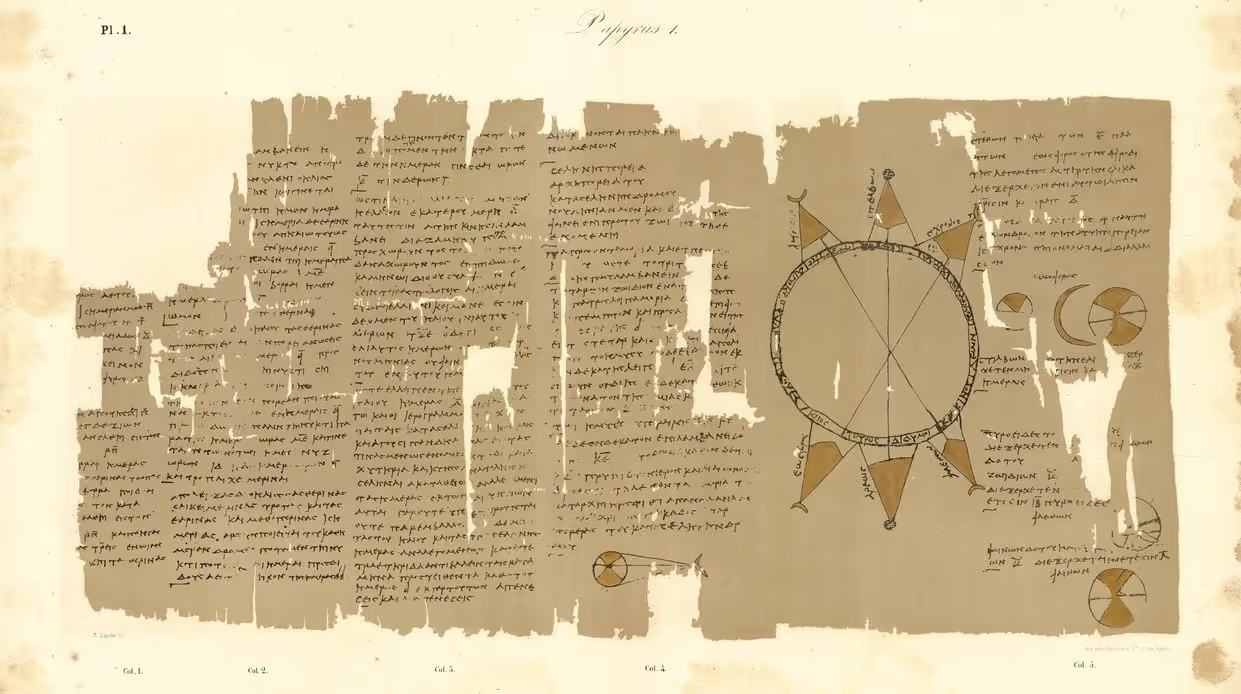
After emerging in the Hellenistic world no later than the 1st century BCE, astrology continued to develop, spreading across empires and cultures while occasionally facing suppression for political or religious reasons.
When the Roman Empire rose to power, it inherited much of the Hellenistic intellectual world — including astrology. Rome absorbed territories such as Egypt (30 BCE) and Greece (146 BCE), becoming one of the first major centers where astrology flourished outside its birthplace.
Astrology fascinated not only ordinary Romans but also the ruling elite. The first emperor, Augustus (27 BCE – 14 CE), reportedly embraced astrology after hearing his horoscope and even published his birth chart to emphasize his divine destiny. By the 2nd and 3rd centuries CE, astrology had become deeply woven into Roman society, influencing politics and personal decision-making alike.
Yet this popularity came with tension. Emperors sometimes feared that astrological predictions could inspire rebellion or challenge their authority — especially those concerning their deaths or the rise of rivals. In 16 CE, Tiberius (14–37 CE) expelled astrologers (then called Chaldaeans) and magicians (mathematici) from Rome, even though he himself relied on trusted astrologers like the Greek Thrasyllus, who had accurately foreseen his ascent to power.
By the 4th century CE, as Christianity gained dominance, astrology’s fortunes changed again. Christian thinkers rejected its deterministic implications, viewing it as incompatible with divine will and human freedom. Still, astrology survived within the Eastern Roman (Byzantine) Empire after the empire’s division in 395 CE. There, scholars preserved and transmitted key works such as Ptolemy’s Tetrabiblos — a cornerstone text that organized Hellenistic astrological theory into a systematic framework.
Although much of this scholarship was in Greek, a few Latin works also circulated. However, during the 7th and 8th centuries, the intellectual climate in Byzantium cooled toward astrology and secular science, as church authorities increasingly labeled such studies “pagan.”
The Sasanian Persian Renaissance (224 – 651 CE)
While astrology’s light dimmed in Byzantium, it shone brightly farther east. In the Sasanian Persian Empire, centered in present-day Iran, astrology entered a remarkable period of revival and innovation. Seeking to recover knowledge they believed lost after Alexander’s conquests, Sasanian scholars translated Greek, Indian, and other texts into Middle Persian (Pahlavi).

Under Khosrow I (531–579 CE) — a ruler known for his patronage of science and philosophy — the Academy of Gondishapur became a meeting place for Greek, Indian, and Persian thinkers. Here, astrology developed in dialogue with medicine, mathematics, and astronomy.
Persian scholars did more than preserve earlier material — they built upon it. They refined mundane astrology, which focuses on world events, natural phenomena, and the fate of empires rather than individuals.
Drawing on Hellenistic planetary theories and Indian time cycles, they devised systems using Jupiter–Saturn conjunctions and zodiacal cycles to forecast dynastic changes. These innovations later shaped Islamic and medieval astrology in profound ways. Influenced by Zoroastrian cosmology, Persian astrologers also explored vast cycles of cosmic time, imagining planetary eras that unfolded over millennia. In this synthesis of traditions, astrology became not only a predictive art but also a reflection of philosophical and spiritual ideas about the universe’s order and destiny.

Written by
Charlotte Zhu
Charlotte Zhu manages the Amsterdam Antiquarian Bookstore and is a candidate at the University of Amsterdam. Her research focuses on the cross-cultural transmission of ancient astrological texts.

.avif)