

.svg)
The Sound of Stillness: The ‘Mystic Chord’ of Alexander Scriabin
By
Natalie Koch
November 15, 2025
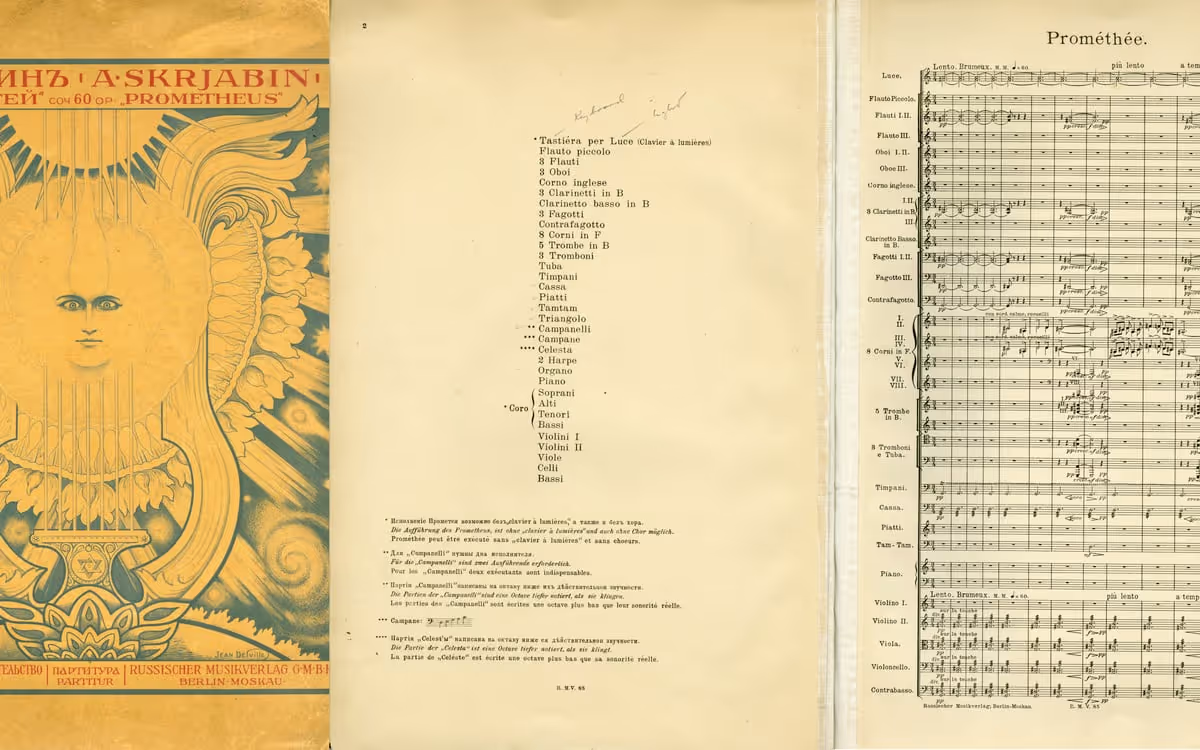
Score Cover 'Prometheus: The Poem of Fire', Alexander Scriabin, published by Éditions Russes de Musi

The Sound of Stillness: The ‘Mystic Chord’ of Alexander Scriabin
Score Cover 'Prometheus: The Poem of Fire', Alexander Scriabin, published by Éditions Russes de Musi

The Sound of Stillness: The ‘Mystic Chord’ of Alexander Scriabin
By
Natalie Koch
November 15, 2025
How do you convey a sense of boundlessness, of eternity and stillness, in an art form as bound to time and movement as music? Like many other avant-garde artists who were interested in spiritualism and esotericism, the Russian composer Alexander Scriabin (1872-1915) sought to express the ineffable.
Many members of the late 19th/early 20th century Russian intelligentsia had become interested in the Theosophy of Helena Blavatsky, and Scriabin was no exception. During one of his visits to London, he 'dined with some Theosophists', as he wrote in a letter dated March 24, 1914. This dinner was organized by George Mead, an influential member of the Theosophical Society, and Scriabin was excited to meet at his house ‘the woman in whose arms Blavatsky died.’ Theosophy informed the development of his idiosyncratic musical style and his individual brand of mysticism, which reflected a quest for spiritual union with the divine.
He saw the act of creation as a magical, holy act, which turned the artist into a kind of high priest, in touch with the divine. Theosophy’s system of colour-pitch associations also inspired him to devise his own colour-coded circle of fifths, which assigns a colour to each key as follows:
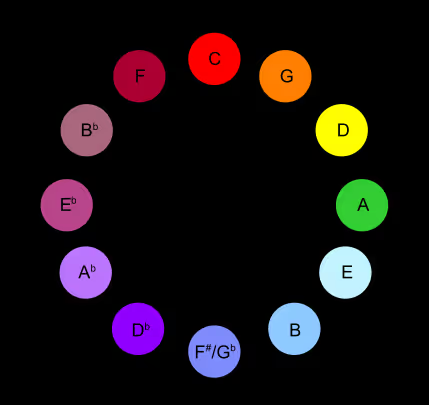
G♭/F♯- Bright Blue, or Violet - Creativity
D♭/C♯- Violet, or Purple - Will of the Creative Spirit
A♭/G♯ - Violet or Lilac - Movement of Spirit into Matter
E♭/D♯ - Flesh (Glint of Steel) - Humanity
B♭/A♯ – Rose or Steel - Lust or Passion
F - Deep Red - Diversification of Will
C - Red (Intense) - the Human Will
G - Orange - Creative Play
D - Yellow - Joy
A - Green - Matter
E - Sky Blue - Moonshine or Frost
As a result, he is often said to have been a ‘synesthete’, although opinions differ. ‘Synesthesia’ is a perceptual phenomena in which the stimulation of one sensory pathway leads to involuntary experiences in a second sensory pathway. People with synesthesia may experience colours when listening to music, see shapes when smelling certain aromas, or even experience tastes when reading words on a page. However, since synesthetic colour-pitch associations are generally quite random, it is suggested that there is too much system in Scriabin’s colour-pitch associations for him to be truly synesthetic.
In 1910, Scriabin composed his most Theosophical work, ‘Prometheus, The Poem of Fire’, Op. 60, an exceptionally novel and daring work for orchestra, piano, optional choir, and a colour organ, which was to project colours during the performance to visually support the effect of the music.
The orchestral poem is an ode to the Greek myth of Prometheus from a Theosophical point of view. In the traditional version of the myth, Prometheus steals fire from the gods to give it to humankind, for which he is severely punished by Zeus, who has him chained to a rock where an eagle tears out his liver every night. The liver then grows back by day, so the torment would last forever.

Atlas, Typhoëus, Prometheus. The three titans are shown upon a laconic bowl while they are being punished for their insurgency against the tyrant Jupiter.
Scriabin, however, saw Prometheus’ fire as the symbol of human consciousness and creative energy, which Zeus gives freely to Prometheus to kindle ‘the ray of light’ in humans and give them the capacity to understand the causes of progress and regression. In this version, Prometheus isn’t punished by Zeus; here, the rock to which Prometheus is chained illustrates the difficulties humans encounter on the spiritual path. ‘Prometheus, The Poem of Fire’ thus tells the story of the development of human consciousness, from primordial formlessness through man’s emerging self-awareness to a final ecstatic union with the cosmos.
A notable feature of this work is the so-called ‘mystic chord’, which has puzzled musicologists for decades. Consisting of an augmented fourth, diminished fourth, augmented fourth, and two perfect fourths (C, F♯, B♭, E, A, D). It is a synthetic chord, a pitch collection which cannot be explained in terms of traditional harmonic structures, and it marks Scriabin’s moving away from traditional tonality towards the highly original harmonic qualities of his later works. The chord appeared in his work as early as 1903, but became famous by its use in ‘Prometheus’, the reason why it is sometimes also called the ‘Promethean chord’, a name coined by the Russian composer and musicologist Leonid Sabaneyev, while it was the English music critic and composer Arthur Eaglefied Hull who, in 1916, launched the term ‘mystic chord’. Scriabin himself called it the ‘chord of pleroma’, a Greek term meaning ‘fullness’ (‘аккорд плеромы’ (akkord pleromy) in Russian). Hovering as it does between harmonies without a sense of direction or drive towards a solution, it has a harmonic weightlessness, suggesting a preternatural stillness and offering listeners a hint of a realm beyond human comprehension.

Written by
Natalie Koch
Natalie Koch is a musicologist, Dutch novelist, and curator at the Bibliotheca Philosophica Hermetica. Published by Querido, her work spans from Victorian London to contemporary Holland. Stargazer, absinthe-lover, restless spirit.


.avif)