

.svg)
The Famous Engravings Accompanying Böhme's Works, which were (not) appreciated by everyone
By
José Bouman
December 15, 2025
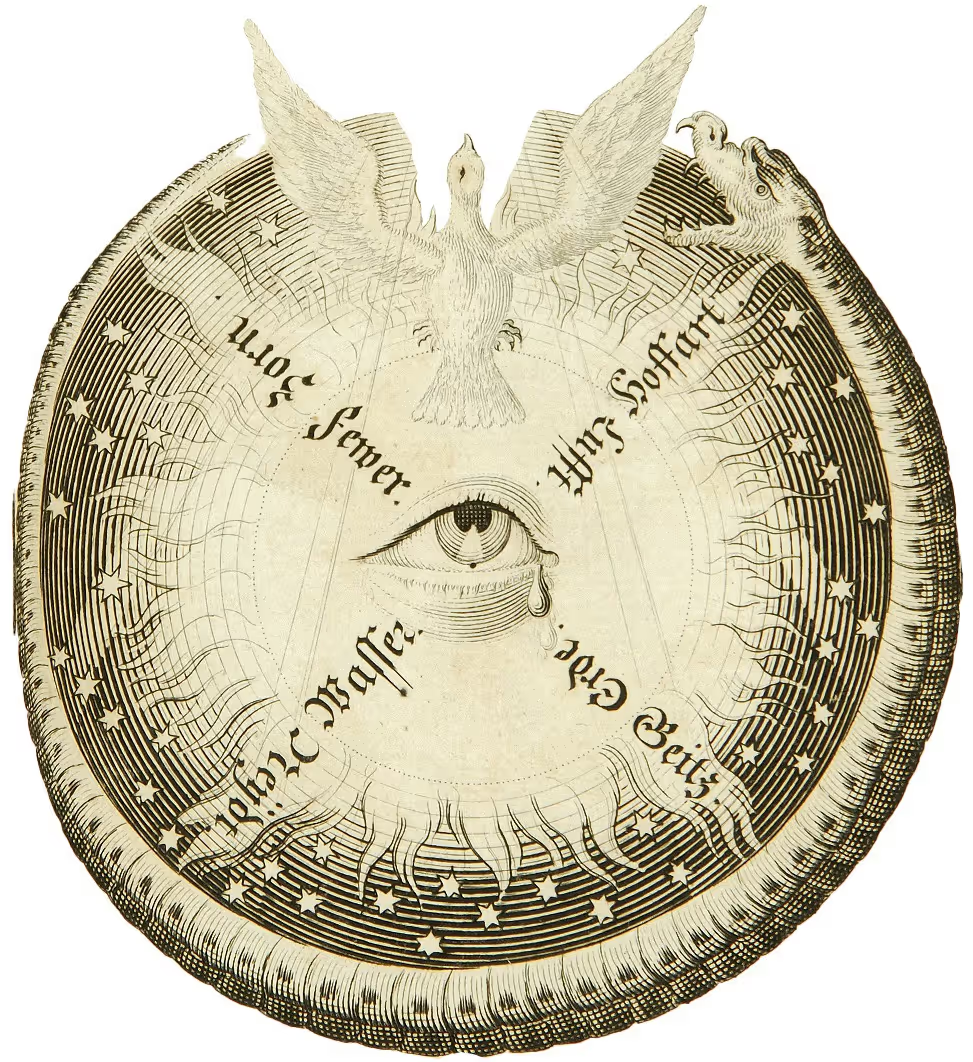
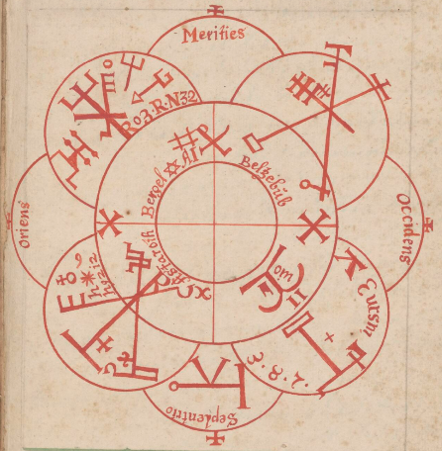
'Illustration of the Soul and the Four Elements', Johann Georg Gichtel, 1736.

The Famous Engravings Accompanying Böhme's Works, which were (not) appreciated by everyone
'Illustration of the Soul and the Four Elements', Johann Georg Gichtel, 1736.

The Famous Engravings Accompanying Böhme's Works, which were (not) appreciated by everyone
By
José Bouman
December 15, 2025
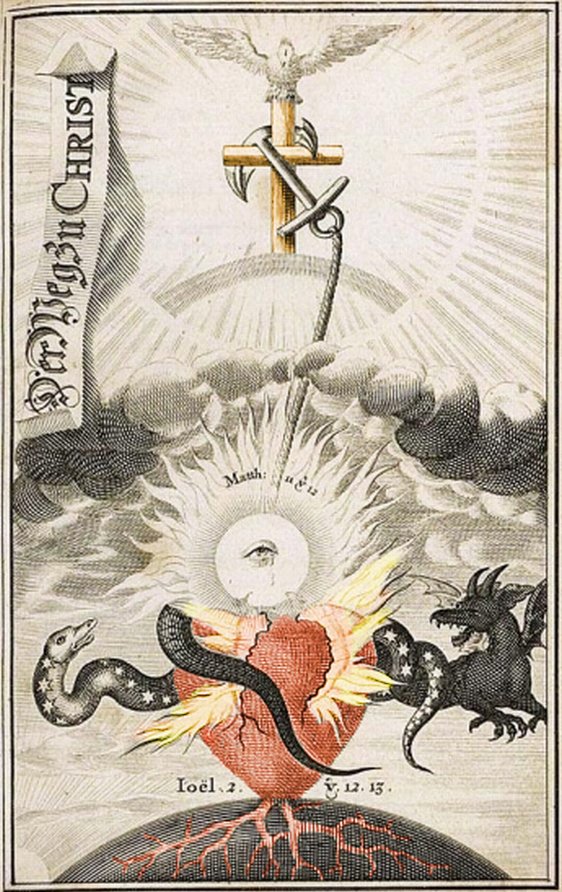
In 1682, the collected works of Jacob Böhme (1575-1624) were published for the first time in German, but printed in Amsterdam. They were accompanied by 22 engravings, which symbolically refer to the content of Böhme's treatises.
The driving force behind this publication was Johann Georg Gichtel, an ardent supporter of Böhme's ideas, who lived in exile in Amsterdam. He signed a contract with the printer Lucas Bijsterus and also financed a printing press and the typeface with which Bijsterus set to work. Shortly afterwards, Bijsterus sold his printing business to his brother-in-law David van Hoogenhuijsen, who, together with his father Andries, continued to typeset Böhme's works. Once again, we find Gichtel's signature on the contract with the new printers. These names are not mentioned anywhere in the thirteen volumes that make up the collected works, nor are those of the engraver of the prints. Historians and art historians have speculated a great deal about the latter name in particular, because the prints are very artistic and also demonstrate an insight into the content of Böhme's ideas.
The solution to the mystery turned out to be literally close to home: in a manuscript that is part of the BPH collection. It is a diary of a certain Johann Heinrich Potthoff, who came to Leiden in 1730 to meet with Johan Willem Überfeld, who had been part of Gichtel's circle since 1685. He wanted to discuss a new edition of Böhme's works with him. Researcher Frank van Lamoen came across a passage in this manuscript, a copy of the diary from the late 18th century, in which Überfeld reveals the name: it was Michael Andreae (c. 1628-1720), a German, ‘a learned alchemist’ as he calls him, and a gifted calligrapher and engraver. He too, belonged to the circle of Böhme followers in the Netherlands, with Gichtel at its center. But over time, Gichtel's opinion of him became less positive: he did not have enough inner knowledge. Moreover, he had also led others astray, such as Allard de Raadt, to whom he promised the philosopher's stone, according to Überfeld.


Andreae had fallen out of favor since 1685, and in 1730 the editors decided not to include his prints in the new edition because they were too much a product of Andrea's own imagination. The edition appeared without the prints. The editors explained that it would only cost extra money, serve no purpose, and give no pleasure, and that the prints could also be harmful to untrained and weak minds. Then something remarkable happened: a year later, in 1731, a separate volume was published with the prints and accompanying explanations written by Andreae. The foreword included a clear warning that they were “nicht von dem Autoris Geist” (not from the author's mind). The buyers of the new edition had apparently reacted with great disappointment: no plates! It seems very plausible to assume that the decision to publish them separately was taken after Überfeld's death on July 19, 1731.
But there is more to these prints than meets the eye: in the 1730 edition, they are numbered in the upper margin of the print; those in the 1682 edition do not have this. It was not uncommon for something to be added or changed on copper plates that were printed a second time. This is technically possible. But on closer inspection, many more minor differences can be discovered. The shading is less fine and sometimes there is even a variation in spelling (banderole of the Sendbriefe: ‘ff’ instead of a single ‘f’). The conclusion is: the prints have been recut! A very careful copy was made. This is very strange because in 1730 Überfeld had access to the entire collection of autographs and copies of Böhme's works as compiled by van Beijerland, which was later purchased by Willem Gozewijn Huygens, and those plates were part of it. Huygens made an inventory of them in 1693: “The copper plates are also placed in the chest, under the Auroras.” In 1730, they are no longer there: I am inclined to suspect Überfeld of simply destroying them because of his great resistance to the maker Andreae, whose name must henceforth be associated with these beautiful prints.


Written by
José Bouman
Drs José Bouman has been head curator of the Bibliotheca Philosophica Hermetica since 1983. She has shaped every museum exhibition since and specialises in Dutch medieval literature.

.avif)