

.svg)
.svg)
The Hidden Treasury of Divine Spirit: Chymica Vannus (1666), A Marvelous Amsterdam Alchemical Print
By
Corey D. Andrews
May 15, 2026
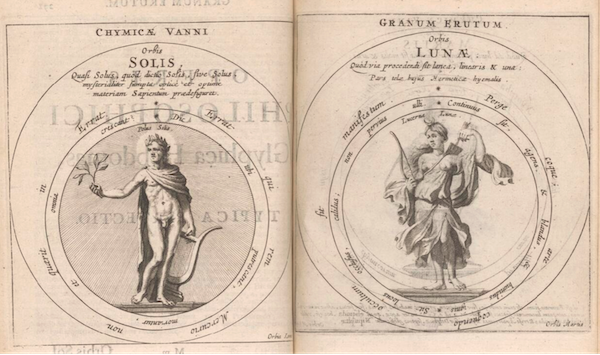
A 1666 Chymica Vannus spread showing alchemical engravings of the Sun (Apollo) and Moon (Diana).

The Hidden Treasury of Divine Spirit: Chymica Vannus (1666), A Marvelous Amsterdam Alchemical Print
A 1666 Chymica Vannus spread showing alchemical engravings of the Sun (Apollo) and Moon (Diana).

The Hidden Treasury of Divine Spirit: Chymica Vannus (1666), A Marvelous Amsterdam Alchemical Print
By
Corey D. Andrews
May 15, 2026
Perhaps the ultimate privilege of my job here at the Bibliotheca Philosophica Hermetica collection involves providing old book tours to our visitors – many of which come from all over the world specifically for the experience. Thus, we always try to make this experience worth the trip!
Among the 30 or so titles which our visitors are always pleased to encounter include such works as Robert Fludd’s magnum opus, the Utriusque Cosmi Historia (1617) filled with magnificent engravings, or the classic alchemical compendium Musaeum Hermeticum (1625/1677), or the Twelve Keys of Basil Valentine (1599), Michael Maier’s Atalanta Fugiens (1618), Heinrich Khunrath’s Amphitheatre of Eternal Wisdom (1595), works by Paracelsus, Comenius, Jakob Böhme, the Rosicrucians, and the list goes on… All fantastic titles, filled with enigmatic symbols, engravings, and ideas.
One title which I often love to show is not as well-known as many of these others, has some wonderful engravings which we will look at, and by all appearances, does not seem to have been researched much at all. After scouring the University of Amsterdam’s online catalogue, which connects to a vast international academic repository of articles, books, reviews, etc (i.e., the enormous ‘walled garden’ of knowledge which one must have academic login credentials to access), there are several links to digitized copies of the book, but no secondary literature about it whatsoever!
This magnificent book – like many of the books in this collection, to be honest - has puzzled me for quite some time. It belongs to our alchemical collection area, was printed in Amsterdam (go figure) in 1666, and although it is anonymously authored, its printing was evidently paid for by ‘Joannem Janssonium à Waesberge and Elizeum Weyerstraet.’
While I was not able to find much discussion of the work, I did find a helpful blog post which devoted some learned conversation of it. In the short article titled ‘Chymica Vannus, or a Mortal’s Ambition: Investigating a Title’ by Iulia Millesima, they observed the work has ‘Always [been] defined as a strange book.’ While Millesima’s piece does not discuss the symbolism of the engravings, it does lucidly trace some of its historiographical and bibliographical provenance.
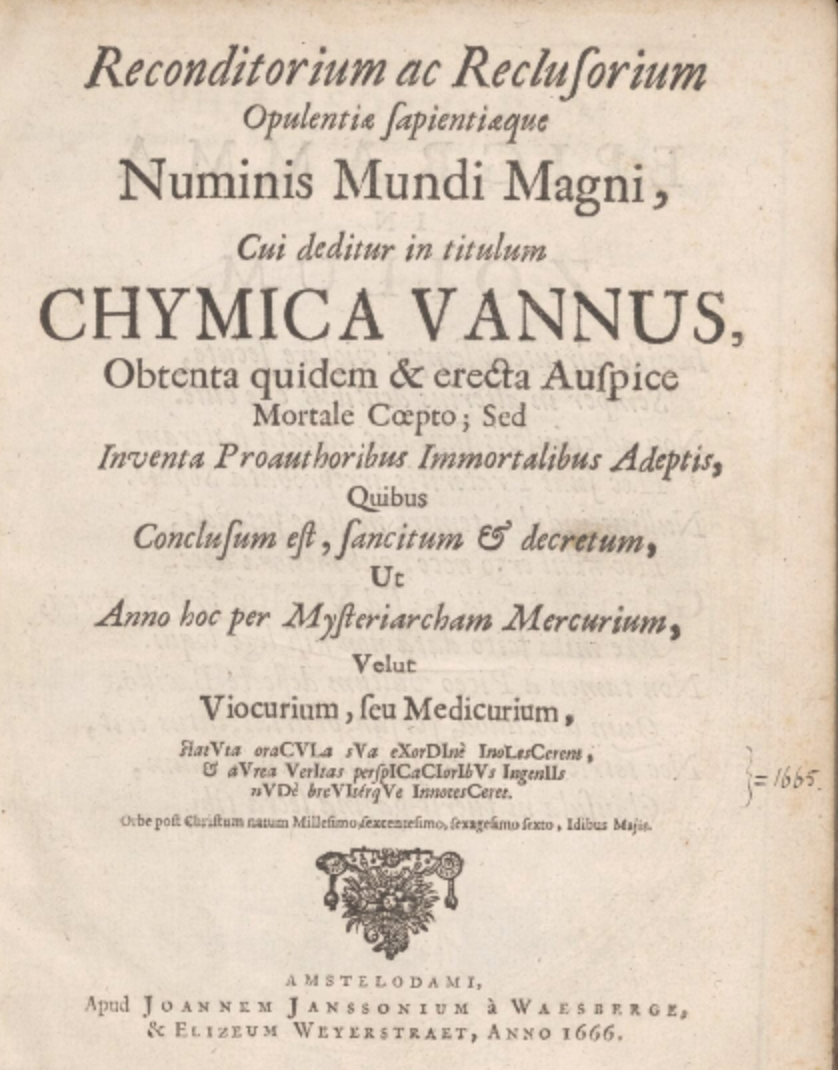
The full title of the book can be rendered in English as follows:
The Hidden Repository and Secluded Treasury of the Riches and Wisdom of the Divine Spirit of the Great World, entitled The Chemical Winnowing Fan. This work was begun as a mortal endeavor, yet it was truly revealed by the immortal Adepts. They have concluded, ordained, and decreed that in this present year, through Mercurius — the Master of Mysteries, Guide of the Way (Viocurius), and Healer (Medicurius).
As you can see, towards the bottom of the title page there are a series of words with seemingly random capital letters strewn throughout – the commenter agrees with our own view regarding them, namely ‘The […] capitals are out of my comprehension’. I cannot understand the reason for the random capitals, but that part of the text is the final line of the work’s full title and translates as follows:
‘their appointed oracles shall unfold in proper sequence, and the golden truth shall be revealed plainly and concisely to sharp and discerning intellects.’
Concerning something which is not out of my comprehension however, are some characters encountered later in the work, namely the seven classical figures which I come across repeatedly in our collection. The sequence consists of seven planetary emblems (Sun, Moon, Mars, Mercury, etc.) that symbolically depict the stages of the alchemical process — a "week" of symbolic images leading to the perfection of the Philosopher’s Stone.
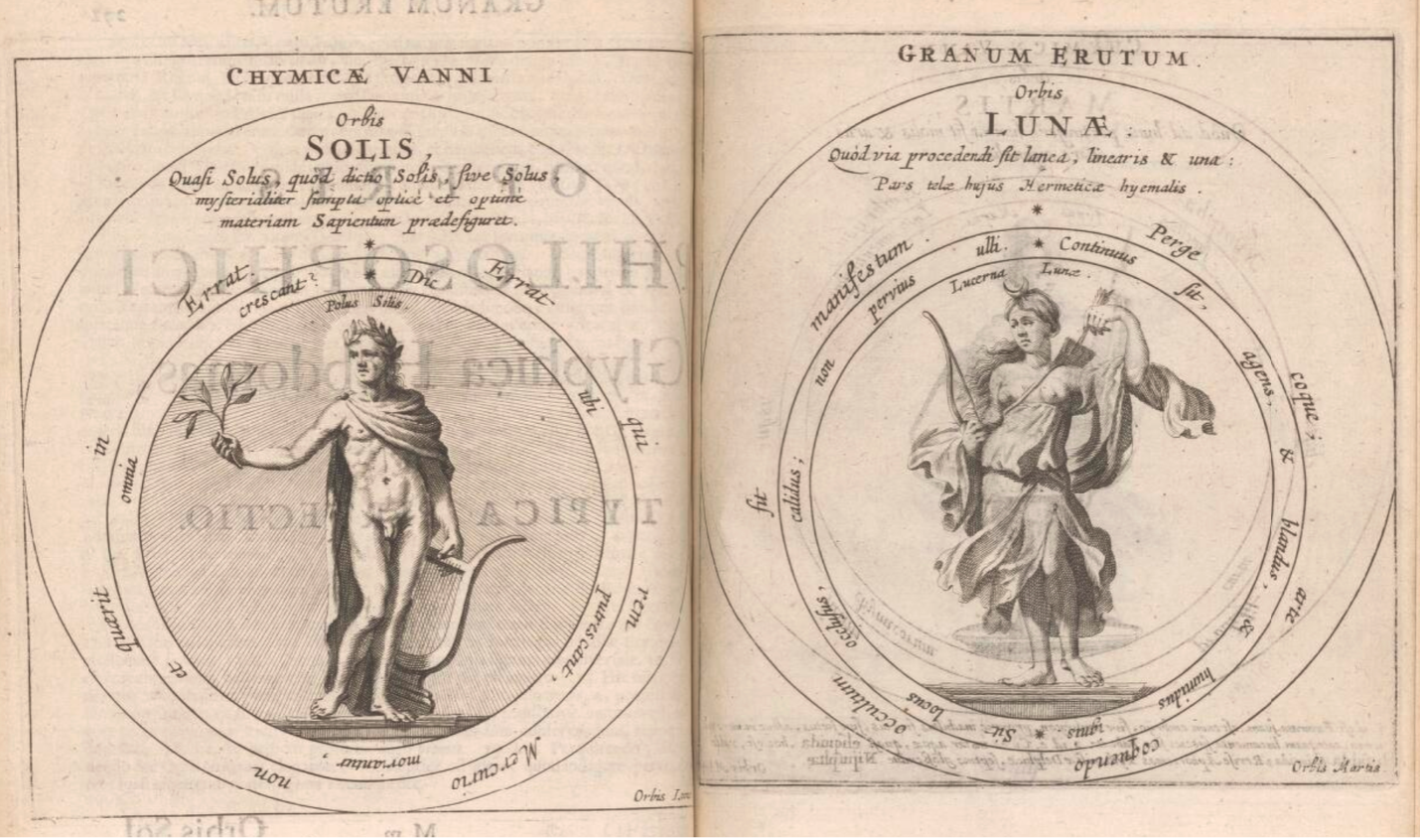
The week begins with Solis (the Sun, i.e, Sunday), the planet after which Apollo gained his solar attributes of rationality, order, harmony, music, discipline, and consciousness. His alchemical metal is – of course – gold. His companion on the next page is Luna, i.e, the moon, (Moonday; Lundi in French). Mythologically she is Diana, the sister of Apollo – her Roman identity as Artemis is known as the huntress, depicted here with her hunting bow and the crescent moon above her head; excessive influence of the moon led some to be classified as ‘lunatics’. She is also often depicted with a wolf, so keep your eye out for that in the next museum you visit! In alchemy she is associated with silver.
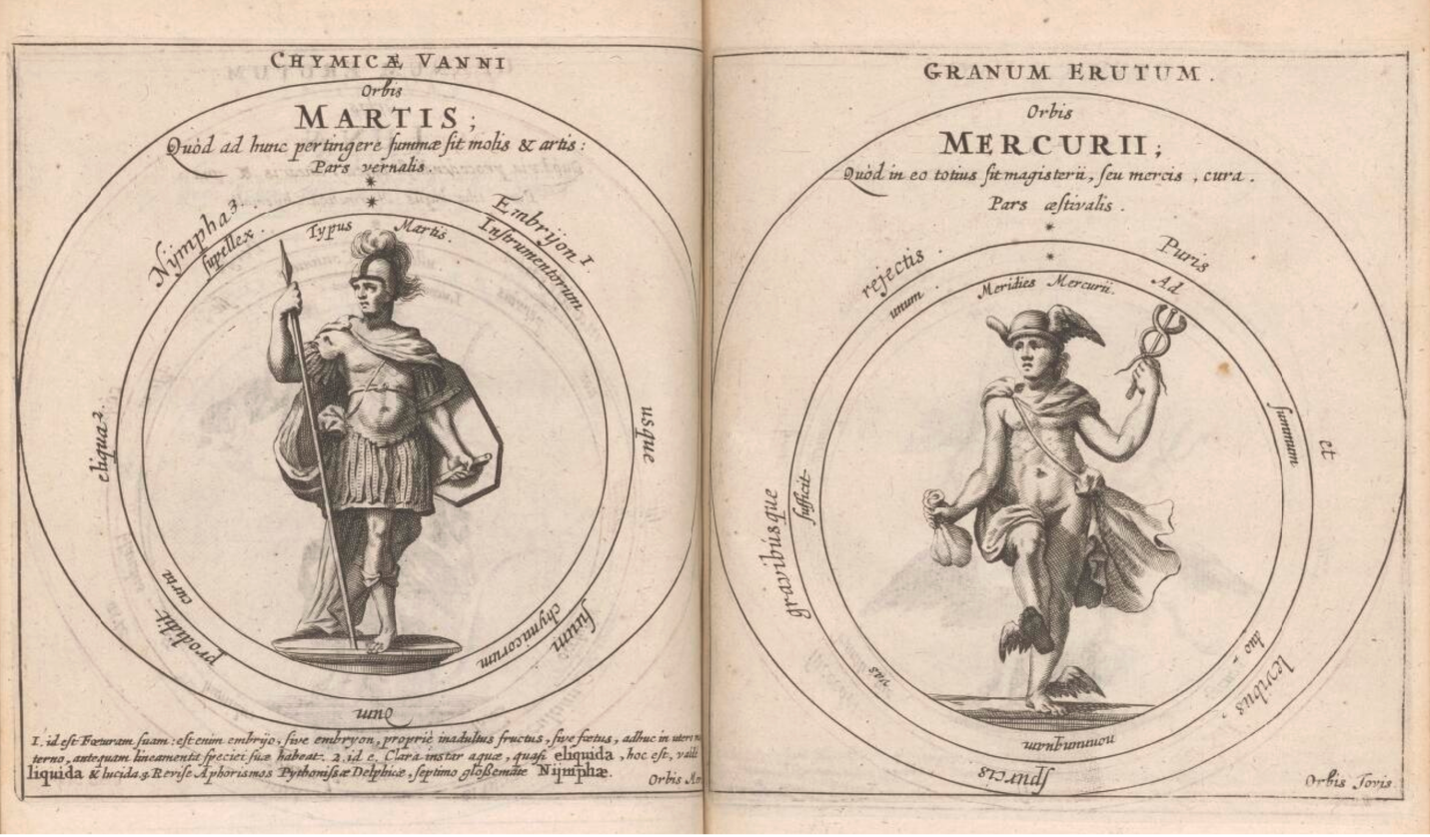
Next in the sequence we have Mars, associated with Maardi (Tuesday). For my fellow Americans, I’ll remind you that the Louisiana carnival tradition of Mardi Gras occurs on ‘Fat Tuesday’ (which the French Mardi Gras translates to…). Mars the warrior god, depicted with his spear and shield, after which it is said the symbol for Mars or Man, i.e., the circle with the arrow pointing out, is said to symbolize. He governs the ‘martial’ arts, and his metal is the one for which weapons were made for millennia, Iron. Next, we have Mercury, or the Italian ‘Mercoledì’, i.e., Wednesday. Quick witted, trickster, mercantile Mercury wields his caduceus and a money bag. Mercury the messenger is always adorned with winged feet and a winged helmet, and his alchemical metal is mercury, or ‘quick’-silver. Thieving Mercury, mythologically he is often playfully deceiving the other gods and you can often find statues of him outside of stock exchanges – he is a thief after all ;)
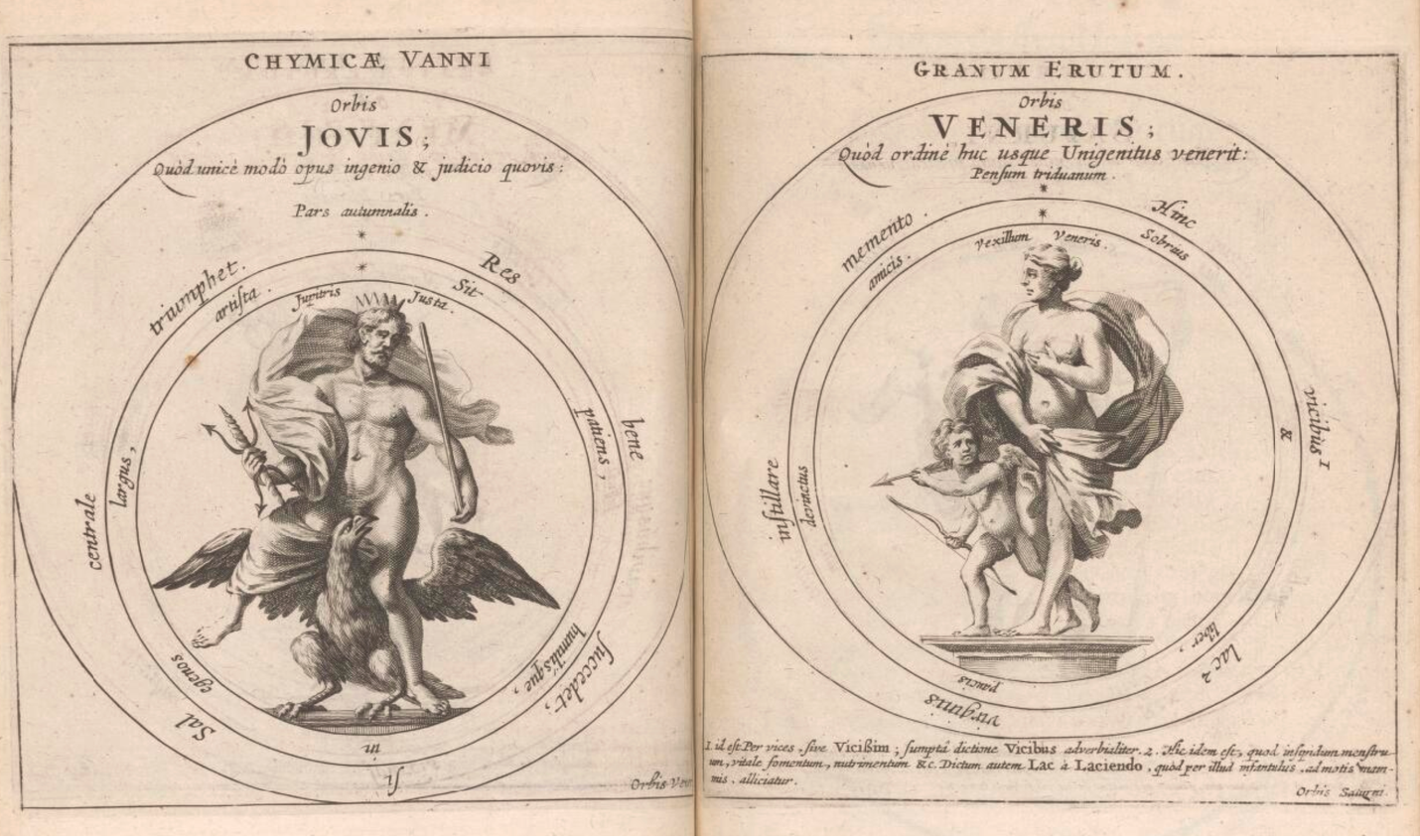
Next, we have the god who rules the sky, the archetypal sky-father who wields a lightning bolt and is always depicted with an eagle. The Roman Jupiter, after which the planet was named, known to the Greeks as Zeus. Jupiter had a Nordic equivalent as well, ‘Thor’, after which the English adopted it’s ‘Thorsday’ attribution. (In Dutch it is ‘Donderdag’, literally ‘Thunder Day’.) Alchemically his depiction is associated with the metal Tin. ‘Vendredi’ (Venus-day) follows, which is of course Friday. She is depicted alongside Cupid with his arrows of love. In other depictions (such as the series in Michelspacher’s Cabala engravings) she is shown holding a mirror, which, on one hand, represents the vanity of Venus, but also self-reflection. The symbol for Venus, or woman, the circle with the cross underneath, is said to symbolize the mirror of Venus. She is associated with the metal copper – for mirrors were made of copper for many centuries, and there are vast copper deposits in Turkey where a goddess of similar attributes was venerated.
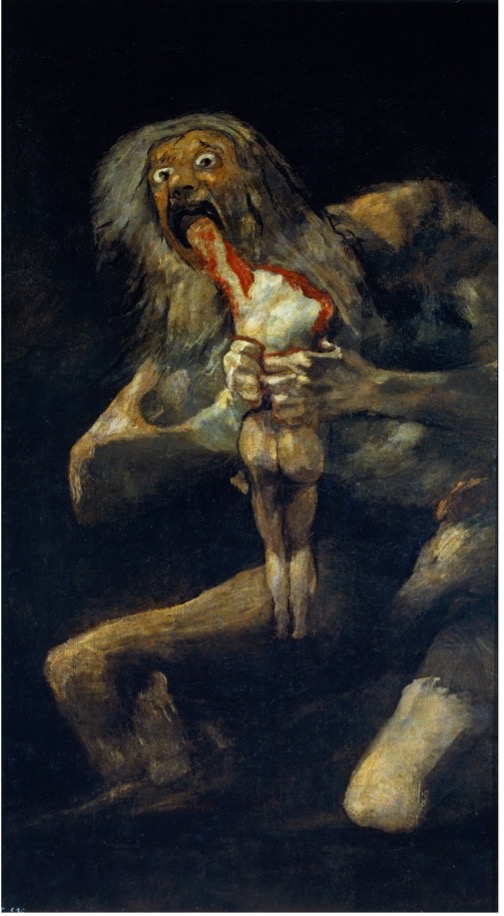
Lastly, and finally, we have Saturn. Mythologically, Saturn eats his children. The famous painting by Goya (1746-1828, painting executed 1820-1823) is a particularly brutal and terrifying example of this motif.
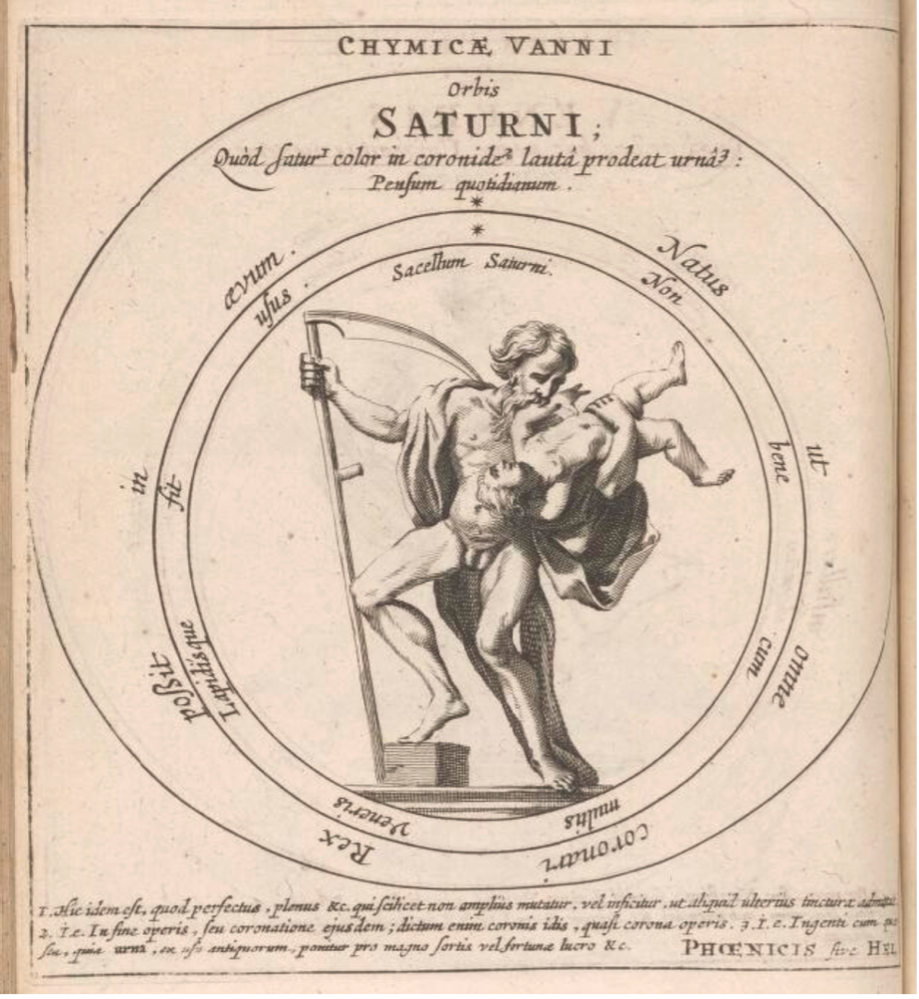
Saturn was the Roman name for the Greek god of Kronos. The myth of Kronos devouring his children derives primarily from Hesiod’s Theogony (8th–7th century BCE), which is the earliest and most important source that introduces this idea. Also however, we know that Kronos (Chronos) is the deity associated with time (i.e., chronology, chronicles, etc), and as we also know, time consumes all things. Often, in other depictions he is winged, carrying the connotation of tempus fugit (time flies). Saturn, the god of Saturn-day, was the deity honored on the Roman festival ‘Saturnalia’, a day associated with varieties of activities such as gift-giving, gambling, inversion of social norms, and other ‘indulgences’ which we still like to do on the day associated to this eternal figure.
In this version, like many others, Saturn wields a scythe, and the motif of ‘Saturn’s return’ is said by many astrologers to portend ominous occasion as he orbits back around to collect or ‘reap’ (with his scythe no doubt) the karma which he is owed every 27-30 years.
There we have it. While I still have such limited knowledge of the overall content of this enigmatic alchemical book, I do thoroughly enjoy puzzling over the engravings with some of our visitors. What is especially novel is that every single one of them – all seven - are included in the sequence. While all of this may be common knowledge to some of you, it is not often that you encounter all of the figures together in such a beautiful series, making this edition quite unique indeed. If you ever find yourself at the Embassy, give me a shout and we can be confused together!

Written by
Corey D. Andrews
Corey D. Andrews is a PhD candidate at the University of Amsterdam and a researcher working for the Ritman Research Institute. His research focuses primarily on 17th and 18th century Rosicrucianism and the life and works of Jan Amos Comenius (1592-1670).

.avif)