

.svg)
Manuale magicum doctoris Fausti: Profiling a grimoire (parts 1, 2 and 3)
By
José Vieira Leitão, PhD
June 15, 2026
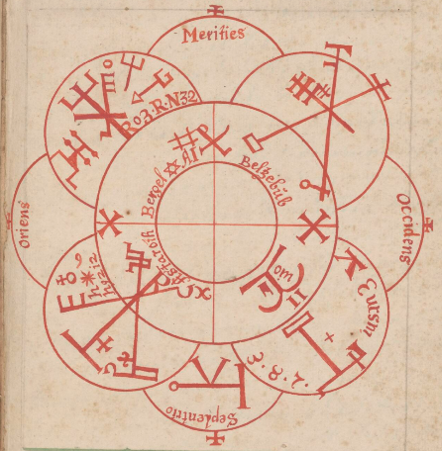
Magic circle and block script from the Faustian Magia naturalis oder ein philosophischer Discurs

Manuale magicum doctoris Fausti: Profiling a grimoire (parts 1, 2 and 3)
Magic circle and block script from the Faustian Magia naturalis oder ein philosophischer Discurs

Manuale magicum doctoris Fausti: Profiling a grimoire (parts 1, 2 and 3)
By
José Vieira Leitão, PhD
June 15, 2026
It is difficult to accurately define what a grimoire is, yet it is usually not difficult to know when you are looking at one. These are a type of magic book with a certain ‘shape’ about them. These might present lists of practices, rituals and secrets in various arrangements and are mostly tailored for clear and immediate goals. They are essentially practical and not very concerned with philosophical exposition, being largely accessible to most social groups. They are found in monasteries, universities and in secret chambers behind an illiterate farmer’s fireplace. As far as magic can be democratic, they are one of the most equalizing traditions in European magic literature.
While not as grave as it once was, dealing with grimoires is a not without challenges. These can range from practitioner idealism, personal expectations, the semi-arbitrary definitions and borders of magic (as a practice and an intellectual and literary tradition), cultural-specific academic habits, or ingrained social taboos.
The grimoire tradition, as a topic of historical and literary inquiry, has been troubled by many factors. From their early framing as detestable objects by authors such as (pseudo-)Albertus Magnus, Nicholas Eymerich or Martin Delrio, to their exclusion from the arbitrary category of ‘high magic’ by 19th century occultist. E. A. Waite’s sanctimoniousness, MacGregor Mather’s Solomonic purism or Aleister Crowley’s goetic dramas, equally contributed to the understanding of grimoires as ‘lesser than’; a decayed, dangerous, degenerate, unevolved, unrefined and low form of magic. And this without even speaking of other longue durée factors, such as institutional book censorship, the triumph of Protestant historiography and its aggressive anti-Catholic bias, or the establishment of the false equivalence between culture and formal/institutional education.
Scholars of esotericism, or magic in specific, do exist in a continuum with all these factors, and while we might strive for objectiveness, grimoires continuously challenge the very borders we set up to define our field of work. Their very delineation is troubling, as ‘grimoire’ is not even an exact category in itself, simply a convenient academic shorthand reference which is more dependent on unspoken empirical notions than any clear definition. The very word ‘grimoire’ only arises from specific French and Italian 17th century literary habits, and the overwhelming majority of books which are given this title today never claimed it nor existed in a world where it meant anything.
Furthermore, grimoires exist in a state constant flux and cultural overlapping. They are learned magic by their written nature, but appeal to the mundane preoccupations and afflictions of everyday humans, being thus akin for folk magic; they bear titles of recognized authority but constantly shed their content and rearrange and reformulate themselves in response to context and circumstance; they shape magical culture and are shaped by it. In a world of perennialist ambitions, grimoires exist as a constant dialogue between paper and voice, author and reader, priest and farmer, angel and demon, spirit and body. They thus speak of disease, hunger, fear, insecurity and sex, and for all such unremarkable matters they can as easily prescribe the medical application of an herb, a magic gesticulation, a petition to a saint, or the evocation of a demon.
It has been said that ‘grotesque’ can be defined as an excess of reality, and in this sense, grimoires are indeed grotesque. Grimoires are mirrors that reflect more reality than that which is cast upon them. A posturing high magician, gazing upon one, might find himself looking back in his flawed nakedness, his desires laid bare, unadorned of regalia or colourful robes; an analytical scholar and historian may see his definitions, borders, methods, divisions and cultural delineations either disappear into an uncaring void, or reflected back as a single undivided mass of historical problems.
2. Dramas aside, the grimoire tradition is an established field of historical inquiry, and it is an intelligible one. Its only real challenge is the acceptance that we will never know everything about it: that the discovery of a new manuscript might destroy decades of academic proposals and conjectures, that the meaning of many sigils, pentacles and barbarous words will never be known, that there is always much more which was lost than has survived.
Delineating our concerns to Europe, an initial step to understand grimoires is to lean into the ambiguity. Bypassing the eternal debate on the exact definition of ‘magic’, let us assume there is an aspect of this which we refer to as ‘learned magic’ or magic associated with the written word and requiring a certain level of education (sometimes as simple as knowing how to read and write). Learned magic is itself a category with a history, and within this one may find other subcategories, such as natural magic, image or astral magic and ceremonial magic. Grimoires can be found in any of these subcategories, but they are mostly associated with ceremonial magic, even if they do not comprise the entirety of that category.
With their ambiguities, frequent border crossings, and overlaps, within learned magic and within ceremonial magic, grimoires can also be considered to organize themselves into literary traditions, clusters or text groups. An exemple of this is Zico Jackson’s description of the Manuale magicum doctoris Fausti as part of the ‘Höllenzwang cluster’; this is a legitimate, logical and viable delineation, but merely one among many, all of which as useful or as frail as any other (see Zico’s article in the April 2026 of the Codex Hermeticus). Recognizing the difficult and ambiguous nature of grimoires implies that no definition can ever be understood as more than an academic artifice of circumstantial convenience with no essential or universal value or applicability, because there will always be a grimoire that breaks it.
In this academic shadow play, another way to distinguish grimoires groups is through authorship attribution and style. Thus, we can consider the existence of Paracelsian, Agrippan, Solomonic, Cyprianic or Faustian grimoires, among a few others. Besides their (spurious) authorship attribution, the distribution of texts along these categories can also be done by their association with a specific geographic or cultural space, textual or iconographic continuities across titles, styles of practical methodology, implicit cosmologies or addressed preoccupations.
Of the named traditions, those such as the Paracelsian and Agrippan can be seen as distinct from the remaining ones, both due to the unambiguous identification of their supposed authors or associated literary/intellectual tradition. While these do not shy from engagement with folkish ideas and preoccupations (as neither did Paracelsus or Agrippa), they are dependent on clearly early modern intellectual trends which are often absent from other grimoires.
Solomonic texts will frequently be attributed to the Biblical King Solomon, or a mysterious rabbi of this same name; these are likely the most famed and widespread texts, and they not only belong to the category of ceremonial magic but are some of the texts which frame and formalize this as a thing in itself. Solomonic texts lean heavily on Judeo-Christian cosmological notions, being largely Christian cultural products. They speak of angels, demons, spirits, and prescribe well-structured methods to summon, constrain and obtain services from these by a constant appeal to (Christian) divine authority. They tend to separate the magician from his summoned subject by the use of circles, triangles and pentacles. Still, Solomonic texts are not removed from mundane preoccupations, frequently prescribing the construction of planetary ‘pentacles’ for the acquisition of worldly benefits, or describing various methods through which one may become invisible, win at gambling, be able to see a naked woman, or other similar things.
Cyprianic texts are less widespread than the Solomonic, being mostly associated with the Iberian Peninsula and Scandinavia, where they fit into the wider category of local Black Books. These texts claim or imply authorship by Saint Cyprian of Antioch, a 4th century fictional character described as a repentant magician turned saint (one of the earliest proto-Fausts). Both strands of the Cyprianic tradition place themselves closer to folk preoccupations than the Solomonic, and at times these may resemble ‘simple’ collections of folk remedies, prayers, and small procedures. What appears to be the central structuring element among the Cyprianic texts is the ‘Prayer of Saint Cyprian’, a popular and widespread talismanic magico-religious text used as a method for the banishment of evil spirits, sorcery, and the evil eye, and which seems to function as an ‘aggregation point’ for other texts and magical procedures in the early modern period. While their texts tend to vary considerably, early modern Cyprianic books frequently tackle the same preoccupations, such as illness, prosperity or banishment of evil influences. Such books are also heavily associated with treasure hunting, particularly from the 18th century onward. Magic circles and complex spirit summoning procedures tend to be rare in Cyprianic books.
The Faustian texts are mostly associated with Germanic territories, being attributed to Johanes Faust. In their magical prescriptions, these are more akin to the Solomonic books and, as once again underlined by Zico Jackson, are likely heavily influenced by Solomonic methods. Thus, they advise the construction of talismans and the consecration of protective magical gear for the summoning of spirits using circles and pentacles. However, the spirits these tend to lean on fall much further away from a strict Judeo-Christian cosmology and their classification is often difficult and related to Germanic folklore, although these are more often identifiable as ‘evil spirits’.
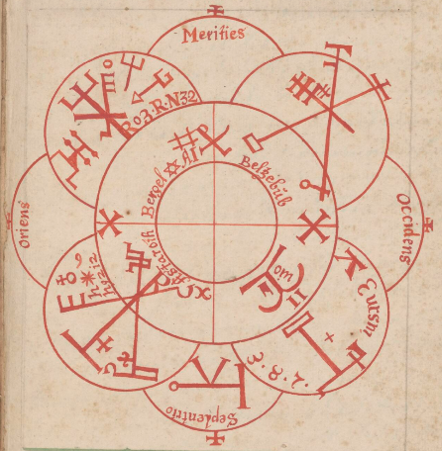
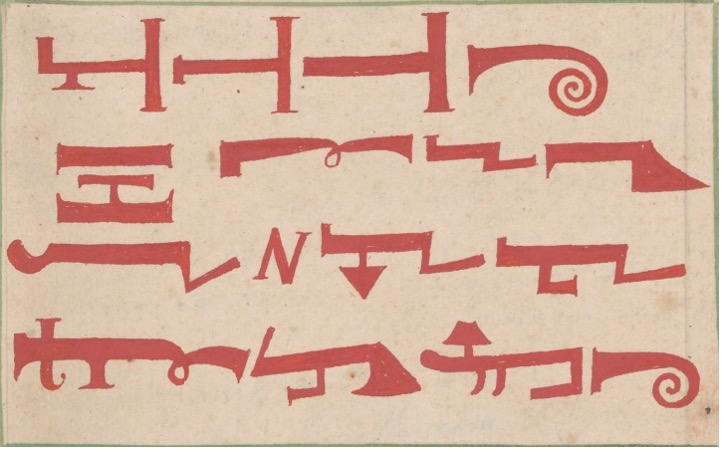
Furthermore, their symbolic language and pictorial aesthetics is distinct from the Solomonic. While Solomonic circles and pentacles are largely regularly geometric, with the occasional use of divine names in Hebrew or Latin script, Faustian magic symbols are frequently draw in thick bold lines, sometimes in square shapes; other smaller magic symbols can be drawn in fine complex shapes challenging geometric conventions. Such symbols can be found isolated but also arranged and overlaid in large and complex compositions. All of these representations can be seen to frequently include mixed letters and symbols, with frequent mimicries of Hebrew script.
Once again, all of these literary traditions should be understood as loose and porous in their borders. Some books which might be classified as grimoires might not fit any of these categories; books attributed to Faust or Cyprian may be found outside of their geographic and cultural turf, such as the English Clavis Inferni sive Magia Alba et Nigra Approbata Metratona by M: L: Cypriani (Wellcome Collection MS 2000); some early modern Solomonic literature can be seen to incorporate Agrippan magical characters or Paracelsian notions of elemental spirits in its summoning; Scandinavian Black Books can equally claim Faustian authorship; from the 18th century onward, the Iberian Cyprianic will frequently forgo their more traditional local magic methodologies and incorporate Solomonic techniques for treasure hunting, such as with the Cypriani Magici Septem Horae Magicae (Portuguese National Library, Mss. 174, n. 155); books belonging to the Faustian tradition will, with relative ease, claim Solomonic or Cyprianic authorship, such as with the Heptameron des Ludowici Zypriani (University of Pennsylvania, Ms. Codex 1679), or even be constructed from an overlap of multiple traditions, such as Solomonic or Paracelsian, as happens with the Magia vera sacra sacratissima (BPH M243).
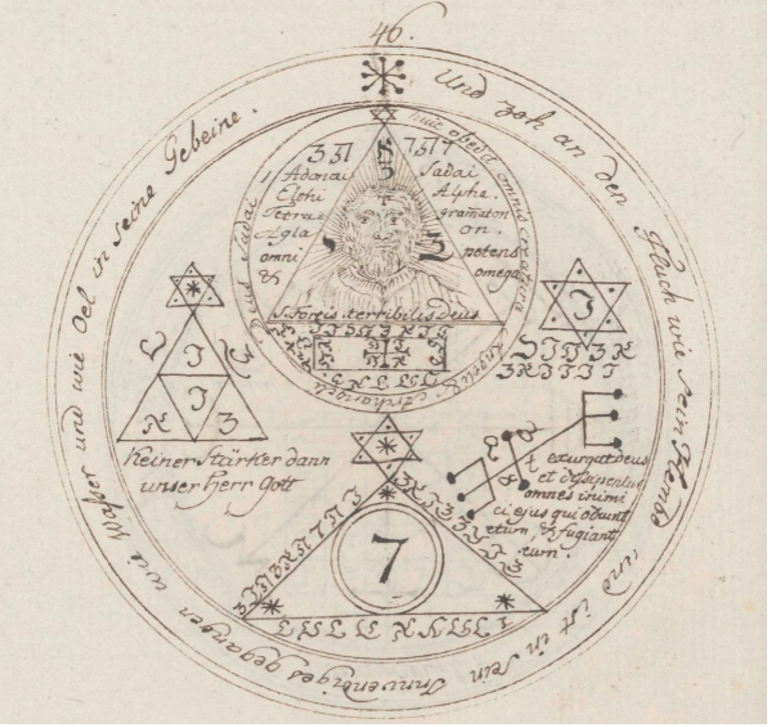
All such permutations need to be understood in a specific light. Notions of textual purity or decay in magic or esoteric manuscripts are not universal, and these will only come to dominate esoteric discourse from the 19th century onwards amidst romanticist obsessions with essential identities and ancient idealisms. The reality of medieval and early modern magic, and magic literature in particular, is that of modularity. This means that the construction of new books by a process of mixing and matching sections from several texts is not really an event of contamination or decay, but rather the normal process by which these books propagate themselves through history. Authors could compile material from several sources in order to construct a ritual for a purpose not prescribed in any book; they could switch tool consecration methods depending on their available resources; they could change spirit names and sigils based on their personal preference; or, if all else failed, an author could rely on their own understanding of magic to create entirely original rituals.
Each grimoire is unique and, importantly, each is a complete thing in itself, for they were written by their authors as such. But each grimoire is also a kaleidoscopic tunnel of shattered stained glass; the result of multiple and asymmetric Venn diagrams, idiosyncratic local notions on the nature of world and the forces believed to inhabit it, unexpressed cultural habits and assumptions and local stories and histories of magic heroes. Every paragraph, pentacle or sigil can, with equal probability, imply centuries of history, or a momentary and meaningless creative impulse by an anonymous author; we may gleam their influences, the lines and trends they fit into, the preoccupations they are responding to, the historical context of their production, but the complete and full understanding of any such text is most often a feat beyond the capacity of historical and academic enquiry. The darkness of lost history is unforgiving, and grimoires can be both a collection of guiding lights into the historical delineation of the very notion of magic, or the echoes of the trickster’s voice leading us deeper into the forest.
The Manuale magicum doctoris Fausti, as its title suggests, can be fitted into what we are here calling the Faustian tradition, yet this is not its entire story. Without delving into its text for now, an analysis of its external structure reveals that, besides being made up of two distinct parts, the Manuale also contains an index. Such would not be cause for interest should this index actually refer to the book in question, which, in effect, it does not.
In very clear terms, the Manuale’s index refers to a text entitled Claviculae Aureae Salomonis regis, tam libri primi, quam libri secundi, et manualis doctoris Fausti. Analysing this further also reveals the content of the Manuale’s first part does indeed feature in this index, but only as a small section of what appears to be a much larger work, with the second part of the not featuring in the index at all.
While fleeting, it is possible to find references to a text entitled Claviculae Aureae Salomonis regis, tam libri primi, quam libri secundi, et manualis doctoris Fausti as being present in a library of the Bentheim-Steinfurt house, as mentioned by the Dutch Germanist Johan Hendrik Gallée in the late 19th century. In light of this, it could be fair to consider the Manuale a fragmented book, meaning, a piece taken from a larger work of mixed Solomonic/Faustian nature, which had been copied and bound together with another text with no apparent relation to this ‘parent’ text. However, refocussing our sights on the Manuale, this does not appear to be incomplete, each section seems to flow into the next rather logically, there are no blank or missing pages, and the handwriting is consistent and coherent across its entirety. Thus, in all likeliness, what we have here is not a fragmented text: it is what its author intended to produce. To judge this book in relation to its supposed ‘parent’ text is an error, as this appears to be a purposeful and deliberate arrangements of material.
The Manuale is most often written in the first person, as in the words of Faust himself. This is not actually an uncommon occurrence, be it in Solomonic or Cyprianic texts (sorry Zico…), serving apparent ‘narrative’ purposes somewhere between an appeal to authority or a long form historiola. Within this ‘narrative’ structure, the text is largely straight forward, even if occasionally debatable in terms of organization. Following its step-by-step instructions, it opens with a blessing meant for the ‘great Faustian squares and sacred pentacles’ (which are discussed further down). This is as rather formal prayer, including instances of call and response between a director and an audience, indicating this is meant to be performed by a priest and as part of a mass-like group activity. Overall, the tone and content seem Catholic, with mentions to saints and divine names (some of which common to Solomonic literature). Following this, the text offers a set of instructions for various preliminary ritual implements and procedures, such as the preparation of virgin parchment, purification washes and sacred vestments, with particular relevance being given to a belt/girdle, a sword and a ring. All of these seem to be once again performed in the context of a Catholic mass and using a consecrated altar.
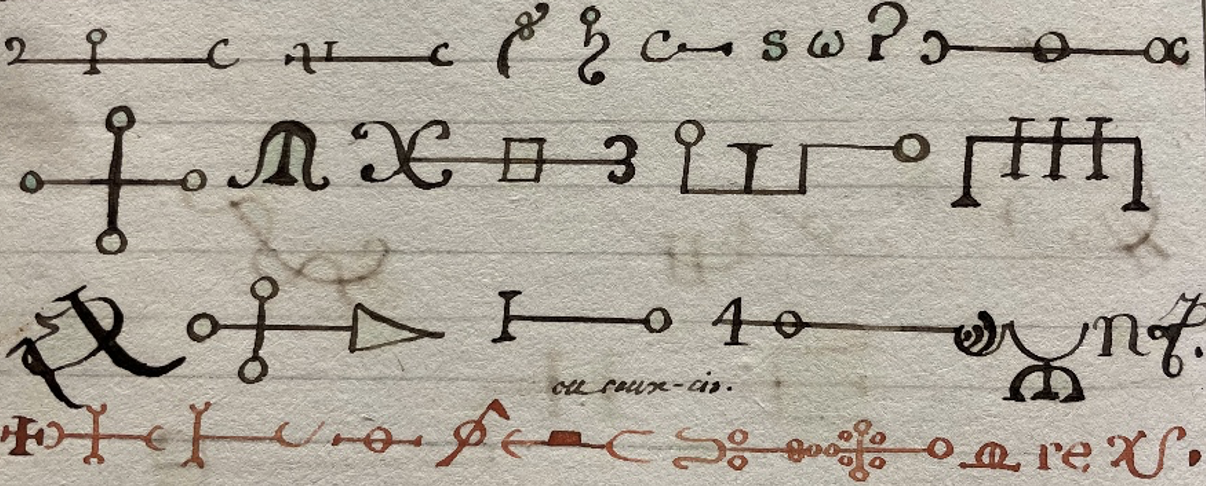
A conjuration meant to be recited inside a magic circle is then presented. This conjuration can be noted as less ‘liturgical’ than the previous prayer, being a rather direct and aggressive banishment. Further offered are what is described as ‘five Chaldean conjurations’, meant to be used should the original conjuration fail. This ‘Chaldean’ section is presented as five lines of mixed symbolic script very much in the Faustian manner.
The next section of the Manuale describes the creation of several magic tools, such as the above-mentioned ring and belt/girdle. The first of these should be made by a mixture of seven metals, each corresponding to a planet, each prepared and purified on the day and hour of that planet. The girdle is put together from the prepared virgin parchment cut into strips, glued as a single strip and inscribed with various symbols and letters.
Following such preparatory instructions the next few pages of the Manuale are largely pictorial. The first of these present the design for a magic circle and a holy square meant to be used as magic protection, both of which seem to be a call back to the opening of the text. The circle, while containing several distinct elements, should be underlined as being somewhat common among known Faustian texts, with variations of this also being present in the mixed Solomonic/Faustian Clavicula Salomonis, sive obedientia angelorum and the Le grand commandeur ou Les secrets des secrets autrement La clavicule de Salomon ou Le veritable grimoire, a complex mixed Solomonic 18th century French text (former BPH call numbers M117 and M244 respectively). Another more heterogeneous version of this same circle can also be found in the Zecor. Beni sive Clavicola Salomonis regis ex hebraica veritate latinitati donata sacris pentaculis insignita suoque candori restituta opera (former BPH call number M175).
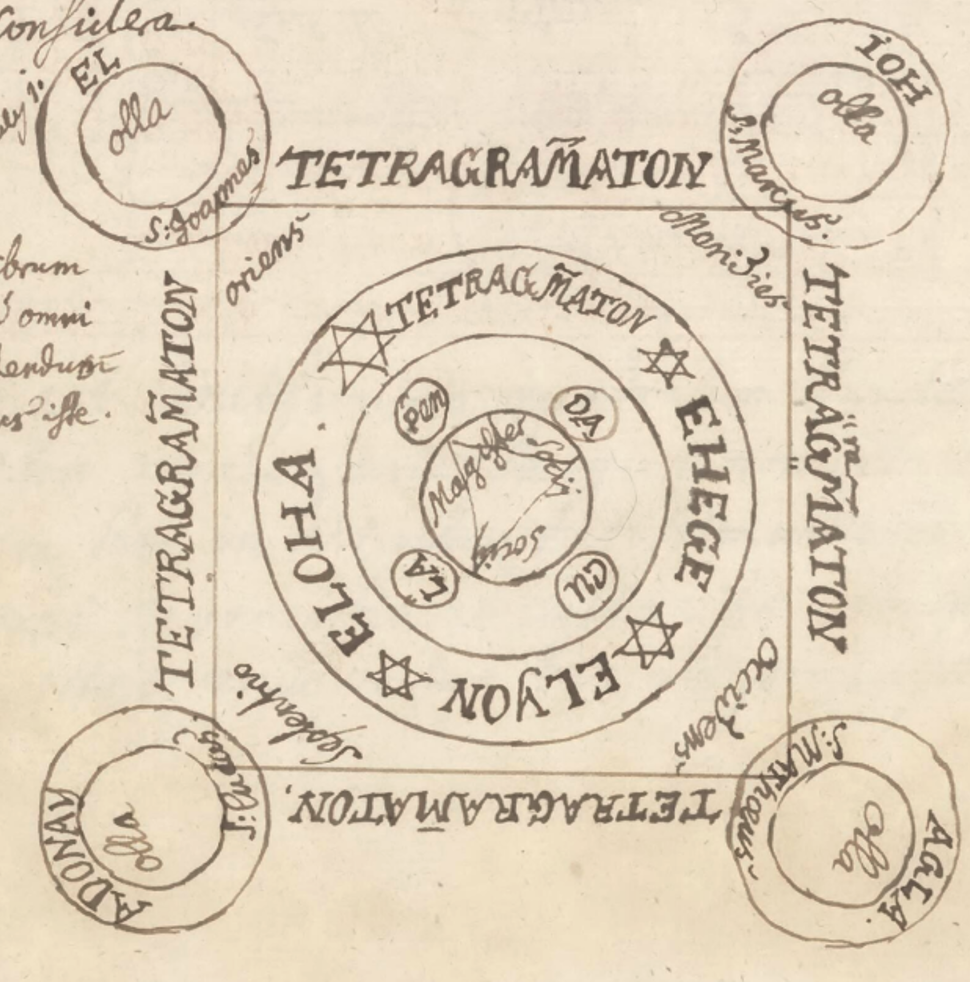
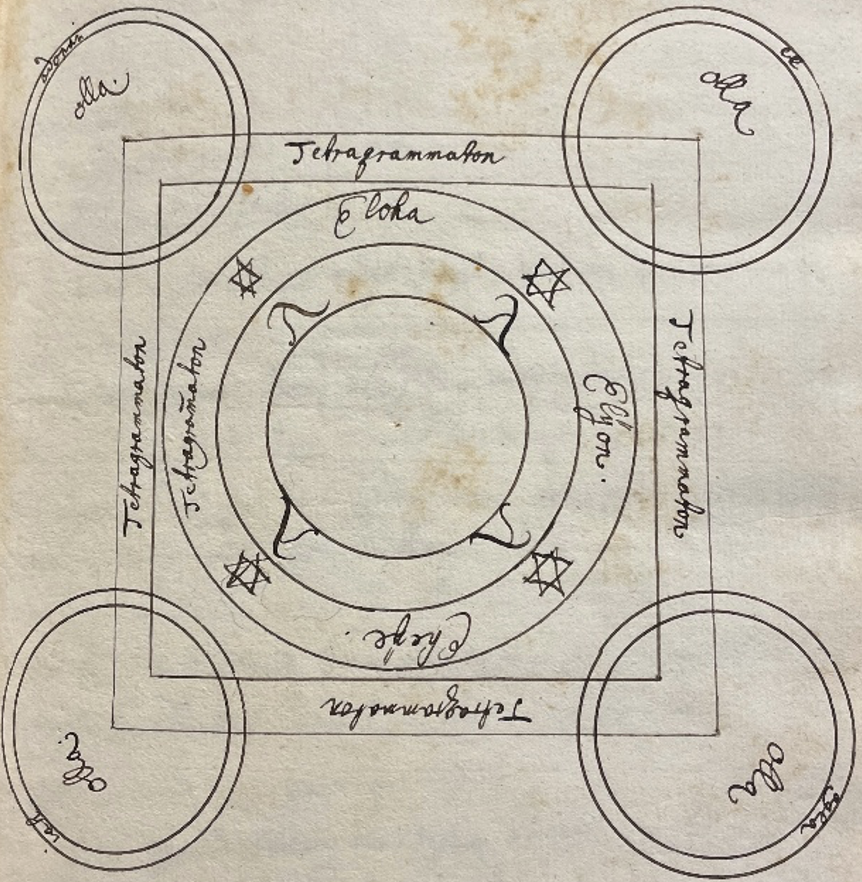
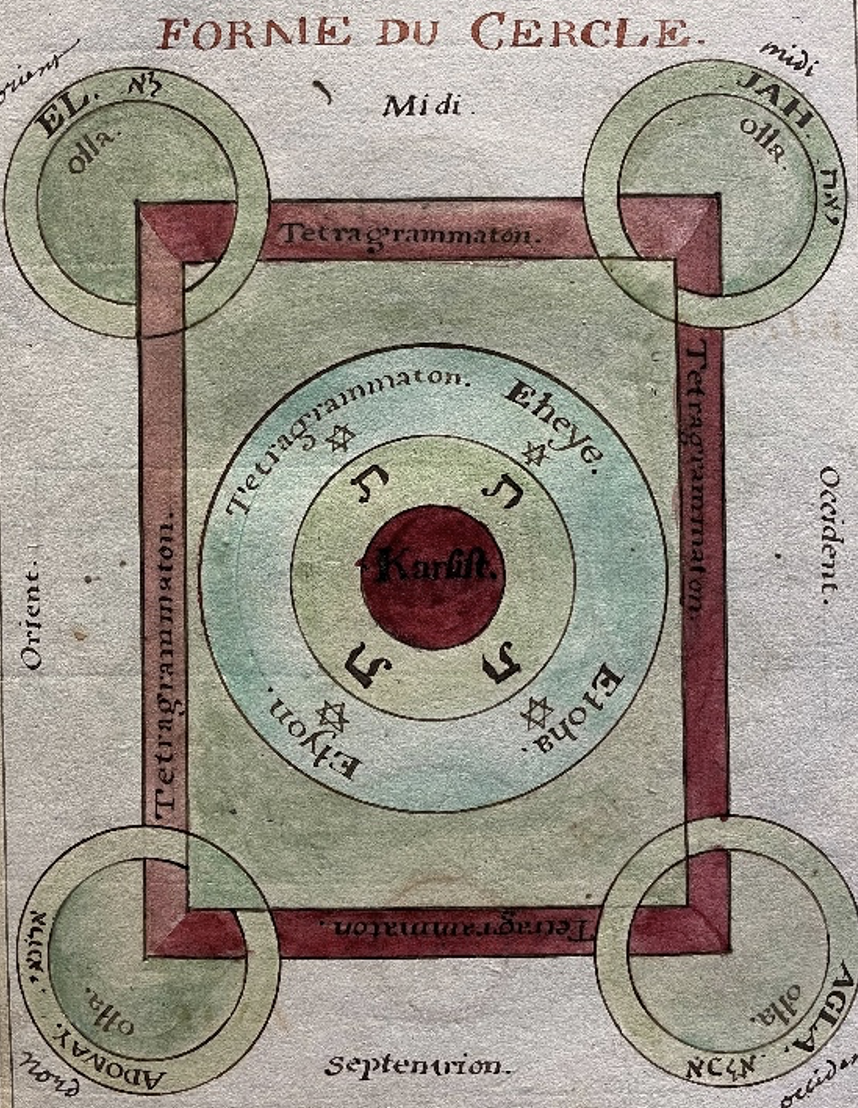
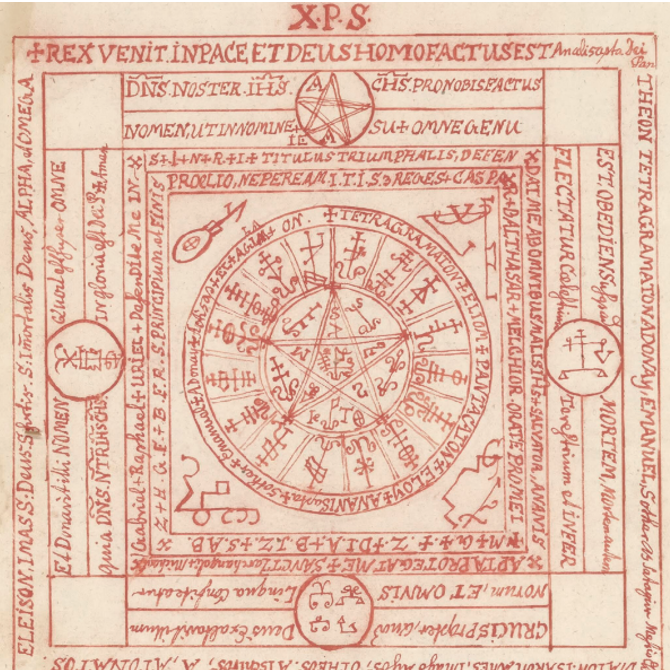
A similar situation happens with the holy square, with a version of this also being present in the already mentioned Magia vera as part of an altar set-up. The Magia vera and the Manuale squares are mostly similar, apart from a few wording differences and apparent errors in textual layout in the Manuale’s version. Apart from this, the most noticeable difference between these two squares are the missing illustrations of the four ‘living creatures’ representing the four Evangelists in the Manuale’s version.
Besides this similarity in the Manuale and the Magia vera, as also pointed out by Zico Jackson, the central circle of these two squares can equally be found in the mixed Faustian text Magia naturalis oder ein philosophischer Discurs (M080) as the face of an electrum (a natural alloy of gold and silver) pendant, indicating a somewhat coherent use with that prescribed in the Manuale. Of significant difference between the Magia naturalis circle and those present of the Magia vera and the Manuale are the number of sigils this circle contains, with the Magia vera and the Manuale counting 16 and the Magia naturalis 18.
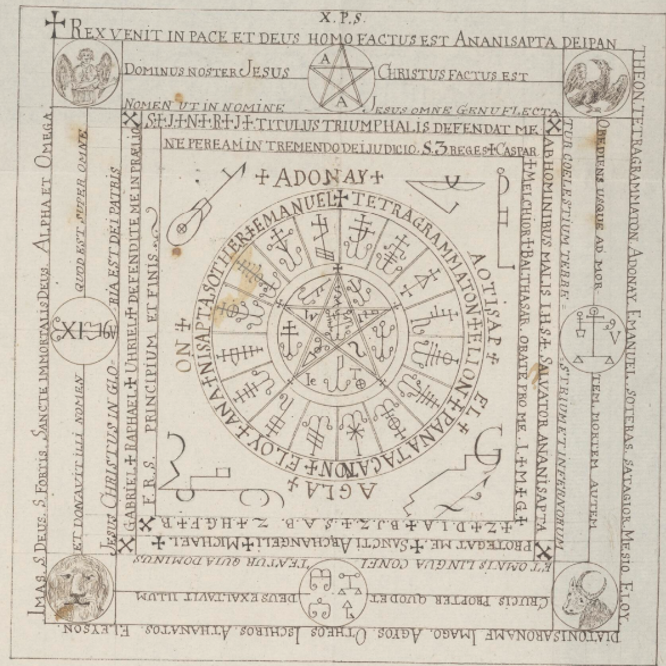
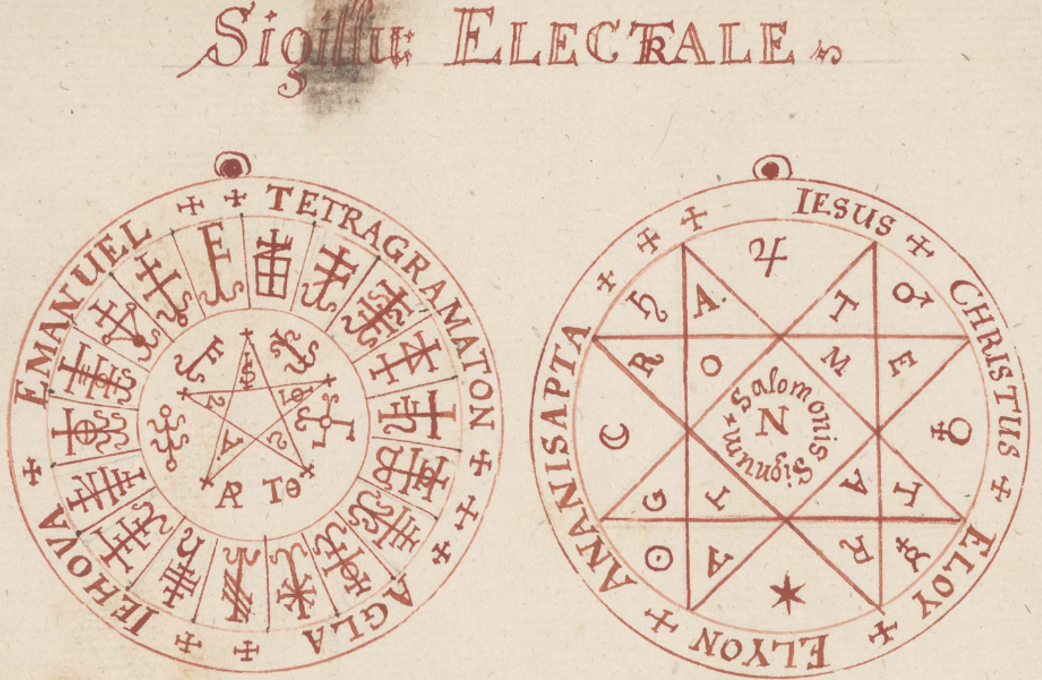
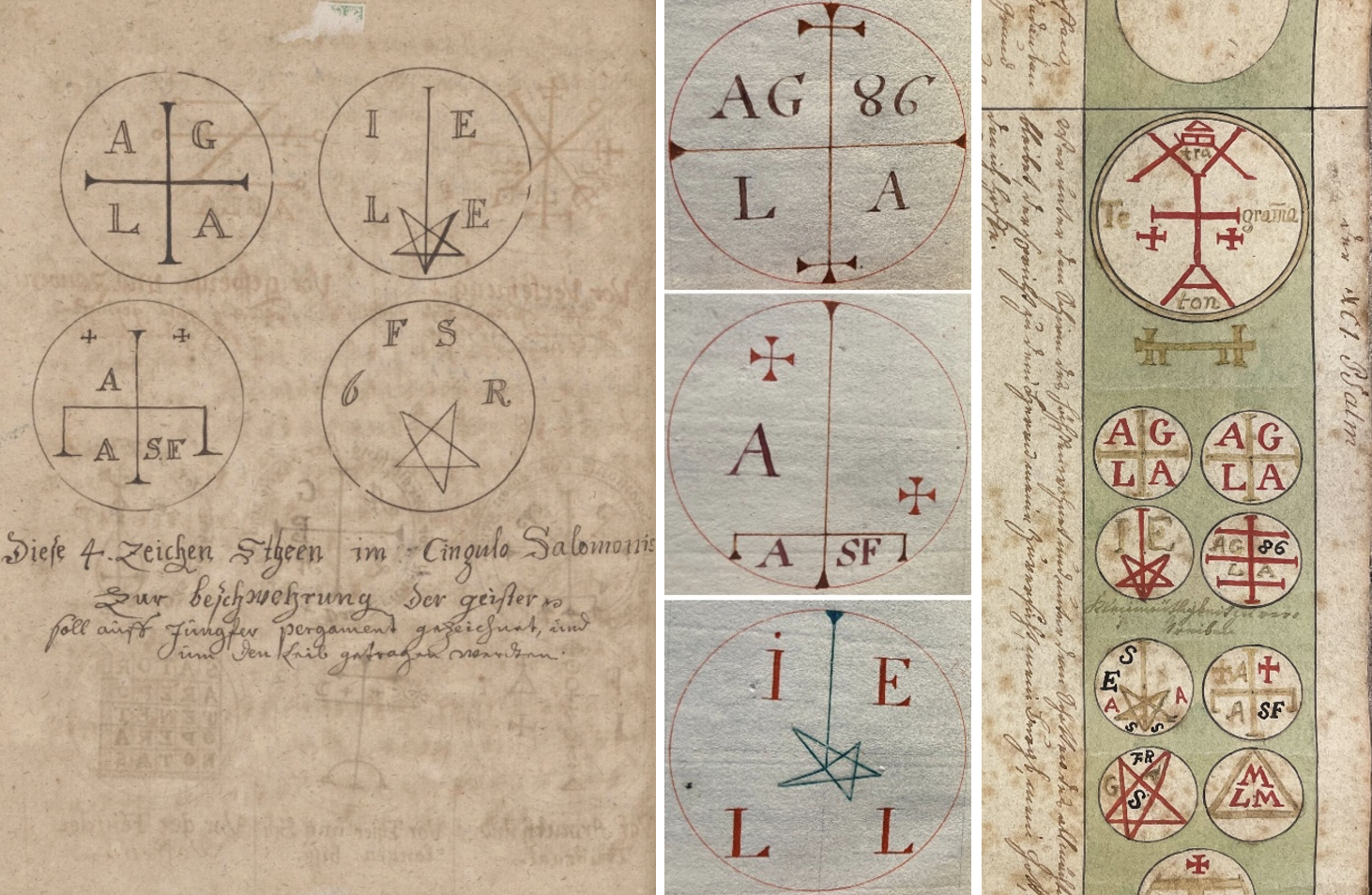
Following the sacred square, the Manuale presents another apparent magic circle of no immediately clear purpose. This additional circle contains common elements with the first, making it most likely a guiding schematic of the ritual space layout to be used in the following sections. Before returning to the text, the Manuale offers three similar representations of the magic girdle, or the lengthy string of characters and sigils to be drawn on it and its overall dimensions.
This combination of ring and girdle as standard protection tools should be noted as recurrent in other Germanic magic texts, such as the Wahrhaffte Zubereitung des so genandten Cinguli Salomonis oder Salomonischen Schlange nebst darzu gehörigen Sigillen und Ringen (Leipzig University Cod.mag.133). Furthermore, such magic girdles can also be considered to organize themselves along several iconographic traditions. Of relevance among these are the texts usually referred to as Vinculum Salomonis which, while possessing various common points with those described in the Manuale and the Wahrhaffte Zubereitung, present distinct and easily identifiable visual characteristics.
After these instructions, the Manuale describes the creation of a set of crowns; one for the ‘master’ and others for the ‘disciples’. Once again, such types of magical crowns are not uncommon in the Faustian tradition, as these can also be found in the Nigromantisches Kunst-Buch, and a crown description very similar to the Manuale’s can equally be found in Le grand commandeur.
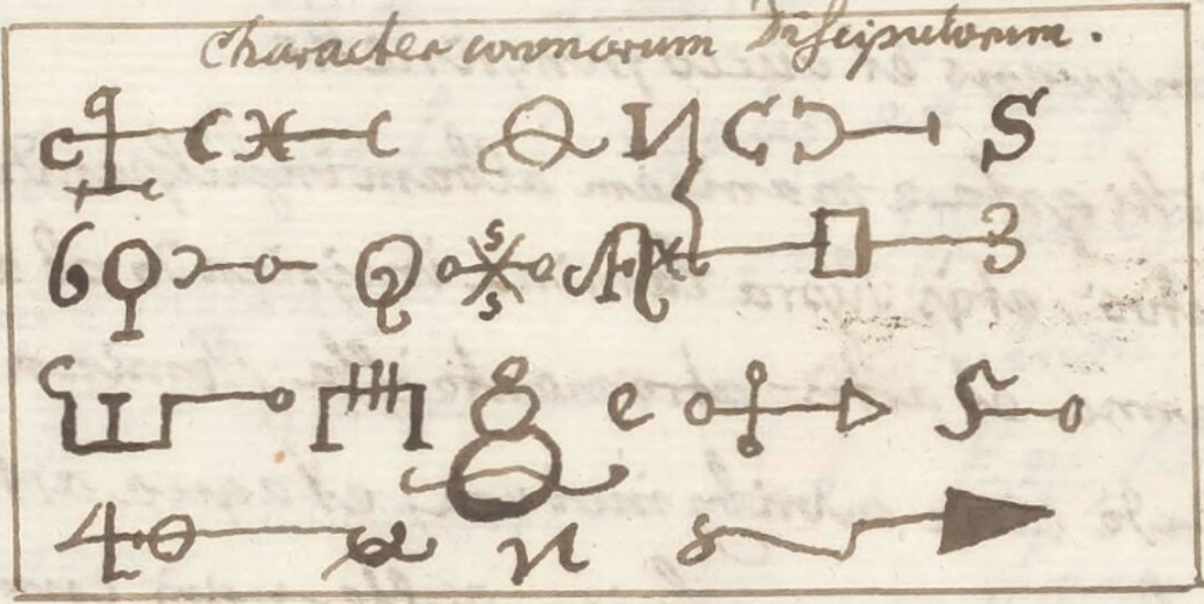
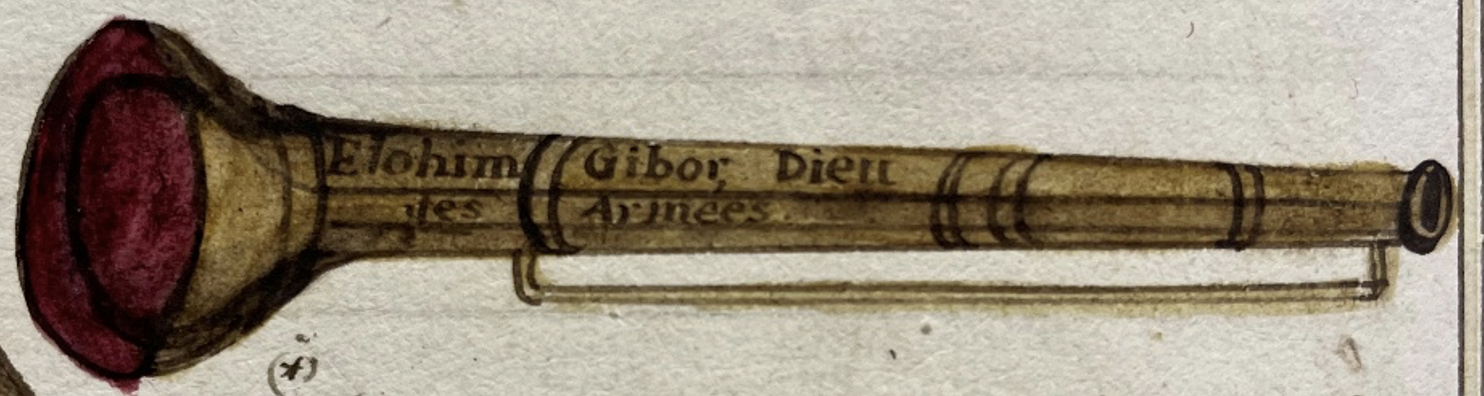
Other tools are then presented: a trumpet, a black handled knife, a white handled knife and a lancet. As in the case of the crowns, similar instructions for the composition of the trumpet and the white handled knife can also once again be found in the Le grand commandeur.
Following this, complementary instructions for the use, production and consecration of the ring and girdle are given. This section of the text is ended with a historiola leading to another collective prayer section of call and response.
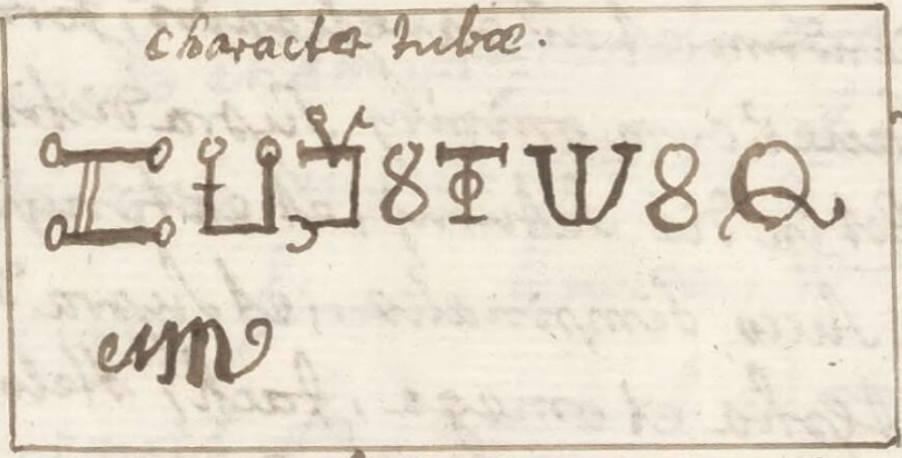

Moving on to the formalities of spirit summoning, the Manuale first describes a double pentacle to be produced in silk and attached to the chest of the magician. Next, four more double pentacles are given, each meant to dominate the Emperor of one cardinal direction. The names of these Emperors are not fully given, solely those of the Emperors of the East and South, these being Oriens or Arison and Austeria respectively. Each of the double sigils also possess individual spirit attributions: Diadamor and Anneador for East, Achiemator and Famidiator for South, Soreph and Saphet for West and Mapheator and Amaricator for North. It seems to be suggested that these names/spirits are capable of subjecting or dominating the mentioned Emperors, by which, within the logic of the Manuale, they could possibly constitute the names of angels. So far none of these names have been found in any other source.
Inserted into the general ritual being described, what the text suggests is that these pentacles are meant to be attached to the inner circle of protection, with the first pentacle mentioned being used by the magician at its center.
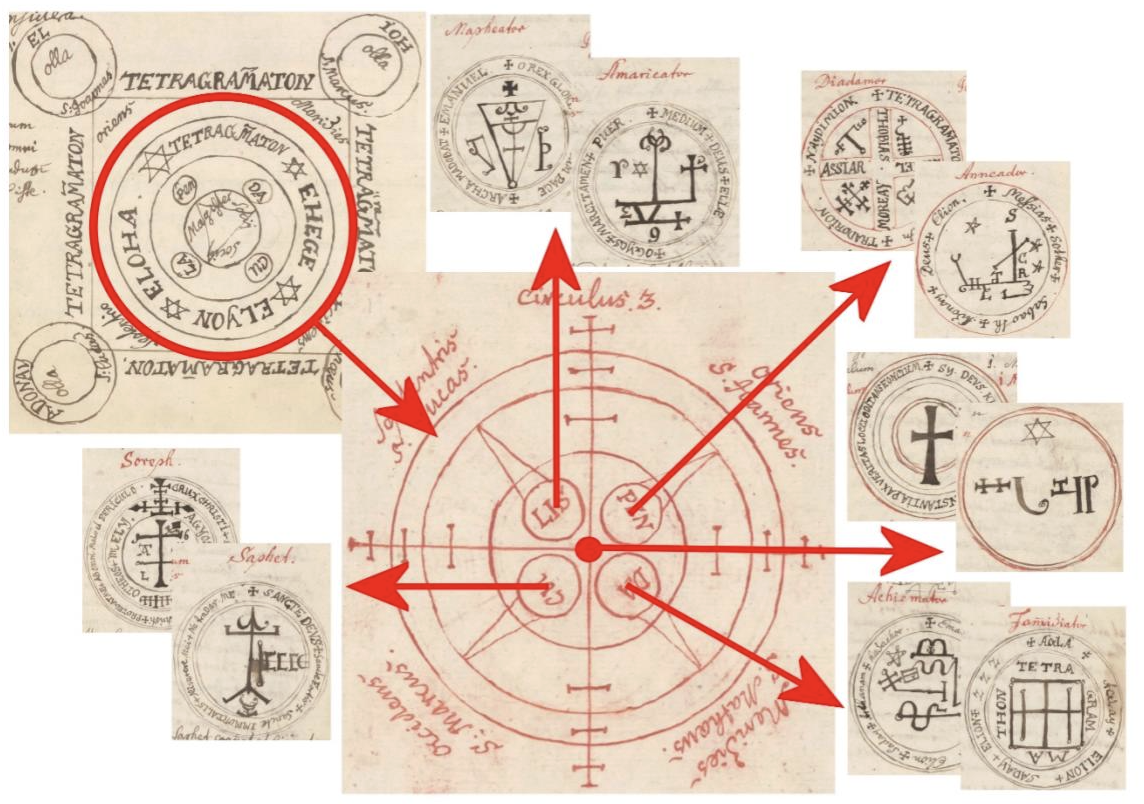
Furthermore, besides their function in this overall ritual, at least two of these pentacles claim inherent virtue, should they be worn as pendants: the pentacle of the West can aid in the finding of treasure, and the pentacle of the North in acquiring fiends and protection from enemies.
The circle and pentacles being arranged, the magician is instructed to recite three long conjurations binding spirits into obedience. These are not dissonant from Solomonic conjurations, although they can be noted by several uncommon divine names, and by having a particular focus on the spirit Astaroth. Finishing this, and securing the obedience of the spirits, the Manuale proceeds to immediately offer their dismissal and the appropriate post-ritual purification procedure for all participants.
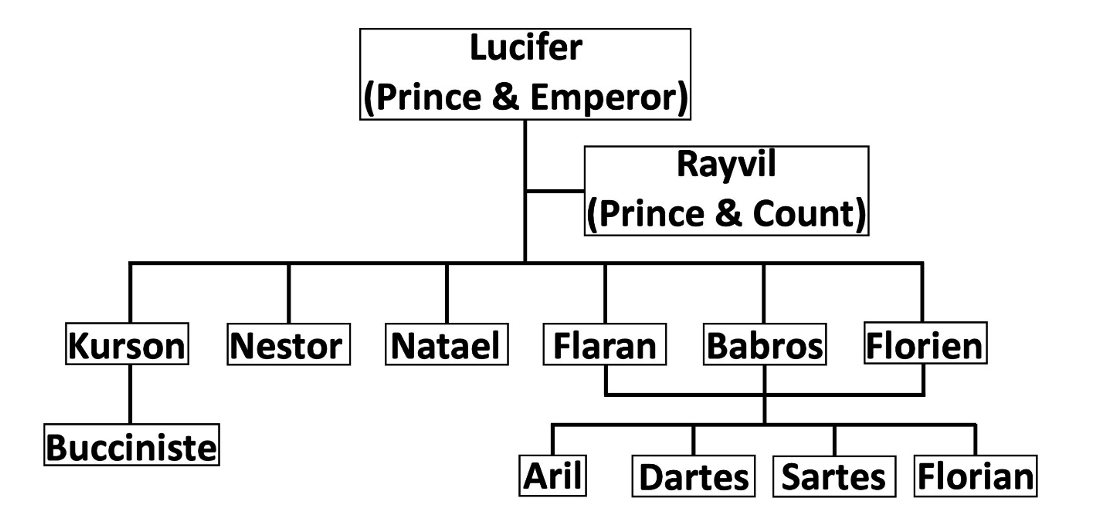
Having concluded the general ritual description, the Manuale shifts its structure and proceeds to offers specific details for the summoning of specific spirits. These are presented in three hierarchies, with several ‘chiefs’. At the top of all hierarchies is Lucifer, Prince and Emperor of demons, also mentioned here as Emperor of the East. Directly under Lucifer are Kurson (or Durson), who is served by Bucciniste, Nestor, Natael, a teacher of alchemy, Flaran, Babros and Florien, three spirits responsible for treasure hunting. Below these last three are Aril, who hides treasure, and Dartes, Sartes and Florian, those who bring treasure up from the sea and earth. Below Lucifer is also the Prince and Count Rayvil, another treasure spirit.
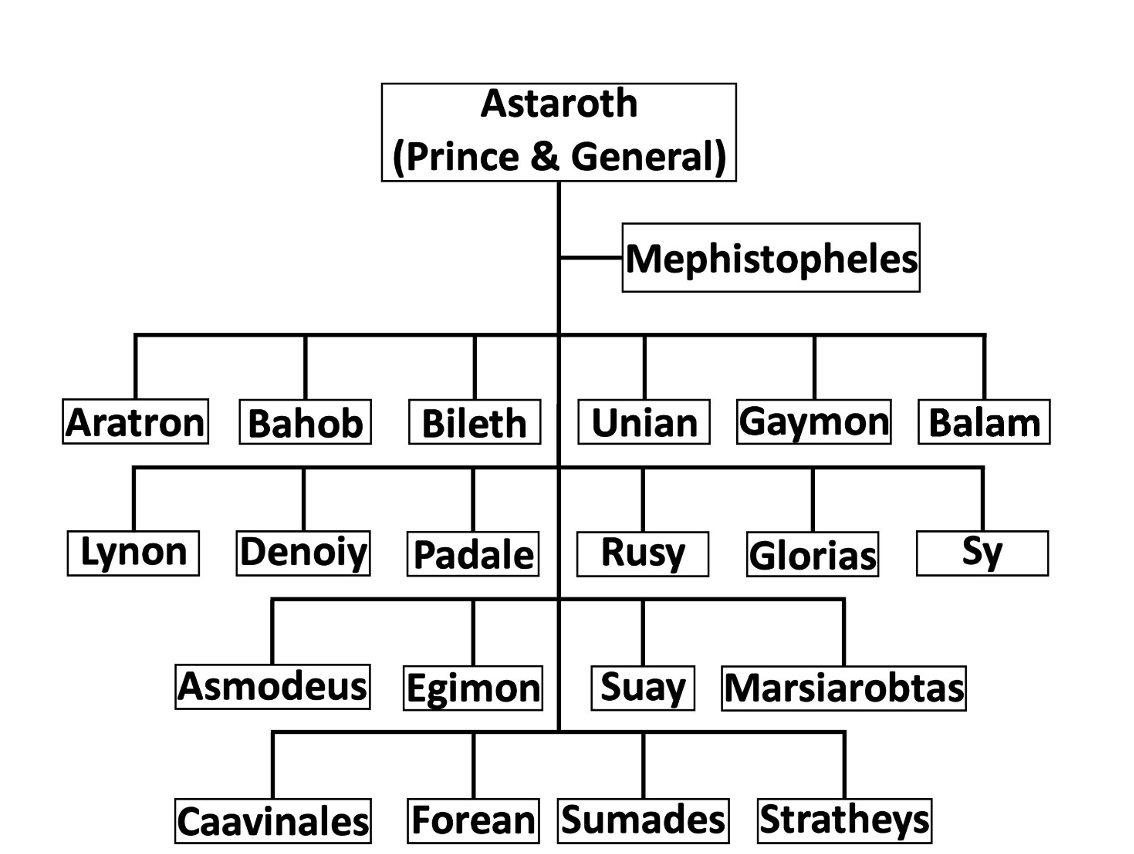
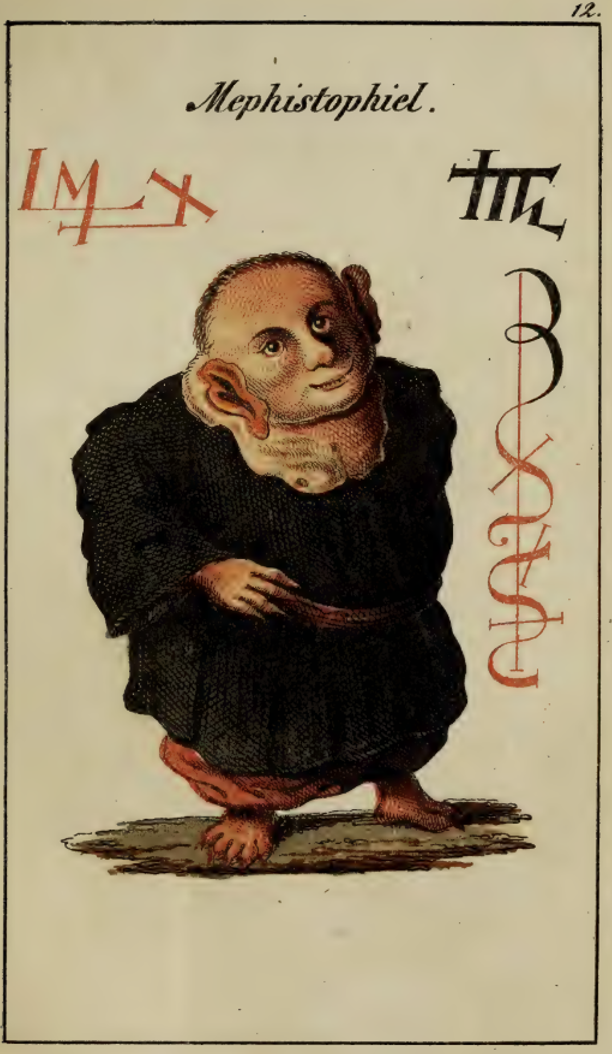
Second in command in relation to Lucifer is Astaroth, Prince and General, and already addressed in the text. Placed under this, and given some relevance, is Mephistopheles, described as the swiftest and best servant. Such is obviously a reference to the narrative of Faust himself, with this same spirit being somewhat common in several other Faustian grimoires. Further below Astaroth are the spirits Aratron, Asmodeus, Bahob, Balam, Bileth, Caavinales, Marsiarobtas, Forean, Egimon, Gaymon, Glorias, Rusy, Stratheys, Unian, Suay, Lynon, Padale, Sumades, Sy and Denoiy.
Following Astaroth the Manuale places the spirits of the seven days of the week: Och, Phul, Phaleus, Ophiel, Bethor, Hagioh, Aratron. While inserted here in this hierarchy, these spirits and their sigils are easily identifiable with those of the Arbatel, a 16th century grimoire detailing the names and sigils of the seven Olympic spirits governing the planets and, consequently, the days of the week. Apart from these seven spirits, only Lucifer, Rayvil and Astharoth are given sigils, with Lucifer being given a second one as Emperor of the East. All these spirits are also given a specialized conjuration in a somewhat Solomonic fashion.
The origin of many of the names present in the spirit summoning section of the Manuale is a mystery, although some are recognizable. Allowing for a certain degree of free association, this whole system suggests a certain influence from the Grimorium Verum, an 18th century text which places Lucifer, Astaroth and Beelzebub on top of a complex and non-linear hierarchy of spirits somewhat reminiscent of Lucifer’s ‘court’ in the Manuale.
Of the ‘lesser’ spirits, the identity of some is unambiguous, such as Asmodeus, Balam, Bileth and Aratron, with the first three being also present in texts such as the Lemegeton Clavicula Salomonis, and Aratron being the Olympian spirit of Saturn from the Arbatel (which raises more questions regarding the accurate identity of this name, as it is used in two different ‘courts’ in the Manuale). Other names are open for debate, such as Kurson/Durson and Egimon, which might be variations on Purson, another name in the Lemegeton, and Egin, the King of the North present in several grimoires. Other names open to speculation are those of Babros, Flara and Sy, which might be possible variations on Barbatos, another name mentioned in the Lemegeton, and Flauros and Sytry, both from the Ars Goetia. Other names, such as Aril and Gaymon can also be found in the already mentioned Nigromantisches Kunst-Buch with minor spelling differences, indicating a clear Faustian origin. Similarly, Florien, Florian and Forean are likely variations of the single Florian also found in the Nigromantisches Kunst-Buch.
In a rather unexplained way, the Manuale rapidly processed through a series of conjurations: one for each element (air, fire, earth and water), one for the four collective elements, another for the coercion of hell and finally a conjuration for the twenty-four winds and storms. There is no clear relationship between these conjurations and previous ones, but overall, there is a certain ritual logic to this sequence. Looking at these conjurations as a whole, the Manuale seems to suggest a descending delegation of authority towards the magician and his companions, meaning that, in order to acquire authority over a specific spirit or part of world, the magician needs to request this from its superior. Thus, the text starts by describing the higher echelons of a spirit hierarchy, led by Lucifer and Astaroth and their ‘courts’. Moving down, the magician is instructed to summon the specific ruler of the day he is working on. After this, he conjures the four sublunar elements, the obedience of the underworld and, finally, the wind corresponding to the hour of ritual performance. This ‘downward’ delegation is further reinforced by the conjurations of the four elements and winds not aiming at the dominion of ‘abstract’ concepts, but rather individualized spirits inhabiting these. This point also implies a potential influence of Paracelsian ideas on the Manuale, particularly those around the notion of elemental spirits.
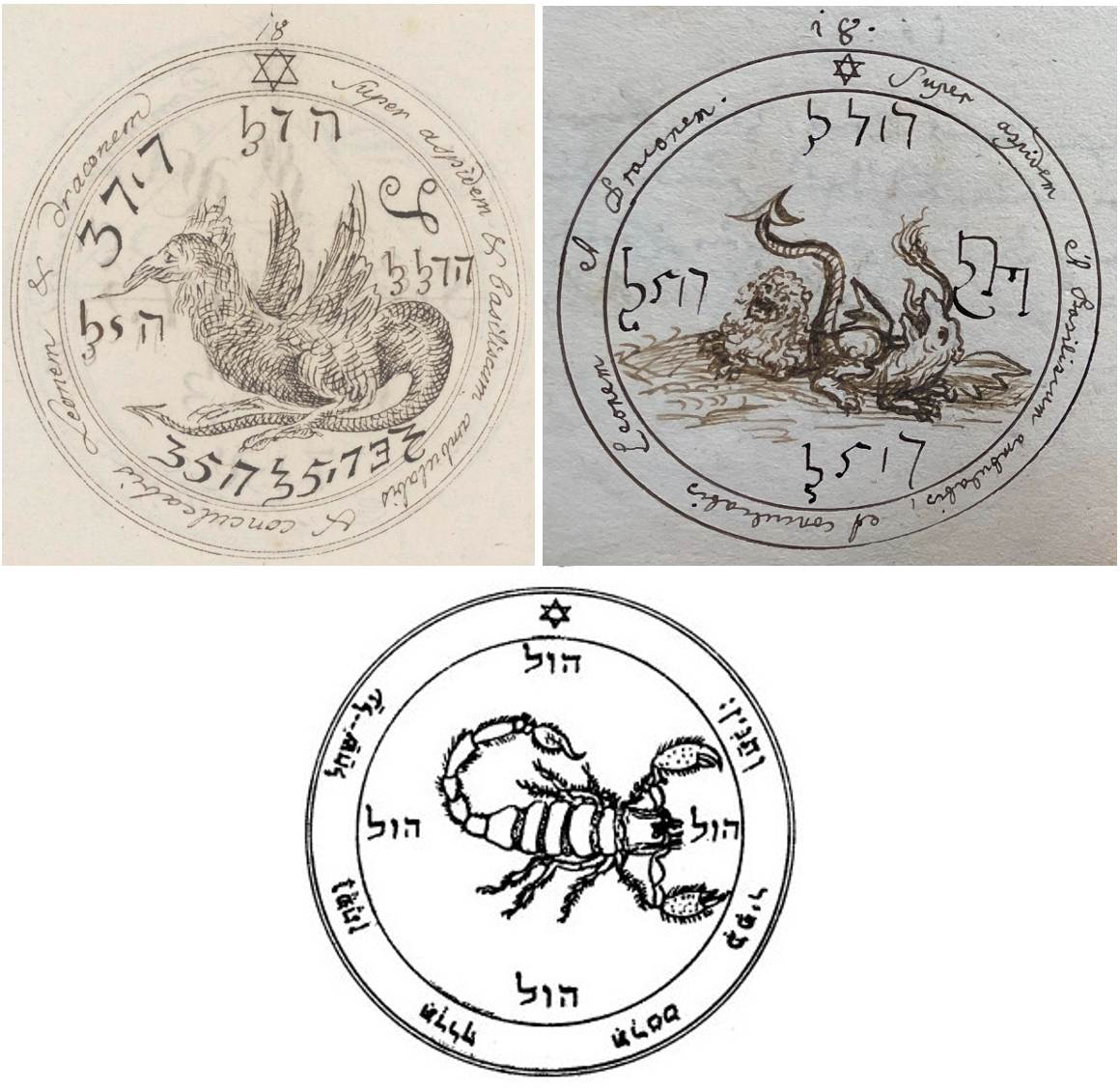
This interpretation is not without uncertainties, as the conjuration of hell seems to personify its ruler as Lucifer once again, placing him simultaneously as the top of the hierarchy and one of its lower spirits. Further complicating this conjuration is a small line instructing the magician to show Lucifer the ‘above mentioned basilisk pentacle’. Effectively, the Manuale does not possess any such pentacle, by which this is likely an artifact from the Claviculae Aureae. However, a pentacle fitting this description can be found in the Magia vera, and yet another can be found in the already mentioned Clavicula Salomonis, sive obedientia angelorum, both of which seem to be a variation of a common Solomonic pentacle of Mars.
Approaching the second part of the Manuale, we now leave the Claviculae Aureae section and move on to what makes this manuscript a unique thing in itself.
Looking back, even with the several doubts and uncertainties already pointed out, the first part of the Manuale presents a complete system of spirit summoning. Yet, it seems to conclude without much of an explanation on the purpose of this same system. A few of the spirits mentioned are offered certain jobs and specialization, such as Kurson/Durson, a master of the liberal arts, Nestor, capable of prophesy, or Natael, a teacher of alchemy, but these aspects are not development, nor do the majority of the spirits have a specific attribution, as is the common rule in Solomonic literature. On the other hand, what the Manuale most often seem to concern itself with is buried treasure. This is explicitly associated with Kurson/Durson, Flaran, Babros, Florien, Aril, Dartes, Sartes, Florian and Rayvil. Looking now at the second part of the Manuale, this is entirely dedicated to treasure hunting.
Obviously, it is not possible to determine if the treasure hunting associations the Manuale offers these spirits are specific to itself (a purposeful change by its author), or if these were already present in the Claviculae Aureae. But be that as it may, by cutting the text when it does, and adding this second part, the Manuale effectively retcons its text as an elaborate treasure hunting system. Accepting it as a coherent object, then the gradual and systematic conjuration of higher to lowers spirits, the days of the week, the elements, and the winds, function as preliminary steps of authority delegation for the eventual act of treasure finding.
While the exact date of the Manuale is unknown, this type of ‘ritual recasting’ is a known and somewhat common phenomenon. This is particular visible in late-18th and early-19th century Iberian Cyprianic texts, where one can find spirit summing systems from popular grimoires such as the Heptameron, Grand Grimoire or Le Grimoire du Pape Honorius being mixed and matched with local treasure hunting literature, being thus recast as treasure hunting books.
Supporting this interpretation, the second part of the Manuale goes to considerable lengths to frame itself as part of the same ‘inner narrative’ as the remaining text, immediately establishing ritual and magic tool continuities by making ample references not only to its first part, but the full Claviculae Aureae. Furthermore, these continuities are not solely textual orchestrations, as most ritual performances in this section of the text once again take the form of collective mass-like ceremonies, with uses of liturgical literature, recitation of psalms and antiphons and call and response prayers. This once again implies an unavoidably Catholic collective practice, with at least one of the participants needing to be a priest. Furthermore, at its opening, this second part offers a list of appropriate treasure hunting days, with all of these being Catholic feast days.
Even if striving for coherence, such assemblies of magical material do tend to result in inconsistencies, and the chief spirit in charge of buried treasures is here named as ‘Mammon Asmodus’. While it is not a stretch to assume this is meant as Asmodeus, there is a clear difference in nomenclature with the first part of the Manuale, where Asmodeus is solely mentioned as a member of the Astaroth ‘court’, with no given specialization. Should we choose to look at the Manuale as a fragmented object, this would be a clearly visible fracture line.
In regard to this new ritual, the Manuale offers several instructions for several magical tools, some specifically tailored for treasure hunting. Besides swords and lancets, this offers instructions for magic shovels and hoes, tools which are mostly absent from both Solomonic and Cyprianic literature. Following common treasure hunting procedures, the text describes a new circle to be drawn over the treasure hunting location. This circle is unknown from other texts (although it is highly unlikely to be original).
It should be noted that the text does not prescribe any method for the finding of a treasure location. It could be that this expects its user to determine this by their own means, such as through rabdomancy or by following a treasure guide, another fairly common form of 18th century treasure literature. But most likely, it could be that the treasure location is meant to be sought with one or several of the treasure spirits mentioned in part one, similarly to the magical system of the Grand Grimoire. This can be implied by later instructions mentioning a license to depart being given to a spirit.
An interesting particularity of the circle of protection is that its purpose is not so much to protect the would-be treasure hunter(s) from spirits, but to isolate the ritual space from external influence. Overall, the ritual does not have particular preoccupations in marking a clear barrier between the magician(s) and the spirits involved, as is common in Solomonic rites; rather the circle intends to lock the magician(s) and the spirits in the same space, making these unable to escape or move the treasure. Once the circle is closed the Manuale prescribes twelve exorcisms to gradually remove any spirit or power placed over the treasure, with one last exorcism being done to the earth/soil and after which digging may commence.
The ritual is concluded by the above-mentioned license to depart, and the ritual sharing of the treasure, with the text ending by advising one to always follow a Catholic life.
Overall, even with its own particularities, the treasure hunting ritual presented is not extraordinary within its genre. Such rituals tend to be long, morose and repetitive, but this is not to say this is not a relevant text and a precious lead into Faustian treasure hunting traditions and Germanic magic culture. The marked Catholic liturgical formalities present in the Manuale offer a window into a confessional demarcation in Germanic magic literature which is not visible in texts originating in homogeneous religious environments, such as the Iberian Cyprianic. The Manuale offers a rare two-way door for its own contextualization: it speaks of macrohistorical and social conflicts framing magic practice in its territory, but it equally offers a microhistorical view into the inner life and world of the individual(s) who pieced this text together.
Like any grimoire, the Manuale is more than its words; it is a snapshot. A deeply historical object on which ambitions, fears, traditions, cosmologies, confessions and identities clash and struggle. While authors such as Agrippa and Paracelsus might have laid the grounds for entirely new conceptions of magic that would come to dominate its theory and practice for much of early modern period, grimoires such as this are where the ground-level reality of that same practice is visible. Even if their roots are in the medieval period, grimoires emerge as some of the most dramatic expressions of magic of the early modern age, products of an expanding world, the collapse of established intellectual and religious doctrines and the rapid dissemination of new textual information. The Manuale magicum doctoris Fausti, with its fictional authors, partial and reconstructed rituals, is a shining example of a literary genre still underappreciated by the academic community.
Written by
José Vieira Leitão, PhD
José Vieira Leitão is an author and translator of magic texts, and a contributing researcher at the Center for the History of Society and Culture of the University of Coimbra. His academic research focuses on the understanding of Iberian magic and literature.


.avif)