

.svg)
.svg)
How Someone Puts Himself on a Pedestal and is Thrown Off Again: Jacques Fabien Gautier d'Agoty (1716-1788), the Self-Proclaimed Inventor of Four-colour Printing
By
José Bouman
February 15, 2026
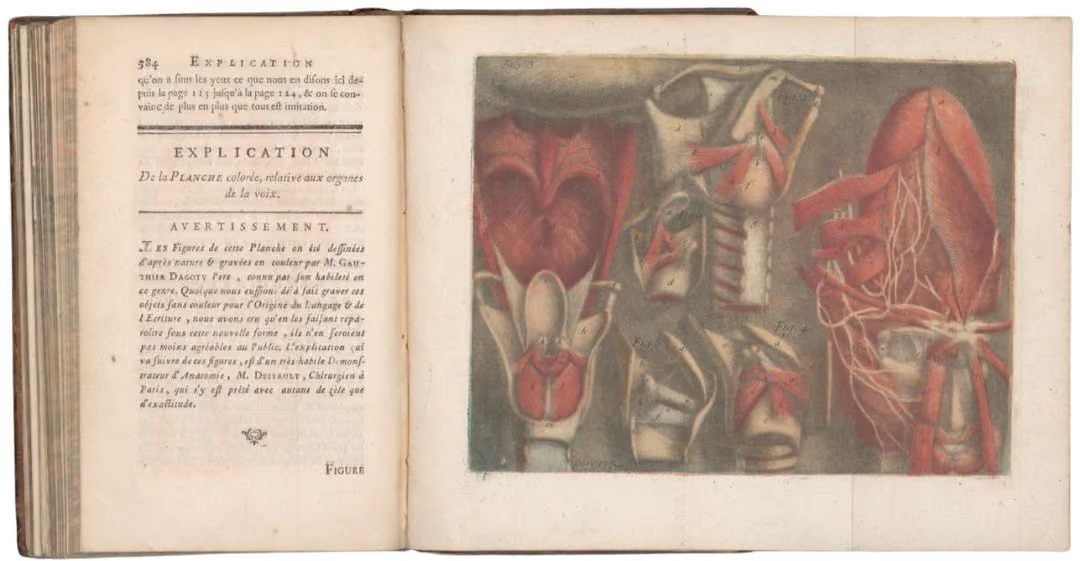
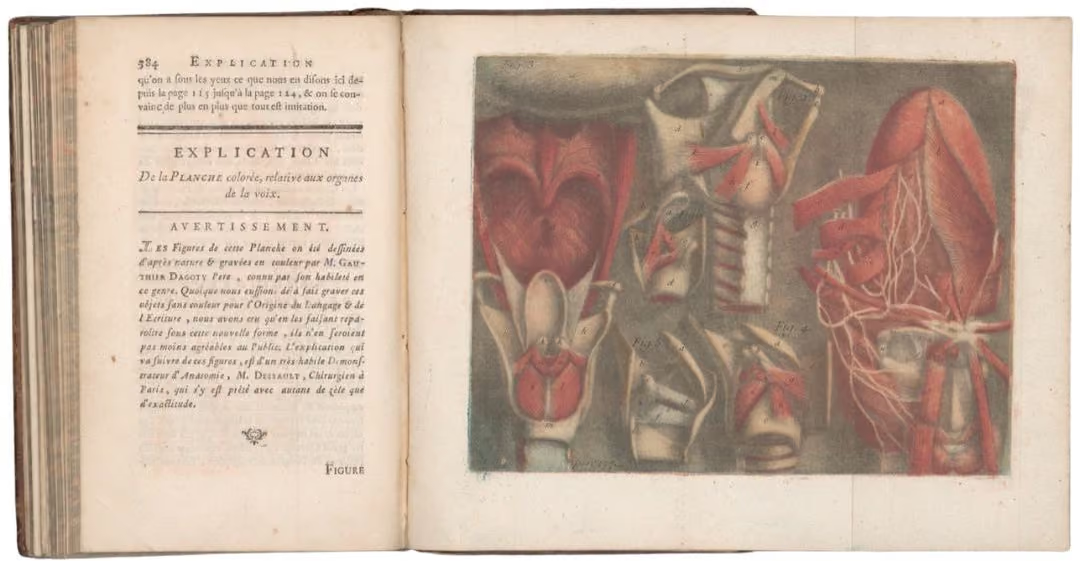
Gautier d'Agoty, color print of speech organs, Histoire naturelle de la parole (1776).

How Someone Puts Himself on a Pedestal and is Thrown Off Again: Jacques Fabien Gautier d'Agoty (1716-1788), the Self-Proclaimed Inventor of Four-colour Printing
Gautier d'Agoty, color print of speech organs, Histoire naturelle de la parole (1776).

How Someone Puts Himself on a Pedestal and is Thrown Off Again: Jacques Fabien Gautier d'Agoty (1716-1788), the Self-Proclaimed Inventor of Four-colour Printing
By
José Bouman
February 15, 2026
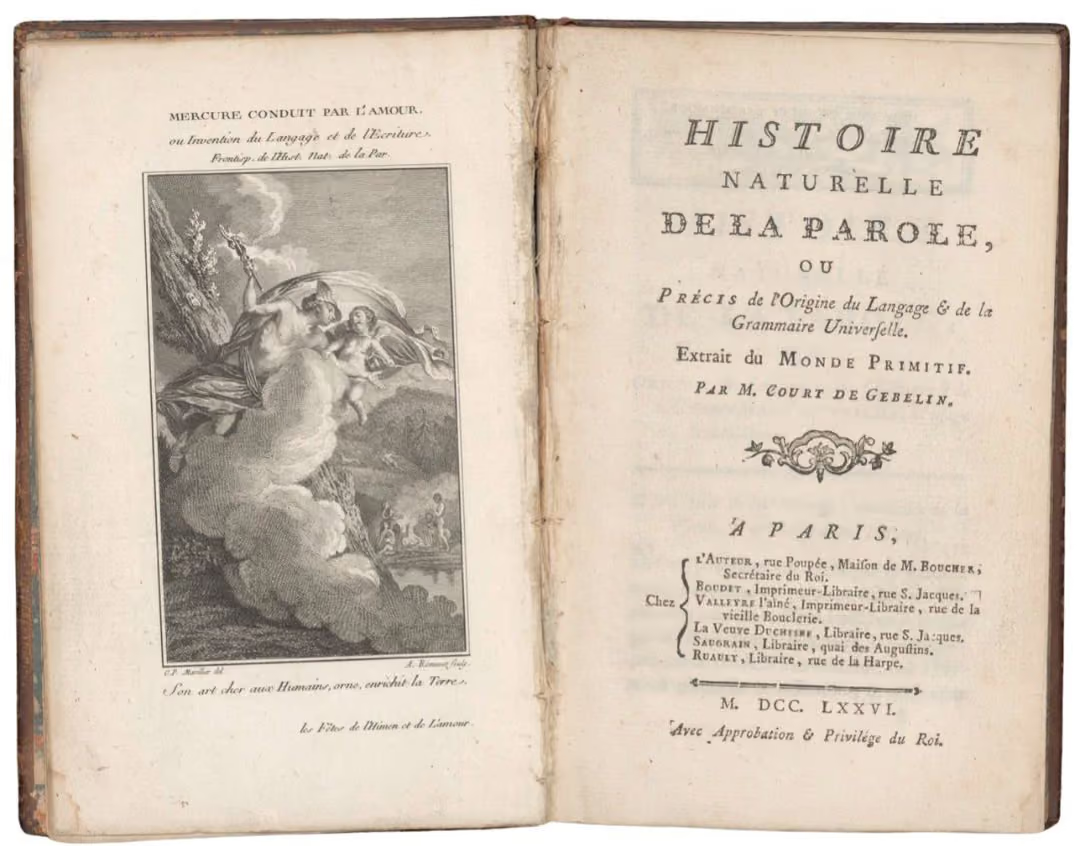
The subject of this contribution concerns a book from the BPH with a famous coloured print, Histoire naturelle de la parole (Natural History of Speech), printed in Paris in 1776. It is written by Antoine Court de Gébelin (1719–1784), a pastor, Freemason, and mesmerist, who is best known for his Monde primitif (Primitive World), a monumental nine-volume work (1773–1782) in which he sought to explain everything, or almost everything, through the legends and myths of Antiquity. In this way, with the help of etymological speculation, he rediscovered a primitive and original language. His reflections on this subject formed a volume from which the book I will discuss is extracted.
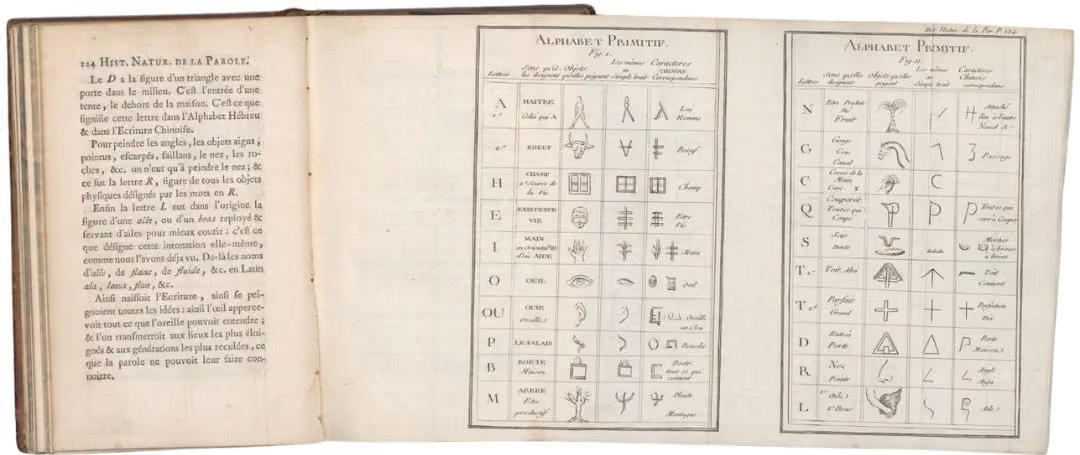
The frontispiece of the Histoire naturelle de la parole represents Hermes (or Mercury) and Love as an allegory about the invention of speech and writing. This refers to the legend that the Egyptian god Hermes (Thoth) gave writing to mankind. The book contains fold-out pages of a primitive alphabet, composed of pictograms and ideograms. But the book does not only contain speculation: it is very modern for its time because of the colour plate that depicts the speech organs, drawn “from nature” by Jacques Fabien Gautier Dagoty. It is not a coloured-in black and white print as was usual in that period: the colours are printed and not painted by hand. Therefore the book is of great interest for bibliophiles and book historians!
d'Agoty was a Parisian painter who specialised in medical-anatomical prints. He used a new technique of four-colour engraving for this purpose. In the mid-18th century, he (and his five artist sons) succeeded in gaining an influential position in the Parisian world of medical publications. He supplied colour plates for the periodicals Mercure de France, Observations physiques, Observations sur histoire naturelle, Observations sur la peinture, and Journal de Monsieur. This form of four-colour printing is a labour-intensive process in which four copper plates, one for each colour, are printed on top of each other. However, he did not invent this four-colour printing technique himself, but learned it from Jacob Christoffel Le Blon, with whose studio he was associated for a short time. Le Blon had been experimenting with this technique in Amsterdam since 1710 and in London since 1715.
Le Blon eventually received royal patents for the three-color printing process in 1719. He left England in 1734 and moved to Paris, where he received a privilège for his printing process from Louis XV. His works were very popular in France, and several sequences of prints (mainly portraits) were produced and sold showing the different steps of his printing process. In 1741, Le Blon died and his former pupil, the very proud and conceited Gautier, argued that Le Blon was not the legitimate inventor, and he claimed Le Blon's privilege for himself, naming himself the inventor of colour printing. Gautier succeeded in associating himself with the invention of four-colour printing until at least 1779, after a lifelong battle with the Le Blon clan. His vanity and conceit are also evident in the wording of the colophon of Anatomie generale (Paris, 1752): although two others collaborated on this book, he states: ‘je suis le demonstrateur, le peintre et le graveur de tout ensemble’ (I am the demonstrator, painter and engraver of all of this).
Having fallen from his pedestal, he received another blow in 1852 when the German physician Johann Ludwig Choulant (1791-1861) wrote about him: "Although his anatomical illustrations may be fascinating to the layman... they impress the critical observer with their arrogance and charlatanism and are not to be recommended to the anatomy student, neither for their accuracy nor for their technique". But despite the damaged reputation of the printmaker, the Histoire naturelle de la parole remains a remarkable book!

Written by
José Bouman
Drs José Bouman has been head curator of the Bibliotheca Philosophica Hermetica since 1983. She has shaped every museum exhibition since and specialises in Dutch medieval literature.

.avif)