


Forbidden, but reprinted more than 60 times: Marcellus Palingenius, Zodiacus Vitae
By
José Bouman
April 15, 2026
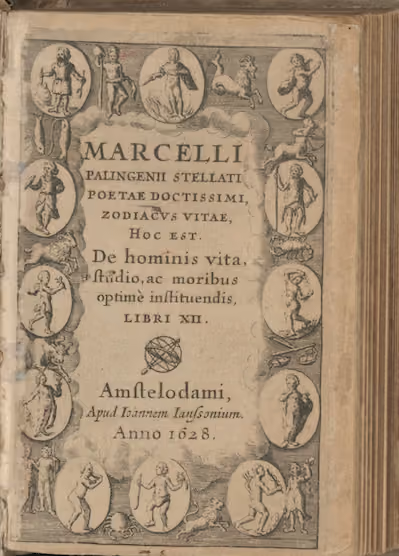
Marcelli Palingenii, Zodiacus Vitae, Amsterdam edition, 1628

Forbidden, but reprinted more than 60 times: Marcellus Palingenius, Zodiacus Vitae
Marcelli Palingenii, Zodiacus Vitae, Amsterdam edition, 1628

Forbidden, but reprinted more than 60 times: Marcellus Palingenius, Zodiacus Vitae
By
José Bouman
April 15, 2026
First published in 1531, this small work has the dubious distinction of having been put on the very first Index Librorum Prohibitorum or index of forbidden books, in 1559. By then the Inquisition had already burnt the heretical bones of the (supposed) author, who had stated that he did not believe in anything, including the divinity of Christ (‘nihil credens neque divinitatem Christi’). The Zodiacus vitae is a philosophical poem divided into twelve books, one for each of the signs of the zodiac.
It explores the nature of human existence and the universe. The poem discusses various topics such as the nature of God, the purpose of life, and the role of the stars and planets in human destiny, but also human happiness, morality and the pursuit of knowledge. Of course, the church authorities also objected to the sharp satirical critiques of ecclesiastical corruption.
The author of Zodiacus Vitae, writing under the pseudonym Marcellus Palingenius Stellatus, remains obscure. One hypothesis identifies him as the Neapolitan poet Marcellus Stellatus, born ca. 1500, and it were his bones that the Catholic church exhumed and burnt after his death in 1551. Another supposed author is Pier Angelo Manzolli, linked via anagram from rearranging letters in the pseudonym—Marcellus Palingenius Stellatus yielding Pier Angelo Manzolli a Stellata—and associated with La Stellata near Ferrara. However, evidence for the existence of this ‘Pier Angelo’ is very thin. The paucity of primary records leaves the debate unresolved, reflecting uncertainties in attributing anonymous early modern works evading censorship.

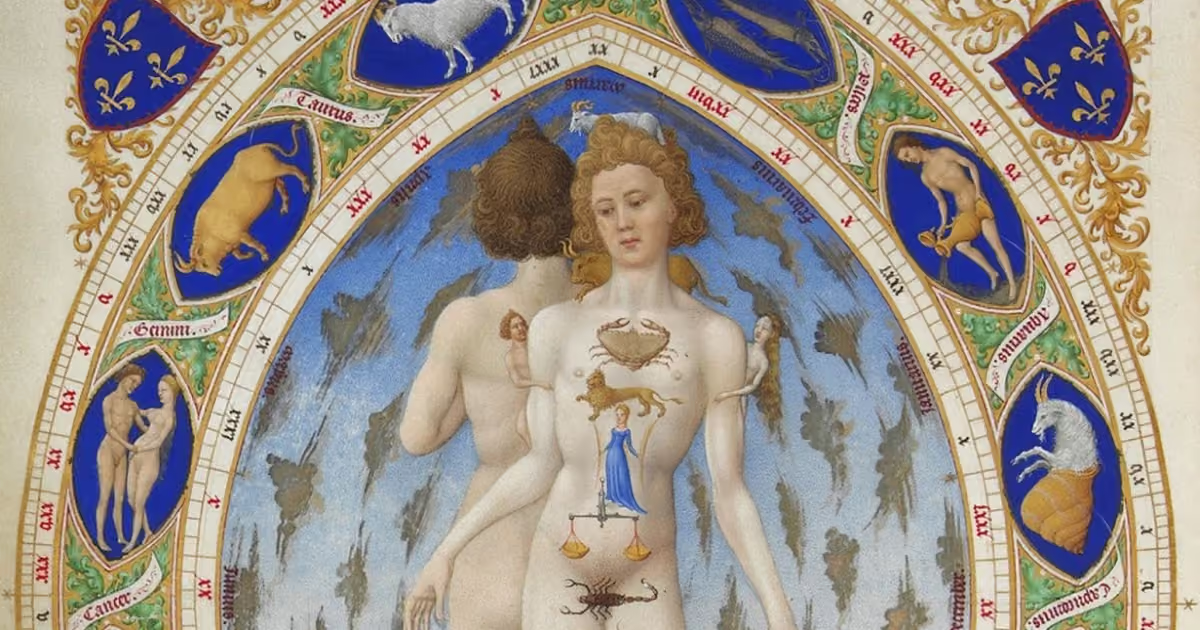
The pseudonym chosen by the author, ‘Palingenius’, perhaps alludes to Marsilio Ficino’s philosophy, who wrote on the concept of ‘palingenesis’ or the rebirth of the soul, a heretical concept in Christian terms, since the soul is also created ex nihilo) and – rebirth, renewal – Hermetic and alchemical symbolism. Book XI (Aquarius) is the most decidedly astrological of all twelve books.
The author wonders whether the heavens and the stars are perhaps inhabited – another claim which would have alarmed the Inquisition, as it did in the case of Giordano Bruno, who argued the same in his De innumerabilibus, immenso, et infigurabili (1591) – quoting also from the Zodiacus vitae. Bruno was burnt at the stake in 1600 for his heretical ideas! Palingenius in his turn draws on several classical Roman authors, but also on humanistic sources. In Book IX’s assault on corrupt education he clearly mirrors Erasmus’ exposure of scholastic folly and advocacy for reformed learning from his Moriae Encomium. In Book X we find references to the philosopher’s stone and other details taken from Agrippa’s De occulta philosophia.
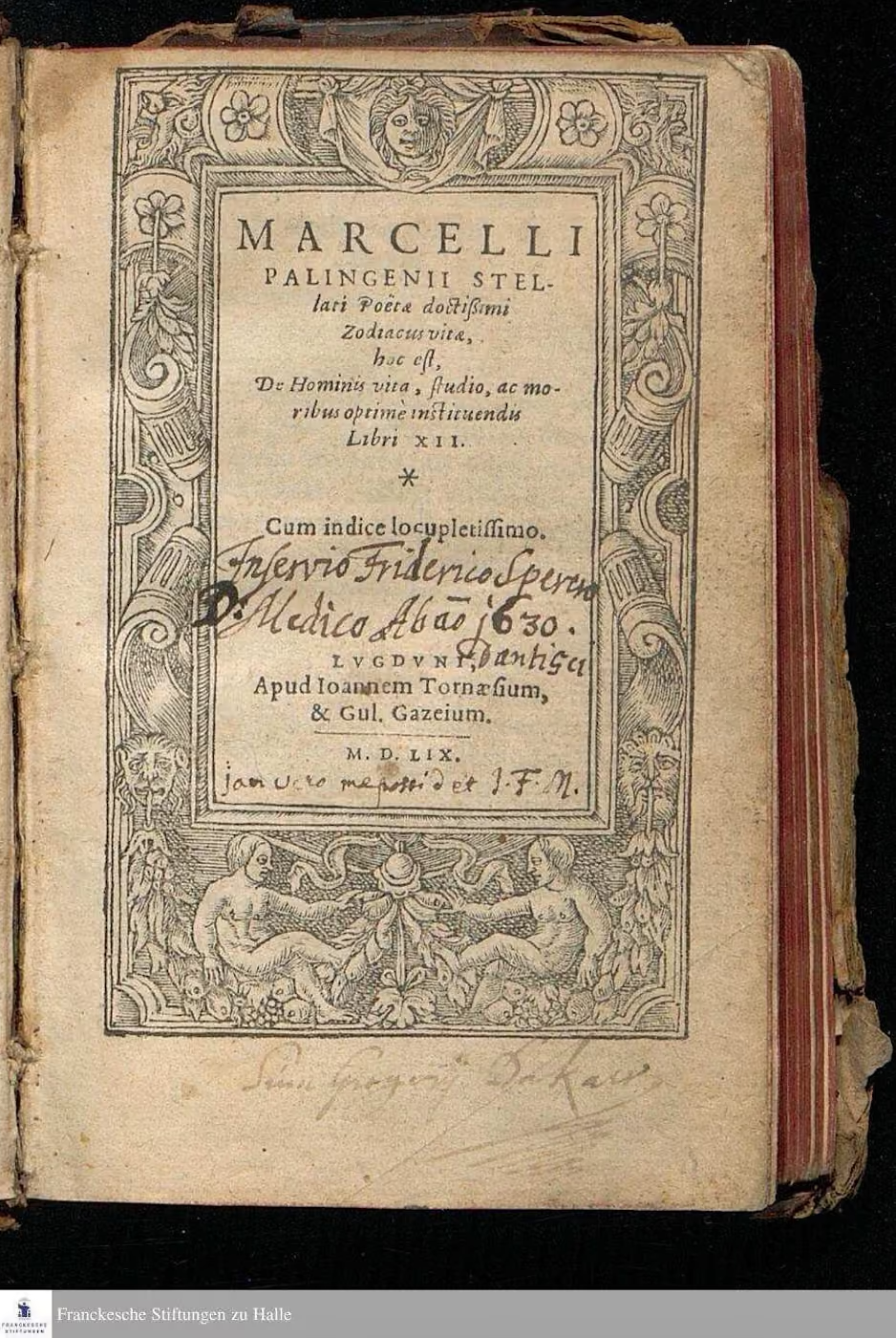
In spite of papal censorship, more than sixty Latin editions were published and already in the 16th century, it had become a textbook used in schools. By 1560, an English translation (The Zodyake of Life) was issued: one of the earliest vernacular adaptations. Translations into Italian, German and French followed. The publication trajectory reflects the appeal the poem had, underscoring its role in disseminating heterodox ideas on free will, cosmology, and ethics during a period of religious upheaval.
The BPH has a Latin edition in its collection that was printed in Amsterdam in 1628, by Johannes Janssonius (ill). The only Dutch edition is a partial translation: book X, Capricorn, only. It was printed in 1721 and published by Isaac Enchedé in Haarlem (copy in the Allard Pierson/Ritman collection PH2008-C). We know that Enschedé was very interested in “free thinkers”; he published works by various authors in this field in Dutch translations (a.o. Michiel Vinke’s Zilvere Arke, several alchemical texts). But the reason why he published only Palingenius’ tenth book, and not the entire work, remains an open question for now.

Written by
José Bouman
Drs José Bouman has been head curator of the Bibliotheca Philosophica Hermetica since 1983. She has shaped every museum exhibition since and specialises in Dutch medieval literature.