
.svg)
.svg)
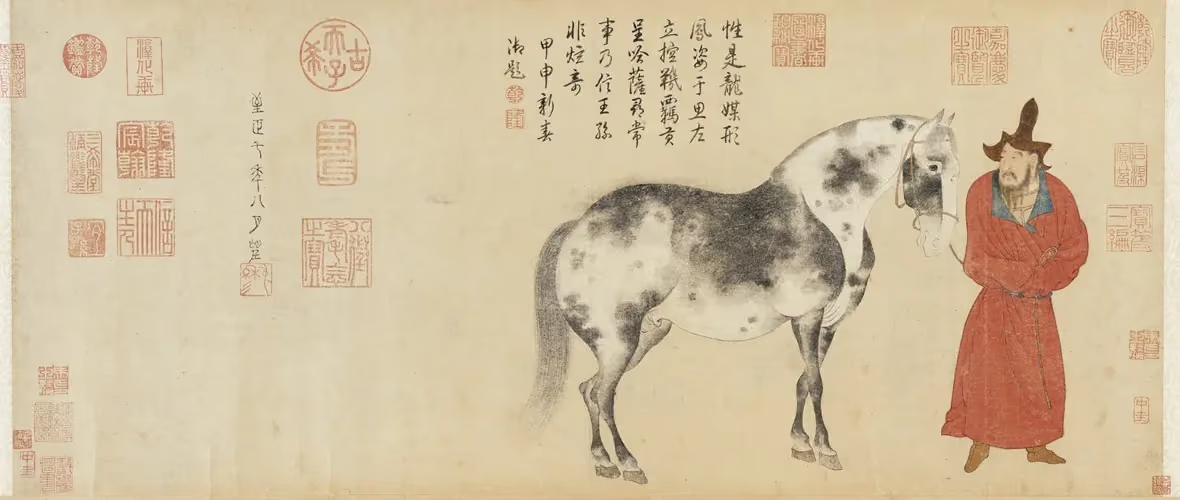
Horse and Groom, after Li Gonglin, 1347, Zhao Yong , (Chinese, 1291-1361), Ink and color on paper, F

Chinese New Year: Multiple Beginnings of Spring
Horse and Groom, after Li Gonglin, 1347, Zhao Yong , (Chinese, 1291-1361), Ink and color on paper, F

Chinese New Year: Multiple Beginnings of Spring
By
Charlotte Zhu
February 15, 2026
February 17 marks the Chinese New Year this year. Taking this moment as an occasion, it is worth pausing to reflect on what this festival represents and how it may express a distinctive way of understanding time, nature, and renewal.
Unlike Western traditions, which usually associate the arrival of spring with March and the spring equinox, Chinese tradition can be understood as allowing for more than one beginning of spring. One is the Chinese New Year, and the other is Lichun (立春), the Start of Spring. These two moments arise from different yet coordinated systems of timekeeping: one based on the Moon, the other on the Sun. Traditional Chinese calendars can be seen as attempts to keep these systems in dialogue, aligning earthly life with both celestial rhythms and seasonal changes.
Chinese New Year marks the beginning of the lunar year and falls on the first new moon of the year. Lichun, however, is one of the Twenty-Four Solar Terms and usually occurs around February 4. Determined through long-term observation of the Sun’s movement, Lichun is often described in traditional sources as the moment when winter begins to loosen its grip and the first signs of renewal quietly emerge, even though cold weather may still persist.
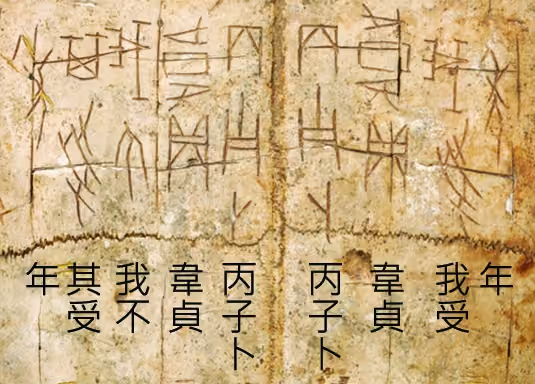
These ways of measuring time are commonly traced back to early agrarian experience, when close attention to seasonal rhythm was essential for survival. Archaeological materials such as Shang dynasty (c. 1600–1046 BCE) oracle bone inscriptions suggest that rainfall, seasonal change, and year yield were matters of sustained concern in early Chinese society. Over long periods, such observations appear to have contributed to calendrical frameworks that allowed lunar and solar cycles to coexist within a single system.
Today, the year 2026 is commonly referred to as the Year of the Red Horse, a designation that belongs to another layer of traditional Chinese cosmology. In China, years are defined through a system known as the ‘Heavenly Stems’ and ‘Earthly Branches’. The Twelve Earthly Branches originally formed an abstract framework for structuring time and were only later paired with animal symbols. The twelve zodiac animals are thus associated with the twelve Earthly Branches, forming a repeating twelve-year cycle.
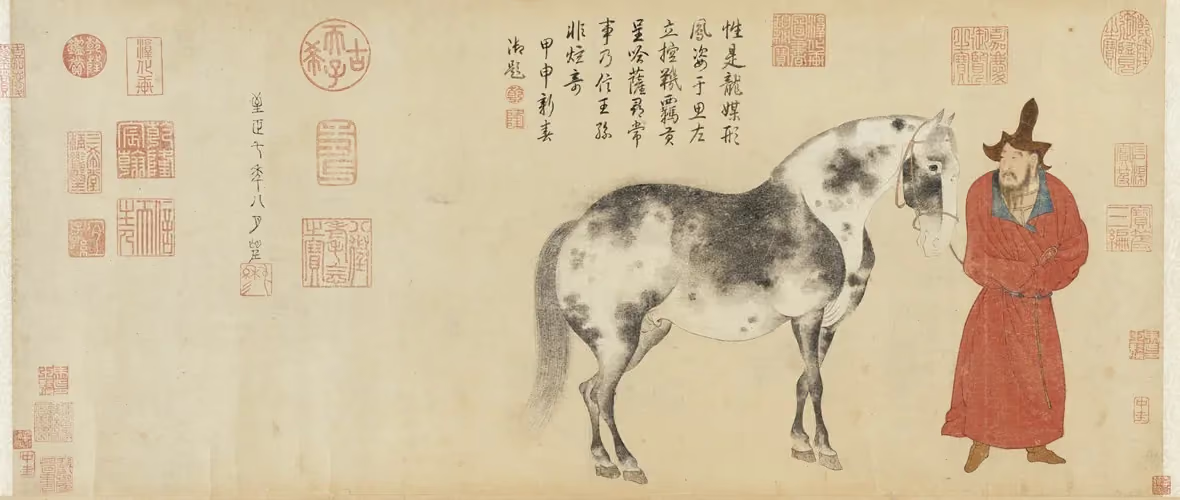
Each zodiac year is further combined with one of the Five Phases (五行), often referred to as the Five Elements: Wood, Fire, Earth, Metal, and Water. When the Horse is paired with the Fire phase, the year is described as a Fire Horse, commonly rendered as a Red Horse, since red is traditionally associated with fire, vitality, and dynamic energy. In more technical calendrical terms, the transition between zodiac years has traditionally been associated with Lichun, once again highlighting the coexistence of lunar and solar time within Chinese tradition.
It is worth noting that the Five Phases are not conceived as static substances, but as dynamic processes. They describe patterns of movement, transformation, and mutual influence, and are associated with cycles of growth and decline in the natural world. From this perspective, a comparison with the Western tradition of the four elements—earth, water, air, and fire—becomes instructive. While the four elements are often understood as focusing on composition and structure, the Five Phases place emphasis on process and change.
Seen in this broader perspective, Chinese New Year is more than a festival. It can be understood as a moment when cosmology, seasonal change, and human life briefly align. It reminds us that time may be experienced not only as a sequence of dates, but also as a cycle of renewal grounded in nature itself.
If you are interested in Western traditions of natural philosophy, the four elements, or related strands of thought such as Taoist philosophy, we warmly invite you to explore these themes further at BPH. Our collection offers a space where different cultural understandings of nature and time can enter into dialogue, revealing how diverse traditions have grappled with the same fundamental questions: how the world is ordered, and where we find ourselves within it.

Written by
Charlotte Zhu
Charlotte Zhu manages the Amsterdam Antiquarian Bookstore and is a candidate at the University of Amsterdam. Her research focuses on the cross-cultural transmission of ancient astrological texts.

.avif)