

.svg)

.svg)
‘Alkaloids of Divine Grace’: Carl Jung’s Warning About Psychedelics from the Jung-White Letters
By
Corey Andrews
February 15, 2026
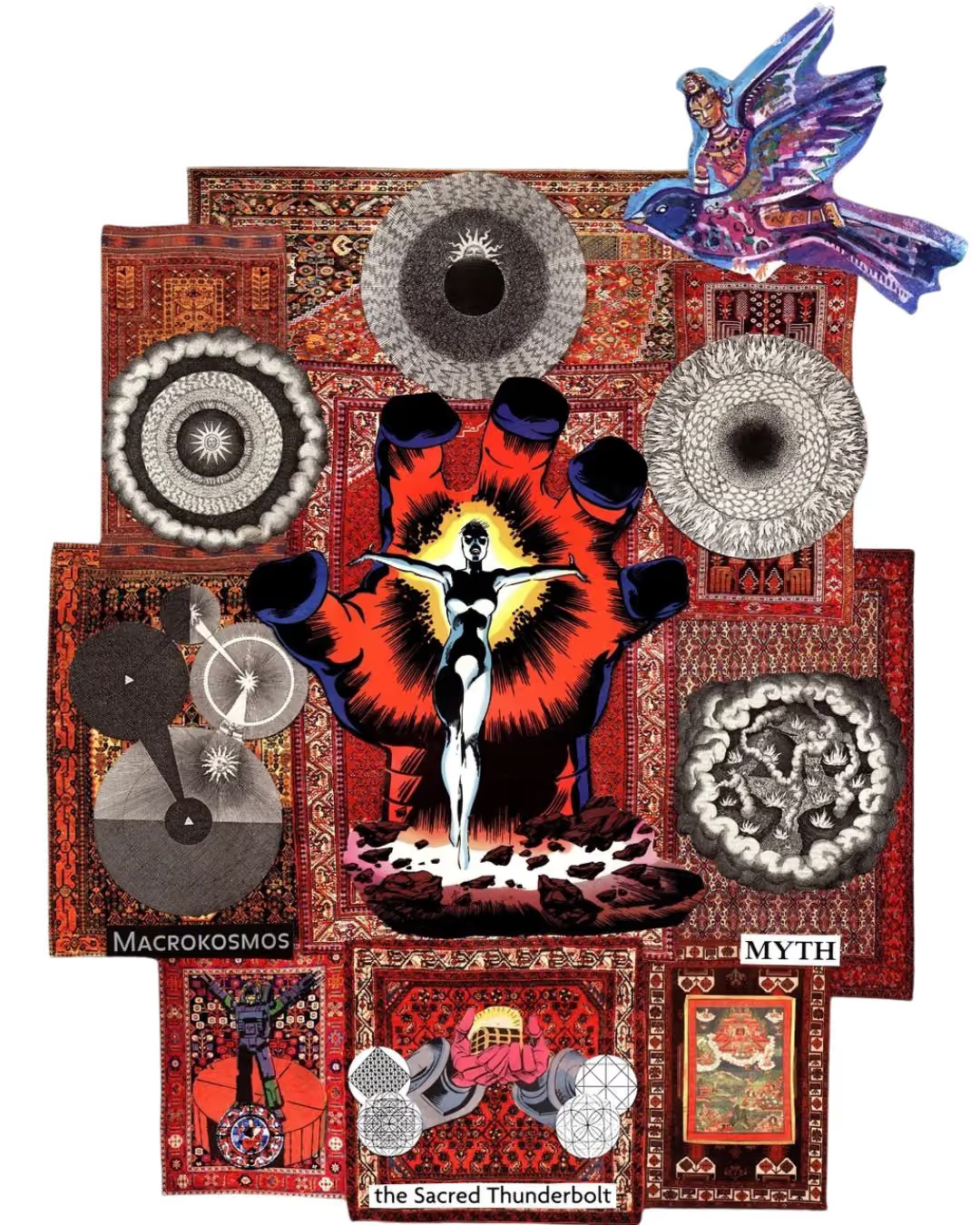
Digital abstract art from the Uoopati "Psychedelic Art" 5D Diamond Painting Set.

‘Alkaloids of Divine Grace’: Carl Jung’s Warning About Psychedelics from the Jung-White Letters
Digital abstract art from the Uoopati "Psychedelic Art" 5D Diamond Painting Set.

‘Alkaloids of Divine Grace’: Carl Jung’s Warning About Psychedelics from the Jung-White Letters
By
Corey Andrews
February 15, 2026
How can we express the inexpressible? The ‘ineffable’? Chasing such ghosts, I have been trying to get more familiar with the enormous Jung collection we have on our second floor, and a passage in one book I came across recently struck me like a bolt of lightning – ZAP!
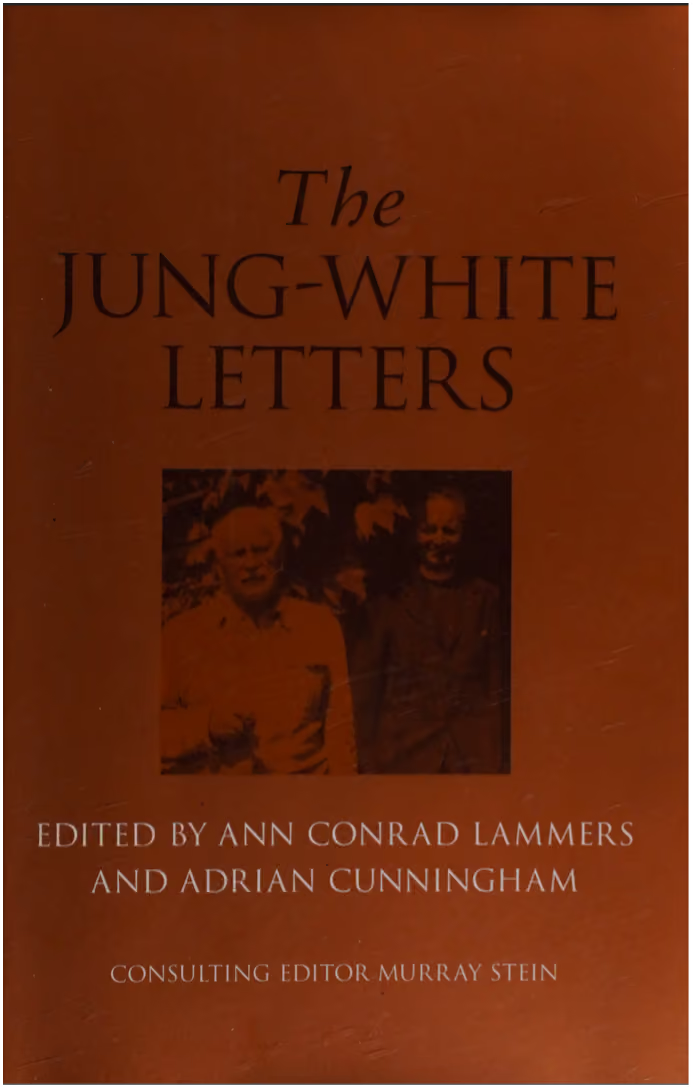
One of the most elusive topics to encapsulate in language concerns the psychedelic experience. Of the countless books – of varying levels of academic rigor – which have been produced in the recent years concerning the topic, there is one in our collection which has impressed me the most. What is strange is that it is not actually a ‘book about psychedelics’ at all, but a book containing the letter correspondence between the Swiss theorist of the unconscious Carl Jung, and a Dominican priest and theologian Victor White. The vast majority of their letters concern problems of Christian theology, the Gnostic texts, dream symbolism, archetypal narratives, and so on – ya know, ‘Jung stuff’. One exchange however, deals with the ‘problem’ of psychedelics, and it is not as well-known as it should be.
On ‘Entheogens’
In recent academic debates, scholars such as Wouter Hanegraaff have constructively contributed to discussions of the term ‘entheogenic esotericism’ to describe the use of psychedelics or ‘entheogens’ in spiritual, religious, shamanic, or mystical contexts. ‘Entheogen’, a term which has Greek roots, etymologically breaks down like this:
ἐν- (en-) Prefix meaning "within", "inside", or "in" (as in English "en-" words: energy, enthusiasm, endemic).
θεός (theós) Noun meaning "god" or "divine being" (root of English "theology", "theism", "pantheon", etc.).
γεν- (gen-) From the verb γίγνομαι (gígnomai) = "to come into being", "to be born", "to generate", or "to produce".
The stem -gen- is very productive in Greek and English (genesis, generate, gene, photogenic, androgen, etc.) and here carries the sense of "generating" or "becoming".
So ἐνθεογενής (entheogenēs) would literally mean:
"generating god/godhood within" / "that which causes the divine to be generated inside".
Consider this philological backdrop as you navigate the following exchange between two leading 20th century thinkers on the topics of the mind, soul, & deity. Intriguingly, the correspondence also contains Jung’s critique of the English philosopher Aldous Huxley, author of ‘Brave New World’ and ‘The Doors of Perception’. Huxley’s Doors, concerning his own experiences (or perhaps in Jung’s view, his indulgences) with mescaline was published in March of the same year as the following correspondence.
The Dialogue
At the beginning of his letter Victor White writes in all capital letters: ‘NO ANSWER IS REQUIRED’
White’s letter is dated March 3rd, 1954.
More interesting was when I was invited to the Worcestershire asylum to talk to the staff, and try to lend a hand with religious-archetypal material which patients were producing under the LSD drug. I wonder if you have met this drug; if not you would be interested in the reports on it which I could get for you. It seems not only to produce both personal and archetypal material in fairly digestible and orderly form, but positively to stimulate ACTIVE imagination in the incubation period after taking it. […] Alas [for me], from the unconscious side little or nothing comes through. There seems to be quite a blockage; maybe I could do with a course of LSD myself. Seriously, I wonder if it is a bad idea?
White even concludes the same letter with the remark: ‘Also I see there are many question marks in the letter. Please understand these are purely rhetorical; and that I do NOT ask you to answer them!’
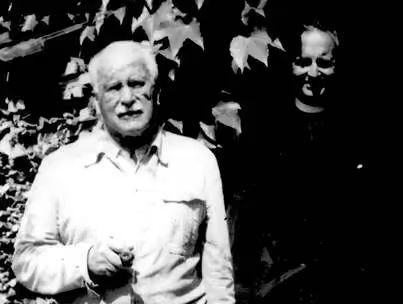
A month later, Jung responded, and boy did he. Jung replied with a letter of 4213 words (1200 words longer than the requirement for the MA essays at the university here - I pasted them directly from my PDF of the book into a word document to determine). Jung’s response is, in my view, one of the best and most poetic descriptions of the phenomena I have encountered – and essentially a message of caution. In a response dated April 10th, Jung addresses the topic directly in the latter half of the letter:
Is the L.S.D. drug Mescal[ine]? It has indeed very curious effects — of which I know far too little. I don’t know either what its psychotherapeutic value with neurotic or psychotic patients is. I only know, there is no point in wishing to know more of the collective unconscious than one gets through dreams and intuition.
The more you know of it, the greater and heavier becomes your moral burden, because the unconscious contents transform into your individual tasks and duties as soon as they begin to become conscious. Do you want to increase loneliness and misunderstanding? Do you want to find more and more complications and increasing responsibilities? You get enough of it. If I once could say, that I have done everything I know I had to do, then perhaps I should realize a legitimate need to take mescal[ine]. But if I should take it now, I would not be sure at all, that I had not taken it out of idle curiosity.
I should hate the thought, that I had touched on the sphere, where the paint is made that colours the world, where the light is created, that makes shine the splendour of the dawn, the lines and shapes of all form, the sound that fills the orbit, the thought that illuminates the darkness of the void.
There are some poor impoverished creatures perhaps, for which mescal would be a heavensent gift without a counterpoison, but I am profoundly mistrustful of the “pure gifts of the Gods”. You pay very dearly for them.
This is not the point at all, to know of or about the unconscious, nor does the story end here; on the contrary it is how and where you begin the real quest. If you are too unconscious it is a great relief to know a bit of the collective unconscious. But it becomes soon dangerous to know more, because one does not learn at the same time how to balance it through a conscious equivalent. It is really the mistake of our age.
We think it is enough to discover new things, but we don’t realize that knowing more demands a corresponding development of morality. That is the mistake Aldous Huxley makes: he does not know that he is in the role of the “Zauberlehrling” [Sorcerer’s Apprentice], that has learned from his master how to call the ghosts, but did not know how to get rid of them again:
“Die Geister, die ich rief,
Werd ich nun nicht los!”
[‘The spirits that I summoned, now I cannot banish!’
From Goethe’s poem, “Der Zauberlehrling”]

Jung concludes by requesting White to send him the material produced by patients under the effects of LSD:
I should be obliged to you indeed if you could let me see the material they get with L.S.D. It is quite awful that the alienists have caught hold of a new poison to play with, without the faintest knowledge or feeling of responsibility. It is just as if a surgeon had never learned further than to cut open his patient’s belly and to leave things there. When one gets to know unconscious contents, one should know how to deal with them. I can only hope that the doctors will feed themselves thoroughly with Mescalin, the alcaloid of divine grace, so that they learn by themselves its marvelous effect.
White, somewhat disturbed by Jung’s portentous warning, downplays his initial curiosity in a letter from May 15th:
I don’t think I was very serious in wanting some myself; I do realize very well the truth of what you say. But sometimes I feel a bit psychically constipated, and foolishly suppose a laxative (if such there be) might be a help!
Jung’s warning was well taken by the Catholic theologian. And Jung’s discussion concerning the insistence to integrate ‘unconscious content’ with a balancing ‘conscious equivalent’ is intriguing – and one I still puzzle over. This, in Jung’s view, was the integral role of the dreaming and intuition function of the psyche – too much unconscious content, and delivered too suddenly, can overwhelm a person and make them ‘aware’ of simply too much mundane realia that demands tending to. ‘Beware of receiving wisdom which you did not earn’ is a take on Jung’s view I’ve read elsewhere. Personally, I think entire libraries of books by the wisest and most learned among us still need to be constructed for us to have even a glimpse of genuine understanding of the psychedelic/entheogenic phenomena. For myself, I look forward to having more time to delve into the Jung library we have on our second floor here and letting my intuition guide me!
Written by
Corey Andrews
Corey Andrews is a PhD candidate at the University of Amsterdam and a researcher working for the Ritman Research Institute. His research focuses primarily on 17th and 18th century Rosicrucianism and the life and works of Jan Amos Comenius (1592-1670).


.avif)