


.svg)
The Story Behind a Bookplate: What a book can tell us about the owner
By
José Bouman
October 15, 2025
Portrait of Friedrich Nicolai, Christian Gottlieb Geyser, 18th century.

The Story Behind a Bookplate: What a book can tell us about the owner
Portrait of Friedrich Nicolai, Christian Gottlieb Geyser, 18th century.

The Story Behind a Bookplate: What a book can tell us about the owner
By
José Bouman
October 15, 2025
“Friederici Nicolai et amicorum”, or ‘Friedrich Nicolai and his friends’, is the inscription in the book held by one putto (Italian for ‘baby angel’) and inscribed by another. This bookplate was made by the Polish-German printmaker and portraitist Daniel Chodowiecki (1726-1801).
He not only made this bookplate, but also a portrait of Friedrich Nicolai (1733-1811), son of the founder of a publishing house that still exists. He continued his father’s publishing house with great success.
With that ‘et amicorum’, Nicolaï also shows that he ranks himself among the great book collectors: he borrows this motto from Jean Grolier, who, in the first half of the 16th century, had his books bound in richly decorated leather bindings with this text stamped on them.
A dedicated man of the Enlightenment, he was also a freemason and a member of the masonic Berlin lodge “Zur Eintracht”, a daughter lodge of the Grand National Mother Lodge “Die drei Weltkugeln”.
In 1791 the man who was lambasted by contemporaries as a ‘coarse rationalist’ suffered for two months from an affliction that brought on delusions and caused him to see ghosts. He was cured, he believed, by the application of medicinal leeches and even reported about the successful treatment to the Berlin Academy of Sciences, to the derision of his foes. The poet Heinrich Heine later said that “old Nicolai was basically a very decent man, who (…) for love of the holy cause of the truth was prepared to suffer the worst kind of martyrdom: that of being found ridiculous”.
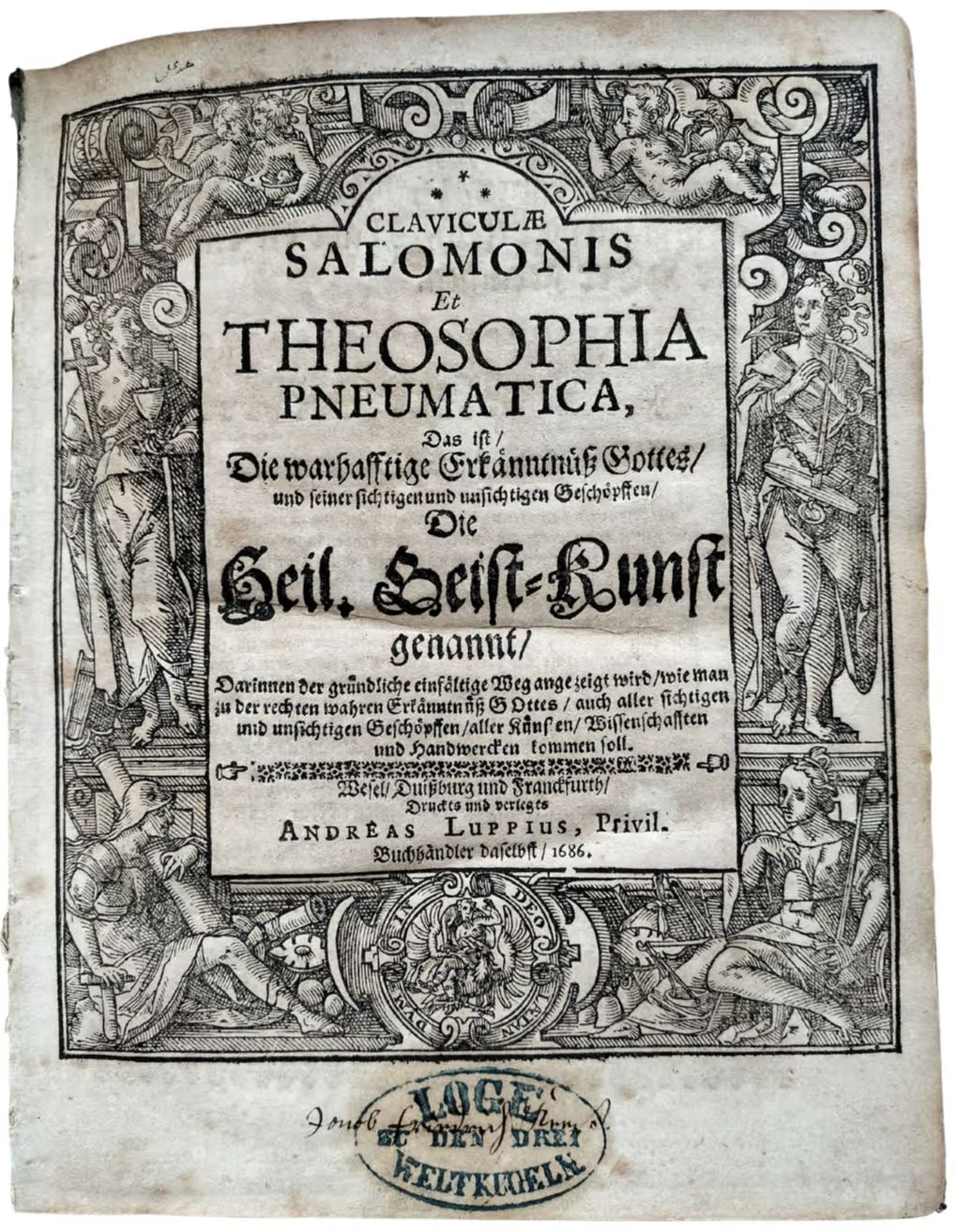
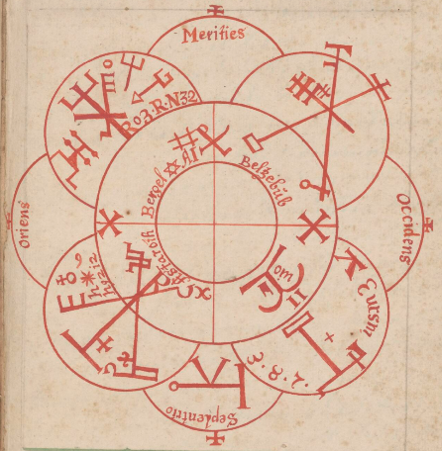
The BPH owns two books with Nicolai’s bookplate: one is a manuscript containing a text by Jacob Böhme, De signatura rerum, copied after the printed edition of 1635. We have not yet been able to determine whether Nicolaï copied this book himself. But the fact that he possessed a text by an author such as Böhme, who had a mystical and decidedly non-rational view of the world, says a lot about Nicolaï. The second is a copy of the (in)famous grimoire Claviculae Salomonis, published by Andreas Luppius in Wesel in 1686. Interestingly, the title page also features the stamp of “Die drei Weltkugeln”. Did Nicolai donate his copy to the lodge library, or did the lodge divest some of its books, including Claviculae Salomonis, to fellow masons? But again: a book we would not have expected in Nicolaï’s library!


Written by
José Bouman
Drs José Bouman has been head curator of the Bibliotheca Philosophica Hermetica since 1983. She has shaped every museum exhibition since and specialises in Dutch medieval literature.

.avif)