
.svg)
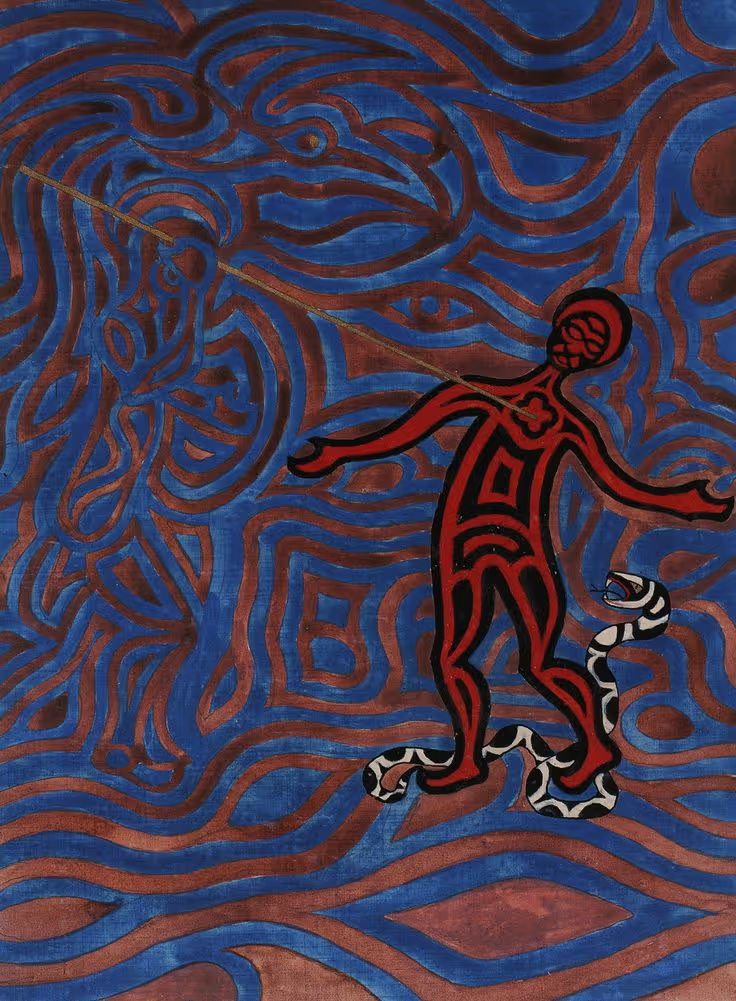
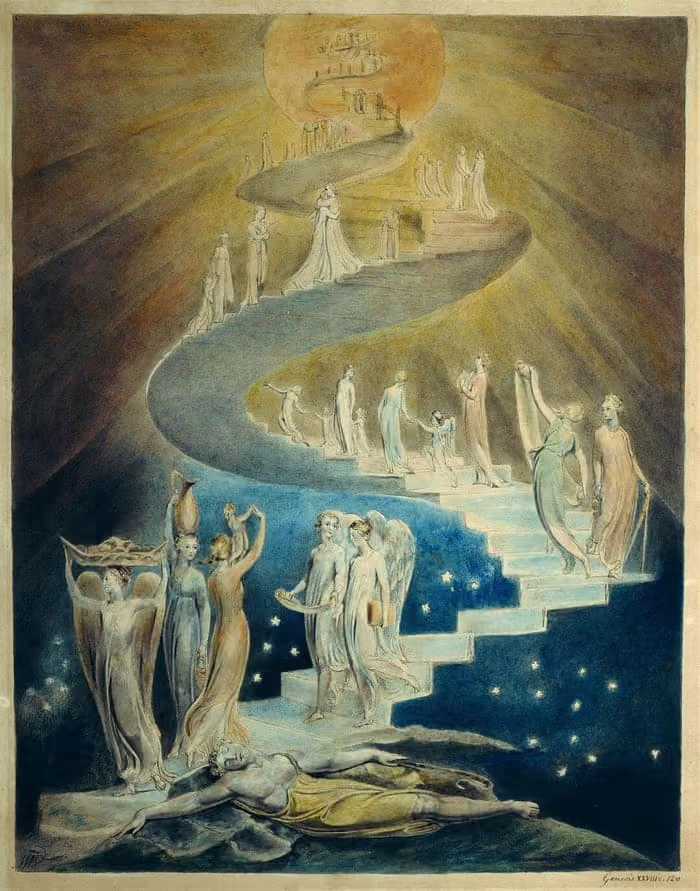
Illustration from The Red Book, Carl Gustav Jung, c. 1915 to 1930.

Neoplatonic Psychoanalysis & Hermetic Magic
Illustration from The Red Book, Carl Gustav Jung, c. 1915 to 1930.

Neoplatonic Psychoanalysis & Hermetic Magic
By
Dr. Barbara Miller
August 15, 2025
I have heard it said that the life of C.G. Jung is a meandering between Neoplatonic Psychoanalysis and Hermetic Magic. In the course of researching religious change and continuity - shamanic, taoist, pietist, Pentecostal, psychoanalytic - I have come to apply Methodological Ludens, as formulated by Professor Anthropology of Religion André Droogers, Vrij University, Amsterdam.
This research methodology is to play and participate for experiences where the desire for wholeness is expressed and that can be read as signs that God is active in each individual life. Through such methodology one can recognize correspondences and note the proposition of a hermeneutics as found in Heidegger.
Hermeneutics requires, not getting outside of an understanding to understand better, but getting more fully within our understanding in order to fully occupy our hermeneutic situation. That is, get into and embody our hermeneutic situation, which sees/reads the potential for human transformation and spiritual evolution.
C. G. Jung - in applied "play and participation” - came to a practice for having Spontaneous Thought, which can be found in the attitude to meet your life and meet your thought, rather than try to escape it.
C. G. Jung wrote in 1957:
“The Years, of which I have spoken to you, when I pursued the inner images, were the most important time of my life. Everything else is to be derived from this. It began at that time, and the later details hardly matter anymore. My entire life consisted in elaborating what had burst forth from the unconscious and flooded me like an enigmatic stream and threatened to break me. That was the stuff and material for more than only one life. Everything later was merely the outer classification, the scientific elaboration. And integration into life. But the numinous beginning, which contained everything, was then.”

What is Jung telling us here?
- Life / existence is always in a certain pattern but told in a variety of stories.
- We function from out of our ego system, which has memory, and function from out of our Self (soul) system, which has symbols.
- Story “becomes” in the mutual response.
- The mutual response is between the ego system and the Self system.
- Spontaneous thought is in the attitude to “meet” your thought rather than to try to escape.
- Spontaneous thought is the revelatory experience of story“becoming” in mutual response.
- Myth tells these stories, and are retold to relive oneness.

Written by
Dr. Barbara Miller
Dr Barbara Miller is an independent scholar who defended her PhD in 2007 at Leiden University. She has numerous publications on themes related to Jungian psychology, myth, healing, art, consciousness, and indigenous peoples.

.avif)