

%20Medium.avif)
.svg)
'The Devil and Dr. Faustus Meet', artist unknown, ca. 1825, Wellcome Library, London.

Manuscript Highlight: The Faust Manuscript
'The Devil and Dr. Faustus Meet', artist unknown, ca. 1825, Wellcome Library, London.

Manuscript Highlight: The Faust Manuscript
By
Corey Andrews
September 15, 2025
‘These metaphysics of magicians
And necromantic books are heavenly.
Lines, circles, letters, and characters
– Ay, these are those that Faustus most desires.’
- Act 1, Scene 1, Christopher Marlowe’s Doctor Faustus
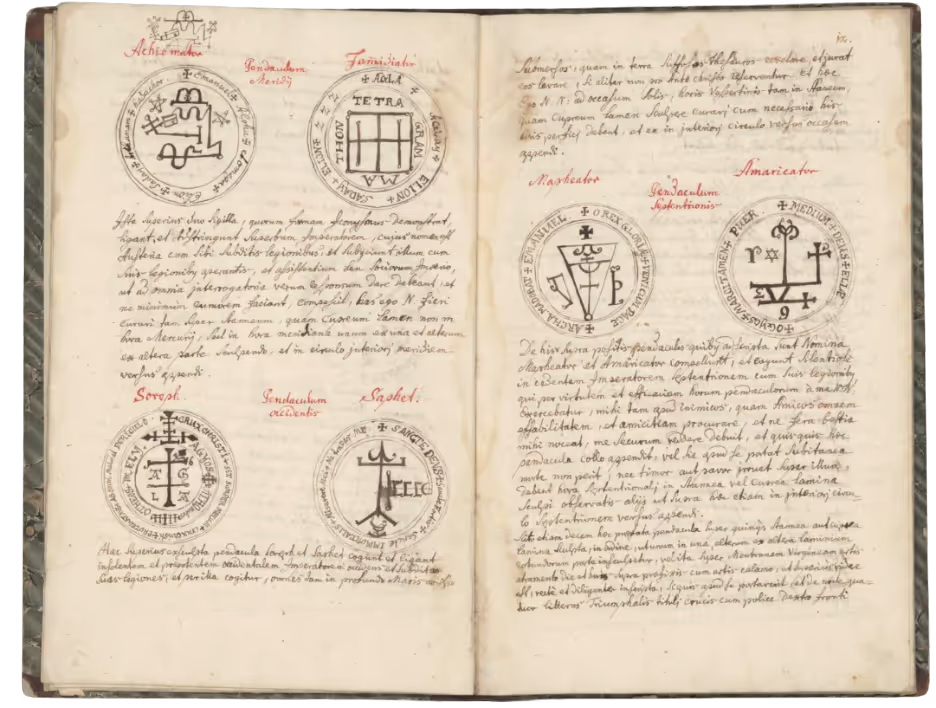
One of the most intriguing manuscripts we have in our collection is what I affectionately refer to as ‘the Faust manuscript’. Its full title reads:
‘Manuale Magicum Doctoris Fausti, id est magnum quatratum pendaculum salomonis regis seu terribilis afstrictio et compulsion gehemae. Omnis Daemonorum genera obediential subijenda.’
(The Magical Manual of Doctor Faustus, that is, the Great Square Pendant of King Solomon, or the Terrible Bondage and Compulsion of Hell. Including Instructions Concerning the Subjugation and Obedience of All Kinds of Demons.)
In addition to a course on the cross-cultural study of rites of passage, my favorite course from my undergraduate studies at UMASS Boston was exclusively dedicated to the Faust myth. The course was titled ‘Pacting with the Devil: the Faust Tradition’, taught by the great Diana Lewis Burgin. The course analyzed how the ‘bargain with the devil’ narrative motif originated with the Book of Job from the Biblical corpus where God makes a bet with the devil. The ‘bet’ involved the devil arguing that he could turn Job against his creator by making his life miserable; turning his friends against him, riddling him with disease, et cetera. Spoiler alert: the devil loses the bet in the end, Job never cursed his creator, instead opting to curse the day he was born. A version of the story was then resurrected in the late 16th century in ‘The Tragicall History of Doctor Faustus’ written by English playwright Christopher Marlowe (1564-1593). It focused on a scholar, Faustus, who sells his soul to the devil in exchange for magical power.
The Faust myth was then brought to an apotheotic apogee with the publication of Faust in 1790 by German poet, statesman, and scientist Johann Wolfgang van Goethe (1749-1832). In essence, it tells the story of Faust, a doctor of philosophy, medicine, and law – immediately introducing the character as someone who has attained ‘all worldly knowledge’, but is not satisfied with it.
He wants infinite knowledge, i.e., ‘omniscience’, or the knowledge of God, which is forbidden for human beings to possess. The story begins with Faust conducting a ceremonial magical ritual which results in him summoning an emissary and familiar of Satan, a character called Mephistopheles who appears in the form of a black poodle dog.
The poodle is evocative of the most important magus of the Renaissance, the historical Cornelius Agrippa (1486-1535), author of De Occulta Philosophia libri tres (Three Books of Occult Philosophy, 1533) who – according to legend - owned a black poodle! Mephisto offers Faust the infinite knowledge he seeks in exchange for his soul at the end of his life – a bargain which proves too tempting for Faust and which he agrees to. Then, as matter of course, all hell breaks loose for Faust because of course, one is not supposed to do that! Whereas in Marlowe’s version, our ‘Tragicall’ Faustus is true to its title, (he gets dragged to hell by a legion of demons at the end), Goethe’s Faust character is ultimately permitted into Heaven in the end due to the forgiving Gretchen who represents the positive aspect of the divine feminine archetype in the story.

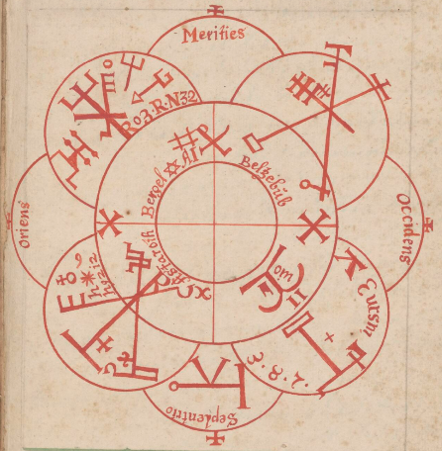
This background brings us to our Faust manuscript, apparently composed in the 18th century when Goethe may have still been alive! Within its pages we encounter hand-drawn magical sigils, talismans, and diagrams very similar to other symbols we encounter in some of our other Solomonic magical grimoires and manuscripts – some of which are currently displayed in our exhibition.
Even without expert knowledge we can make at least two safe assumptions: the person(s?) who made this document took it very seriously, and (2) this is precisely the sort of treatise which many authorities would have been happy to commit to the fire. But lo! It has survived.
The undergraduate course concluded with us having to read the latest iteration of the Faust myth, namely The Master and Margherita (1966) written by Russian novelist Mikhail Bulgakov (1891-1940). A work which was published posthumously due to Soviet censorship and has since been hailed as one of the masterpieces of 20th century literature.
Want to investigate this magical manuscript yourself? You can! Click below to access the completely digitized version on our catalogue.

Written by
Corey Andrews
Corey Andrews is a PhD candidate at the University of Amsterdam and a researcher working for the Ritman Research Institute. His research focuses primarily on 17th and 18th century Rosicrucianism and the life and works of Jan Amos Comenius (1592-1670).

.avif)