

.svg)
Manuscript Highlight: Mysterious Mystical Memory Method Motifs in a Work Attributed to Ramon Lull
By
Corey Andrews
August 15, 2025
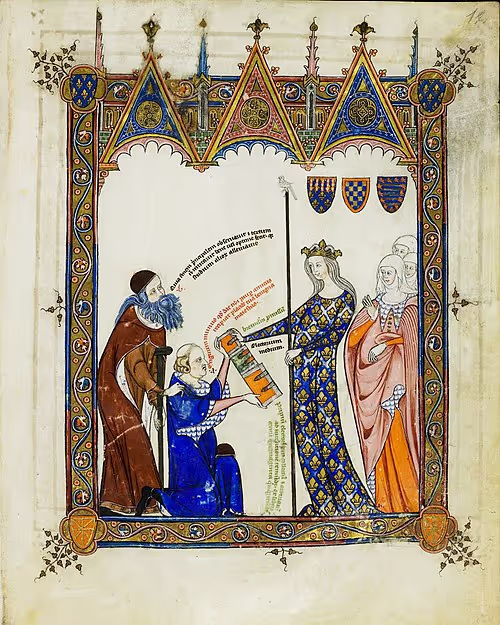
'Ramon Llull with His Disciple Thomas Le Myésier', artist unknown, ca. 14th century.

Manuscript Highlight: Mysterious Mystical Memory Method Motifs in a Work Attributed to Ramon Lull
'Ramon Llull with His Disciple Thomas Le Myésier', artist unknown, ca. 14th century.

Manuscript Highlight: Mysterious Mystical Memory Method Motifs in a Work Attributed to Ramon Lull
By
Corey Andrews
August 15, 2025
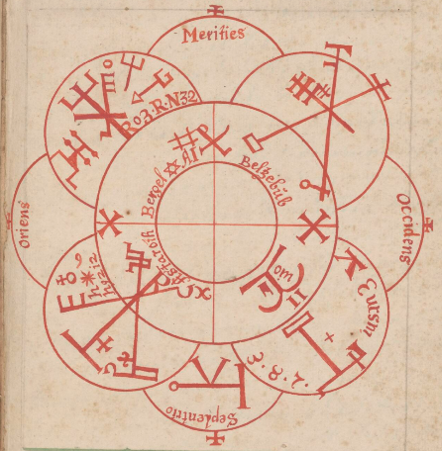
Along the shelves of our manuscript section in our rare book room stand four imposing black tomes - about which very little is known. They are written by someone called ‘Raymundi Lulli’ and as the subtitle of the work suggests, the work concerns ‘De Veri Lapidis Compositione’ (On the True Composition of the Stone), presumably the lapis philosophorum (stone of the philosophers).
The four volumes are written by hand in a combination of German and Latin, and appears to be by not a single hand, but many. The idea of multiple authors became clear to me when I had the chance to host the Oxford scholar Howard Hotson earlier this year. Hotson had just finished delivering the keynote lecture in our great hall at the conclusion of an international Comenius conference when I invited him to have a look at some of our treasures. “It isn’t every day you have someone in house who is more acquainted with Latin than I am with English!” – I thought to myself.
It also helps that Hotson is the specialist of Johann Heinrich Alsted (1588-1638), the father of the early modern encyclopaedic movement, and about whom Hoston has written several monographs. Alsted was an early master to a young Comenius, and – importantly - translator of the compendious works of Blessed Ramon Lull (1232-1316), the 13thcentury theologian, mystic, and ‘doctor illuminatus’ from Majorca who ostensibly wrote the manuscript you see in the photos.
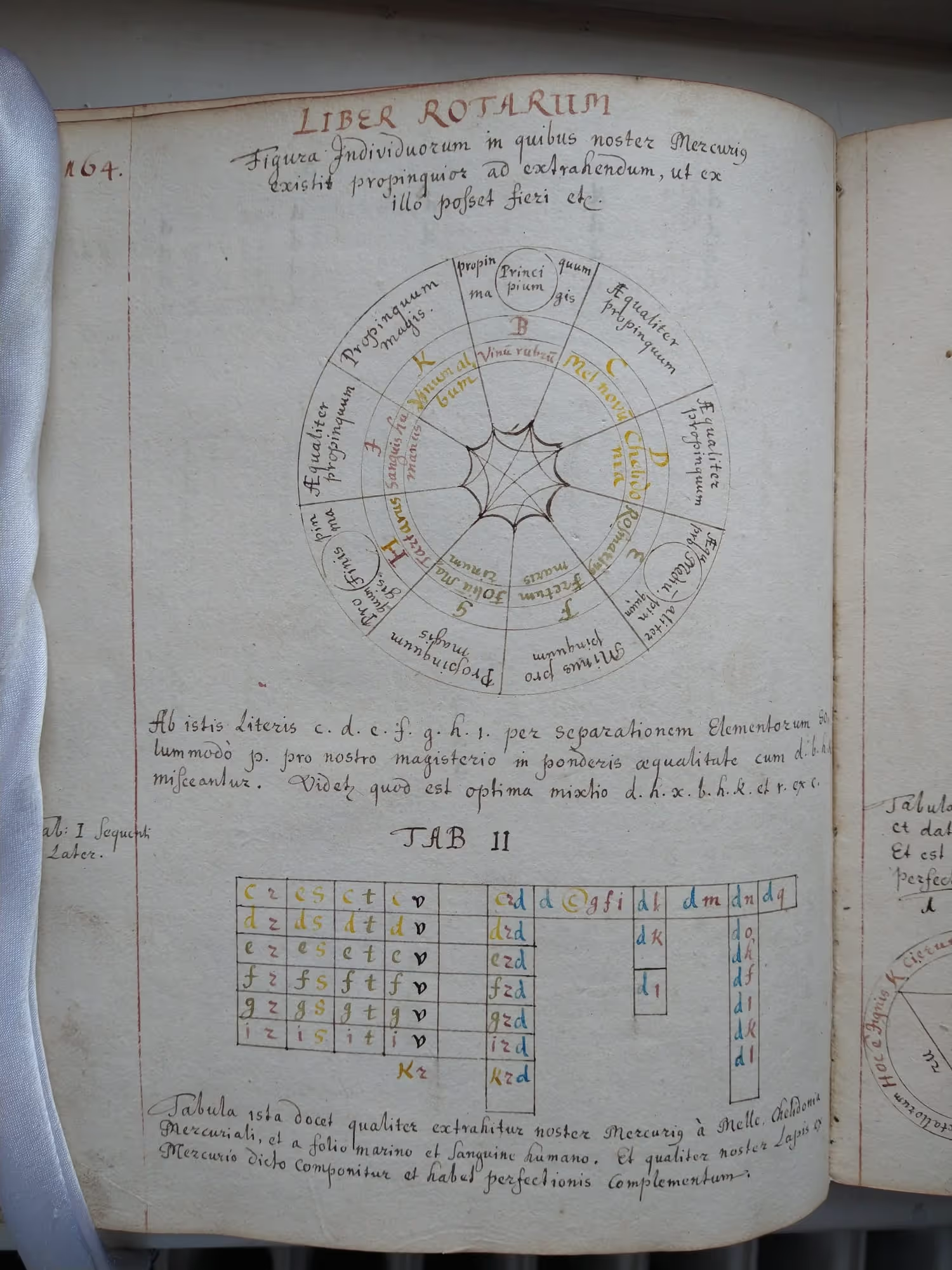
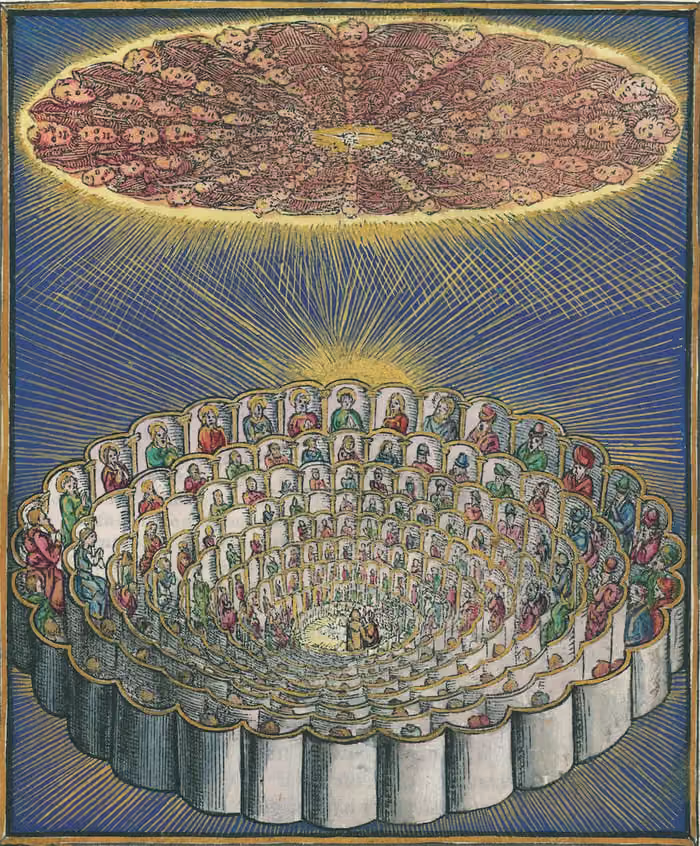
Among other things, Lull is remembered for developing the ‘ars combinatoria’ (combinatory art),which is fundamentally a ‘tékhnē’ (Romanized Greek of the Latin ‘ars’, i.e., art, skill, craft). Put simply it was a practical combinatory method involving mystical, contemplative, mathematical, and divinatory notions ultimately aimed at uniting with God (unio mystica). As indicated by the diagrams, it is often seen as being easily combined with Christian Cabalistic ideas. However, what the Cabalists call ‘sefirot’ (i.e., the emanations of God in Creation), Lull termed ‘Dignities’.
Something is wrong though. As determined by Hotson, the manuscript is in multiple hands, and Lull lived in the 13th-century whereas these Lullian manuscripts were written in the mid-17th-century!
The solution is rather simple and very common in the learned Western Esoteric tradition: pseudonymous authorship.
That’s right, our author(s), like the authors of many works deemed ‘heretical’, opted to use the name of someone whom they revered and who saw themselves as further developing the original person’s system or beliefs.
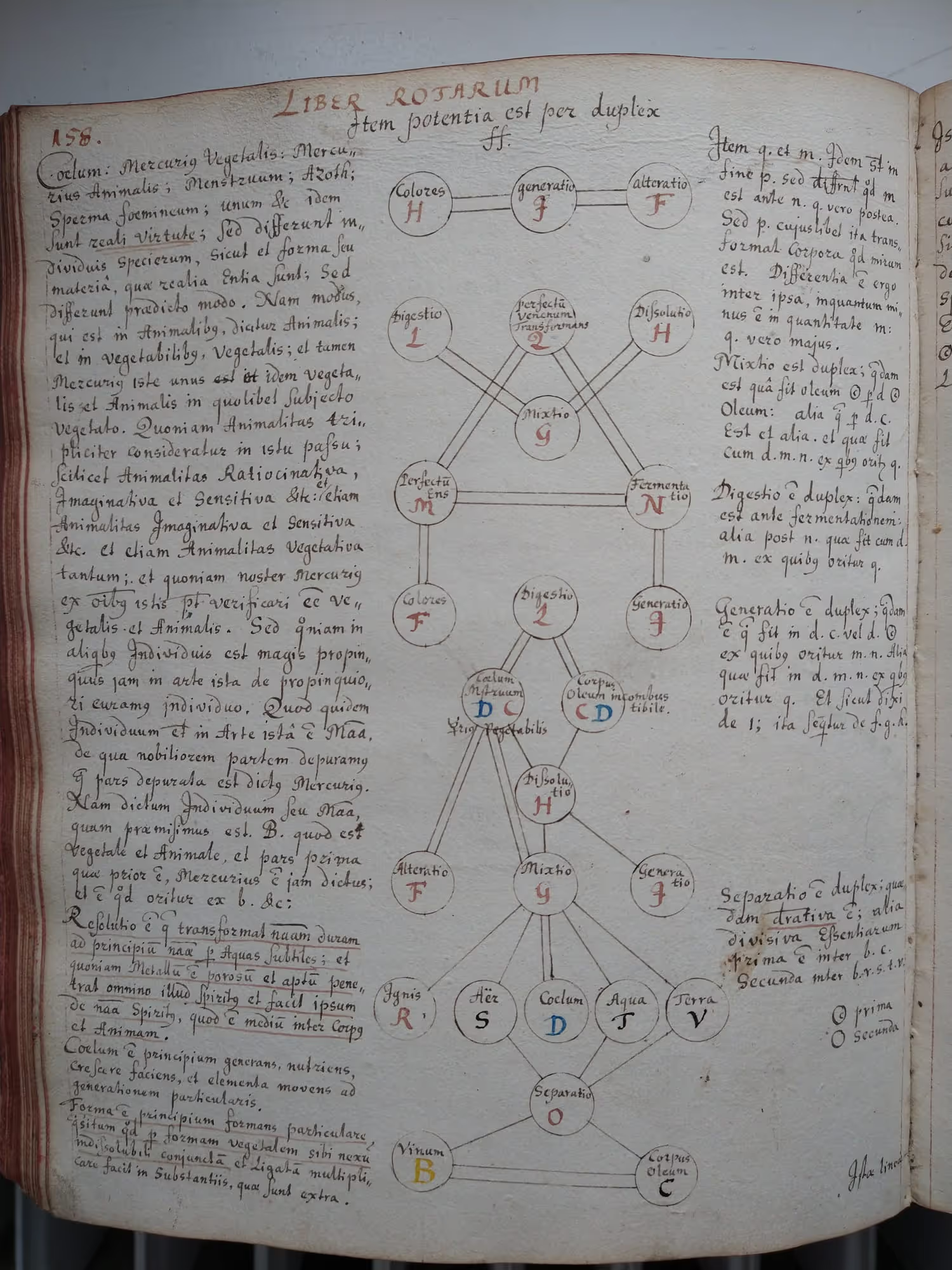
Pseudonyms haunt our collection and make it simultaneously more interesting and more frustrating to research, it’s not always easy to track down who wrote what. Curious readers might also like to learn that the association of Lullism and Cabala to the memory arts was the focus of an important work titled ‘The Art of Memory’ by the great mother of esoteric scholarship, Frances Yates in 1999.
And for those especially curious, the first of four volumes is fully digitized and can be accessed by clicking the link below!
Written by
Corey Andrews
Corey Andrews is a PhD candidate at the University of Amsterdam and a researcher working for the Ritman Research Institute. His research focuses primarily on 17th and 18th century Rosicrucianism and the life and works of Jan Amos Comenius (1592-1670).

.avif)