


.svg)
'The Book of Job: The Lord Answering Job Out of the Whirlwind', William Blake, ca. 1826.

Job, Blake, Leviathan: A Rare Proof Edition
'The Book of Job: The Lord Answering Job Out of the Whirlwind', William Blake, ca. 1826.

Job, Blake, Leviathan: A Rare Proof Edition
By
Corey Andrews
October 15, 2025
Last month I wrote about one our magical manuscripts, the so-called ‘Faust Manuscript’. As I discussed therein, the Faust myth, at the centre of which is the ‘bargain with the devil’ motif, derives ultimately from the Book of Job from the biblical corpus. Goethe’s Faust appeared in publication in 1790. Goethe was so gripped by the story that he continued writing the work over his entire life, completing Faust part two in 1832, the same year he died.
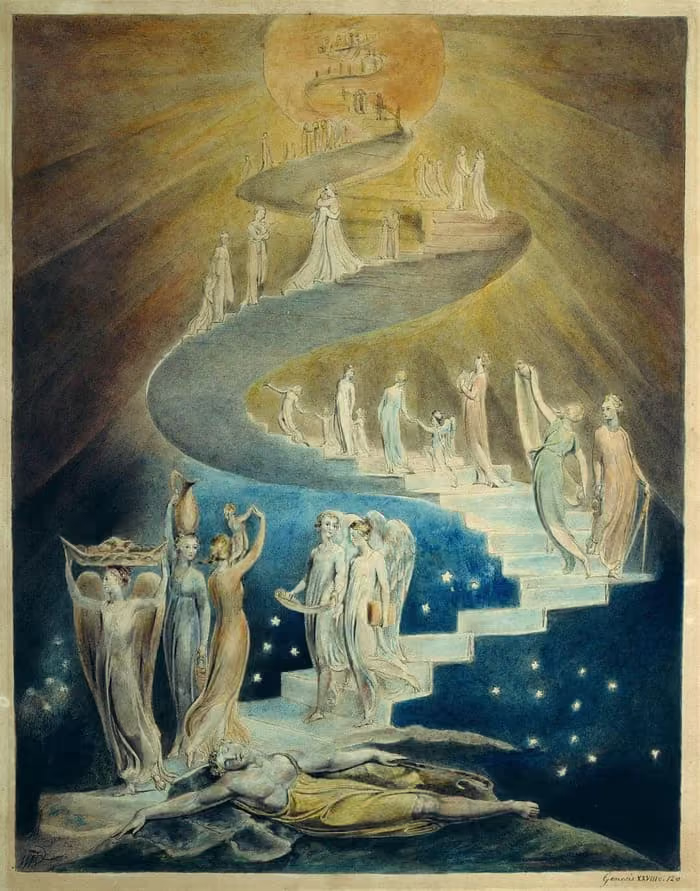
To be sure, Goethe’s Faust is the most important manifestation of the story in the 18th century. However, the archetypal power of the narrative manifested also in the 19th century, where it gripped another figure of equivalent magnitude to Goethe, namely, the great English poet, printmaker, painter, and mystic William Blake (1757-1827). Largely ignored during his lifetime, Blake’s influence at this point is virtually incalculable. Such monumental works as ‘the archetype of the Creator’ (1790), ‘the Ancient of Days’ (1794), and ‘The Great Red Dragon and the Woman Clothed with Sun’ (1805) to name but a few; images which haunt the Western mystic imagination and beckon for notice. I’m unable to include all the images in this contribution, but a quick image search engine query will yield the lot of them.
Continuing the thread, one of Blake’s most important series of engravings are his ‘Illustrations of the Book of Job’, referring to twenty-two engraved prints by Blake illustrating the biblical Book of Job. Considered by many to be Blake’s greatest masterpieces in the medium of engraving, I bring to you a particularly rare, curious, and valuable edition of at least two of them!

In our collection we have a first edition proof run of the illustrations. For the uninitiated, a ‘proof run’ refers to an initial publication of a work which is meant to be provided to the author/creator to determine what flaws exist and must be corrected before it goes through to the final print run. Essentially, before you print hundreds, thousands, or tens of thousands of books, you ought to do a ‘proof’ check to make sure all is in order. The fact that this edition is one of the early proof runs makes it an extremely rare item.

Concerning the story, Job is presented as the exemplary good man. He is a wealthy, God-fearing, hard-working, everyman with a comfortable life and a large family. God then has a discussion with הַשָּׂטן, haśśāṭān, literally 'the adversary'; i.e.,“the Satan” regarding Jobs piety. God ultimately entertains a bet withSatan that regardless of what is taken away from him, Job will refrain from cursing God and will maintain his steadfast faith. God then permits Satan to inflict all kinds of extreme suffering on Job: disease, the loss of his family, his friends, and so forth. Rather than cursing God, Job curses the day he was born, ultimately proving the devil wrong, and God right.
One of the most frightening bits of dialogue from the story involves God explaining to Job the features of Behemoth and Leviathan, primordial monsters which feature in many ancient stories. The Leviathan description in particular is very thought provoking and beautiful. Described as a sea serpent demon and ‘embodiment of chaos threatening to eat the damned when their lives are over’, it is annihilated in the end. Other interpretations state it is that which God defeated in order to create the cosmos (κόσμος; kósmos, literally: ‘order’).
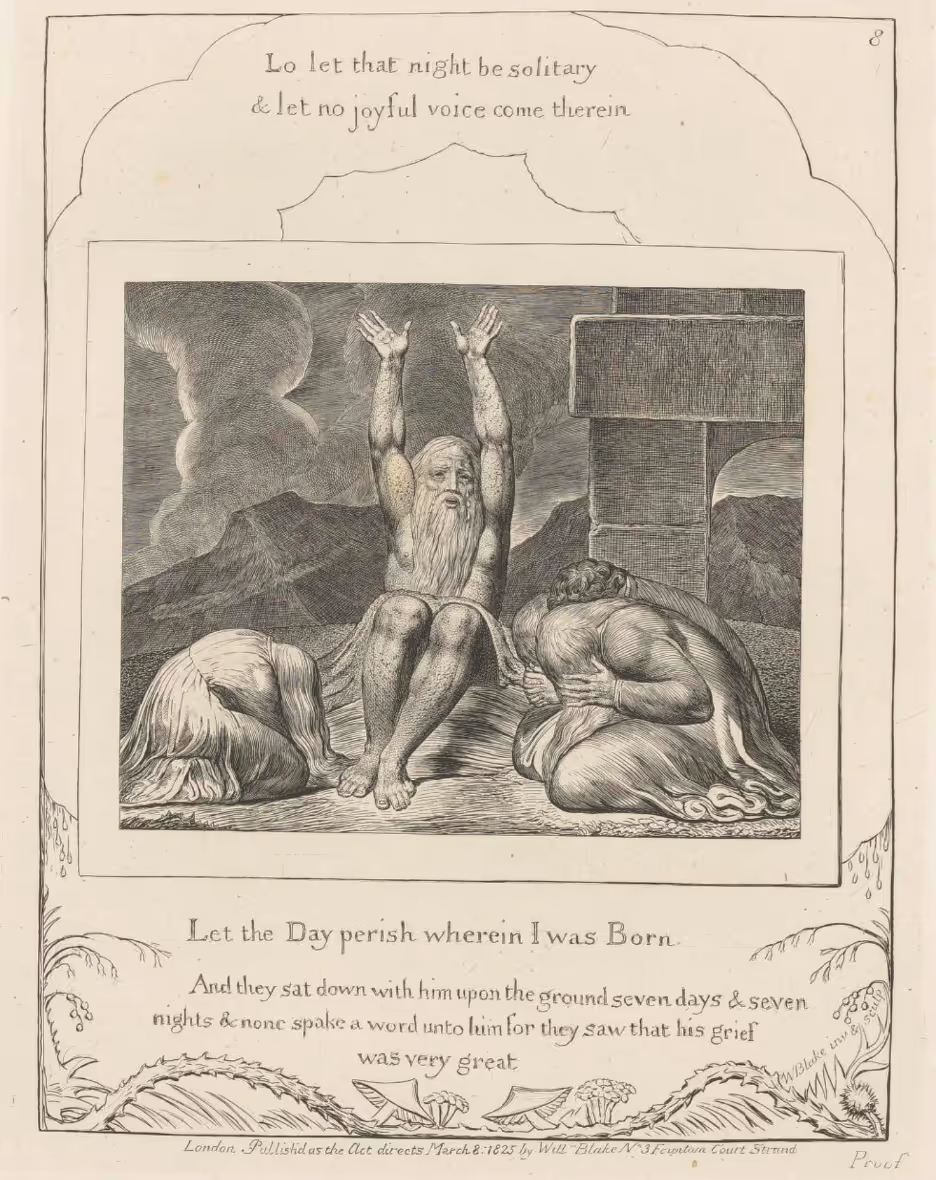
One of the most well-known engravings from Blake’s work depicts the two monsters. I include only a portion of the description, to read its full terrifying description, follow the link below!

“Can you pull in Leviathan with a fishhook, or tie down its tongue with a rope? Will it keep you begging for mercy? Will it speak to you with gentle words? If you lay a hand on it, you will remember the struggle and never do it again! Any hope of subduing it is false; the mere sight of it is overpowering.
…
Its back has rows of shields tightly sealed together; each is so close to the next that no air can pass between. Flames stream from its mouth; sparks of fire shoot out. Its chest is hard as rock, when it rises up the mighty are terrified. The sword that reaches it has no effect, nor does the spear or the dart or the javelin. It leaves a glistening wake behind it. Nothing on earth is its equal – a creature without fear. It looks down on all that are haughty; it is king over all that are proud.”
— Job 41, 1-34, NIV.

Written by
Corey Andrews
Corey Andrews is a PhD candidate at the University of Amsterdam and a researcher working for the Ritman Research Institute. His research focuses primarily on 17th and 18th century Rosicrucianism and the life and works of Jan Amos Comenius (1592-1670).

.avif)