

.svg)
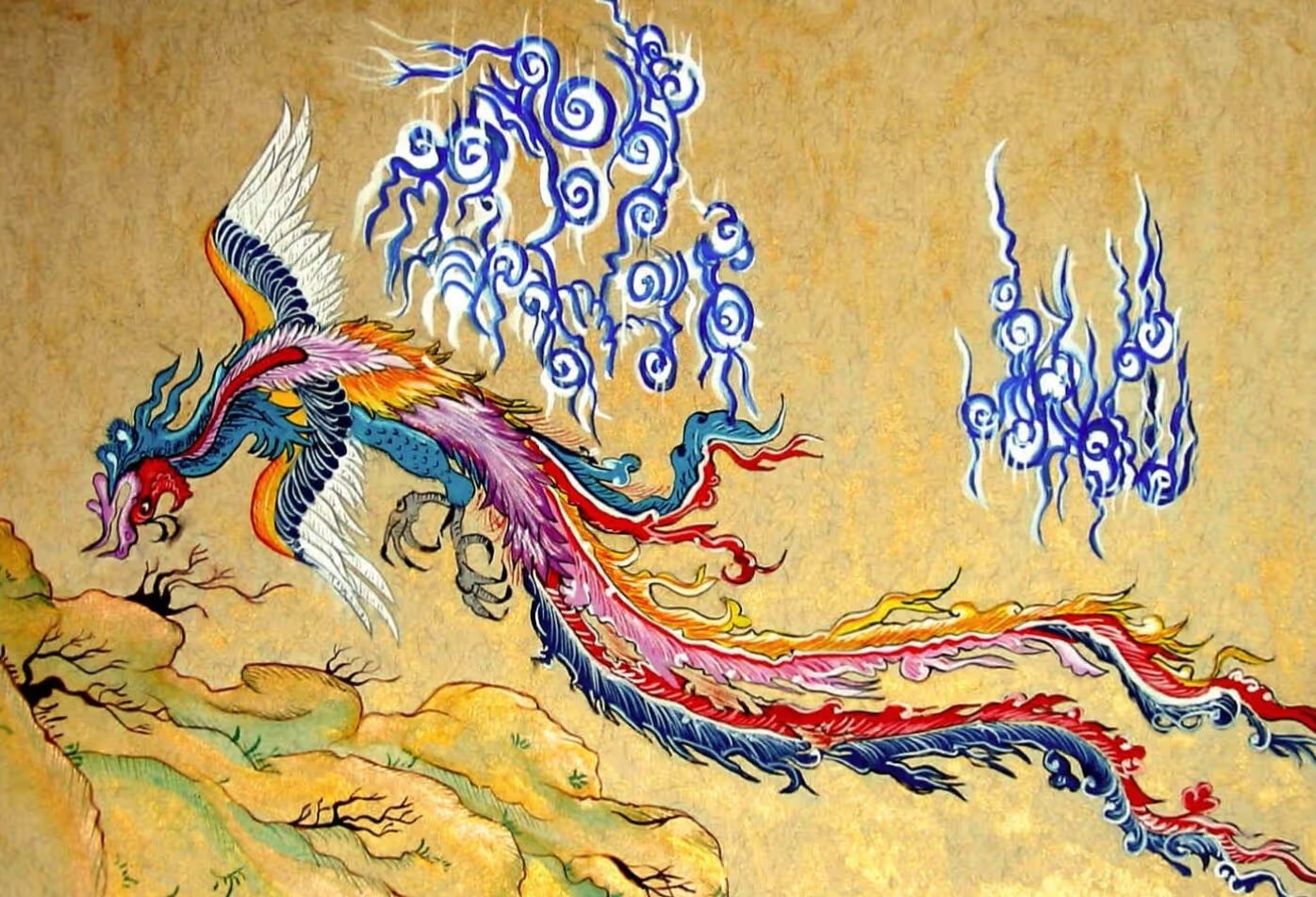
Recording- Paradise Garden: Phoenix, Firebird, Simorgh
Illustration of Simorgh


From the ashes of the alchemical blackening – the Nigredo– rises the phoenix, the Firebird or the Persian Simorgh.
A bird whose feathers or tears heal the unhealable, make possible the impossible, bring hope where there is hopelessness and bring back life to that which has been deemed completely lost.
From the intensity of fire, after utter loss and devastation, a being so one with the element of fire is gestated in ash. In Alchemy it is an image of the Philosophers’ stone – the dynamic stone of life that emerges from the intense work of inner and outer alchemy, an embodiment of Wisdom herself, incarnate in the human soul. In Persian cosmogony, the Simorgh is a spiritual guide that leads the mystical seeker to their true home, Mount Qaf. But older than Attar’s Sufi allegory, the Simorgh is said to be the bird that lives in the liminal space of heaven and earth, it belongs to and brings together the Sky and the Earth in the Zoroastrian Vourukasha, making home in the Tree of Life. It is said to have lived through many apocalypses and to have seen the rise and fall of civilisations. But this fiery bird is not only a heavenly presence; the Iranian pahlevan (hero) depends on the Simorgh for healing and guidance in his battle to preserve a nation. And between the East and West soars the Slavic Firebird whose fiery feathers are the mark of authenticity and initiation of the hero/ine, while a mysterious bird in Armenia heals a lost, thorny paradise garden and its wicked gardeners through her songs of sorrow and joy.
What other companion could we seek out at this time of immense political confusion, disruption and uncertainty – not only as Iranians but as global citizens facing the poly-crises? Perhaps, invoking and listening to the fiery wisdom of this firebird and its tales from the East and the West is what will bring resilience and meaning –even if a droplet– in times of real need.
About the Hosts
Farânak Mirjalili is a Zürich trained Jungian analyst (IAAP). As both a Sufi mystic and psychoanalyst, she's interested in the places where trauma and the soul meet, and how the analytical work can become a work of descent and incarnation that can hold both the ordinary and extraordinary of life, while being rooted in the depths of the inner and imaginal worlds. She’s especially drawn to the questions of what it means to be a mystic and advocate of the soul in our current landscapes of poly-crises.
She earned a Research Master's degree at the University of Amsterdam, where she did groundbreaking fieldwork on the intersection of Jungian psycho-spiritual alchemy and laboratory alchemy— a work that she has now completed within a psychoanalytical framework at the CG Jung Institute. The title of her research is: “Alchemy & The Poetics of Matter: Eco-mysticism and the Practice of Alchemy for a Wounded World.”
Sepand Dadbeh (b. 1992) is an Iranian multi-instrumentalist, troubadour, and cultural entrepreneur known for his musical storytelling and innovative interpretation of multiculturalism in the performing arts. Raised in a family of renowned artists, he began with the Tombak before specializing in the Oud and Tanbour. At 18, he joined the prestigious Shams Ensemble, and in 2012 co-founded the Jansouz Collective with his sister Khorshid to honor their grandfather’s legacy. Sepand holds a BA in Iranian Music from Tehran University and an MMus in World Music from Codarts Rotterdam. His work seeks to harmonize spirituality and ancient musical traditions with contemporary artistic expression.
Format
Storytelling | Music | Recording
Price
€20,- recording (shared on August 14th 2026).
Getting There
Address
House with the Heads
Keizersgracht 123, 1015 CJ Amsterdam
Public Transport
A fifteen-minute walk from Amsterdam Central Station. Prefer public transport? Take trams 13 or 17, or bus 170, 172, or 174 to the Westermarkt stop. From there, walk back a short distance, turn left onto Keizersgracht, and you will find us on your right after 300 meters.
Bike
Amsterdam is best explored on two wheels, and the EFM is no exception. Ample bike parking is available along the Keizersgracht.
Car
Parking in the area is paid (~ €8,05 per hour), and spaces can be difficult to find. The nearest parking garages are Q-park Nieuwendijk at Nieuwezijds Kolk 18 (650 meters), Q-park Bijenkorf at Beursstraat 15 (950 meters), and Q-park Europarking at Marnixstraat 250 (1,300 meters). You can also park at a P+R location and travel into the centre by public transport.
Upcoming Events
From immersive cultural experiences to distinguished academic gatherings, the Embassy of the Free Mind offers a diverse agenda open to all curious minds.
.avif)
.avif)
.jpeg)
Become a Member
Become part of a living community dedicated to free inquiry and the extraordinary legacy of the Bibliotheca Philosophica Hermetica.
Join our community
Unlimited museum entry
Seasonal culture & community event invitations
From
/ year
.svg)

.avif)