

Symposium: Spontaneous Thought in Archetypal Narrative
"Sagittarius" (Zodiac Illustration) in Metaliʿü'l-saadet ve yenabiʿü-l-siyadet (The Ascent of Felicity and the Sources of Sovereignty), Seyyid Mohammed ibn Emir Hasan el-Suʿudî, 1582, Bibliothèque nationale de France, Paris.


In 1959, in the Epilogue to his Red Book, Carl Gustav Jung writes, “I always knew that these experiences contained something precious…I knew of nothing better than to write them down… and to paint the images that emerged through reliving it all.” In 1928, Richard Wilhelm sent Jung the Chinese text of the “Golden Flower,” an alchemical treatise, and Jung writes, the contents of the Red Book “found their way into actuality.” In 1932, Wolfgang Pauli (Nobel Prize-winning physicist) began a therapy with Carl Gustav Jung for problems with the body. Their dialogue was to foster an understanding of the common underpinning of the physical sphere and the psychic sphere (body and spirit). In doing so, they refer to certain Far Eastern bodily practices where the body is not something to be mastered, but the body can testify to an original spontaneity inscribing the subject in his environment, which happens below the will and conscious perception.
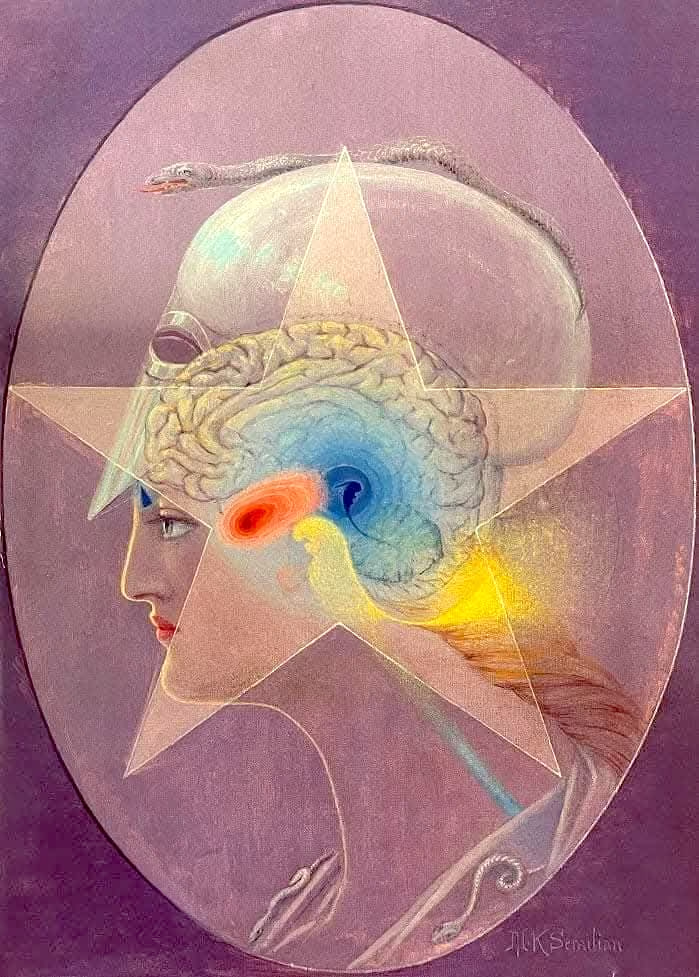
We call your attention to the emerging practice: “through reliving it all” and “an original spontaneity inscribing the subject in his environment”. In Anthropology, such participation mystic is seen as “embodiment.” In Analytical Psychology and Chinese inner alchemy, it is a practice whereby the archetypal patterns are relived and help to heal the lack of complementarity in the present moment. Developments in embodied cognition reveal a code that links the world of universal emotional responses to common experiences, to the world of embodied visuospatial narratives--i.e., the "archetypes" of analytical psychology. Viewed in this manner, archetypes become spontaneous symbolic narratives that symbolize universal emotional responses to typical human environments. Professor André Droogers formulated his research methodology as Methodological Ludens, which is to play and participate FOR experiences where the desire for wholeness is expressed, and that can be read as signs that God is active in each life.
Pre-eminent mythologist Joseph Campbell clarifies: Mythology stems from the human body - our own experiences. Fantasy/imagination is a product of the body; that is, the energies that bring forth the fantasy/imagination derive from the organs of the body (consider the hormonal system). The organs are our source for life and for our intentions. These intentions are often in conflict with each other, and various impulses dominate our life systems. Mythological imagery can be used to harmonize and coordinate the energies of our body in order to live a harmonious and fruitful life. Moreover, myths indicate the possibilities of and for human life. Additionally, myth has systematized and organized fantasy in relation to the values of a specific group - myths inform a given social order. This is the necessary knowledge to live in one’s environment.
Does 'spontaneous thought' provide the necessary knowledge to live in one’s environment? Is a work of Art sometimes a revelation of spontaneous thought? Is there an affinity between spontaneous thought and synchronicity?
Format
Symposium
10:30 | coffee and welcome
11:00 - 12:30 | Talk on Jacob Böhme, Henry Corbin, and the Ethics of the Ineffable by Dr. Joshua Levi Ian Gentzke
12:30 - 13:30 | Lunch
13:30 - 15:00 | Talk "Spontaneous thought dispels the compulsivity of complexed thoughts" by Dr. Barbara Helen Miller
15:00 - 15:30 | Tea Break
15:30 - 17:00 | Talk on Henry Corbin by Dr. Steven Hermann
17:00 - 17:45 | Borrel / apero
Date & Time
Saturday, May 16 from 10.30 - 17.00
Language
The symposium will be conducted in English.
Price & Admission
€85,- Adults, including food & drinks.
€45,- Students, including food & drinks.
Program Overview
Spontaneous Thought and Imaginal Agency: Jacob Böhme, Henry Corbin, and the Ethics of the Ineffable by Dr. Joshua Levi Ian Gentzke
Scholar and interdisciplinary artist Joshua Levi Ian Gentzke, Ph.D., reconsiders “spontaneous thought” as more than a psychological occurrence—as a participatory event of world-disclosure. Drawing on Henry Corbin’s concept of the mundus imaginalis, a relational domain between the sensible and intelligible, he explores how such moments may unsettle the divide between inner and outer. Corbin’s creative readings of Suhrawardi and Ibn ʿArabī are placed in conversation with the Christian theosophy of Jacob Böhme, whose cosmology of Ungrund and Sophia articulates a dynamic ontology of emergence. Together, these frameworks suggest that spontaneous thought can function as a threshold through which genuine novelty breaks into inherited symbolic worlds—especially in moments when prevailing forms of meaning appear exhausted or closed. Gentzke describes this orientation as “mesophysics”: a practice of thinking and dwelling in the medial space between metaphysics and metaphor. Structured in three movements—disruption, journey, and reintegration—the lecture integrates philosophical reflection, poetic and musical material, and participatory exercises designed not merely to describe the active imagination, but to enact it as a disciplined mode of imaginal participation.
Spontaneous Thought Dispels the Compulsivity of Complexed Thoughts by Dr. Barbara Helen Miller
Scholar and analyst Barbara Helen Miller, Ph.D., will explore how spontaneous thought may dispel the compulsivity of complexed thinking, drawing on recent developments in embodied cognition and analytical psychology. Building on Erik Goodwyn's work on the "innate story code"—which links universal emotional responses to embodied, visuospatial narratives—Miller will examine spontaneous thought both as product and as process, tracing the movement of the experiencer toward greater openness, self-actualization, and an all-embracing love. Weaving together Freudian psychoanalysis, Jungian depth psychology, and shamanic traditions, she will explore how the unconscious—when met with a receptive, listening consciousness—releases its hidden treasure in the form of spontaneous thought. Dreams, fairytales, and alchemical stories will be considered as healing tools and ritual vehicles, with particular attention to the Grail Legend as a vivid illustration of redemption and the liberating power of asking the right question.
Talk on Henry Corbin by Dr. Steven Hermann
Jungian analyst Steven Herrmann, Ph.D., MFT, will introduce you to the life and works of the French visionary philosopher Henry Corbin (1903-1978), an intellectual force at the Eranos
Conferences in Ascona, Switzerland, the Sorbonne in Paris, and at the University of Tehran in Iran. Corbin is credited with bringing European Christian traditions into sympathy with the symbols of esoteric Islam and Sufism. His efforts to unite European Christianity with Iranian mysticism will be examined, including 1) his Islamic studies at the Sorbonne, 2) his lifelong reading of the Swedish polymath, Emanuel Swedenborg, 3) his research into the meanings of religious experience in ancient and medieval Turkey and Iran, and 4) the Holy Grail quest cycle in medieval European spirituality in harmony with Iranian Shi’ism. Corbin is celebrated today for having developed the concept of the Mundus Imaginalis, which will be the central focus of the lecture. Dr. Herrmann will provide some psycho biographical notes on Corbin’s life, his teachers, and his thoughts on active imagination, individuation, and our evolving Weltreligion. In addition, Dr. Herrmann will provide an experiential exploration into the meaning of the Self in Part II of his presentation.
About the Speakers
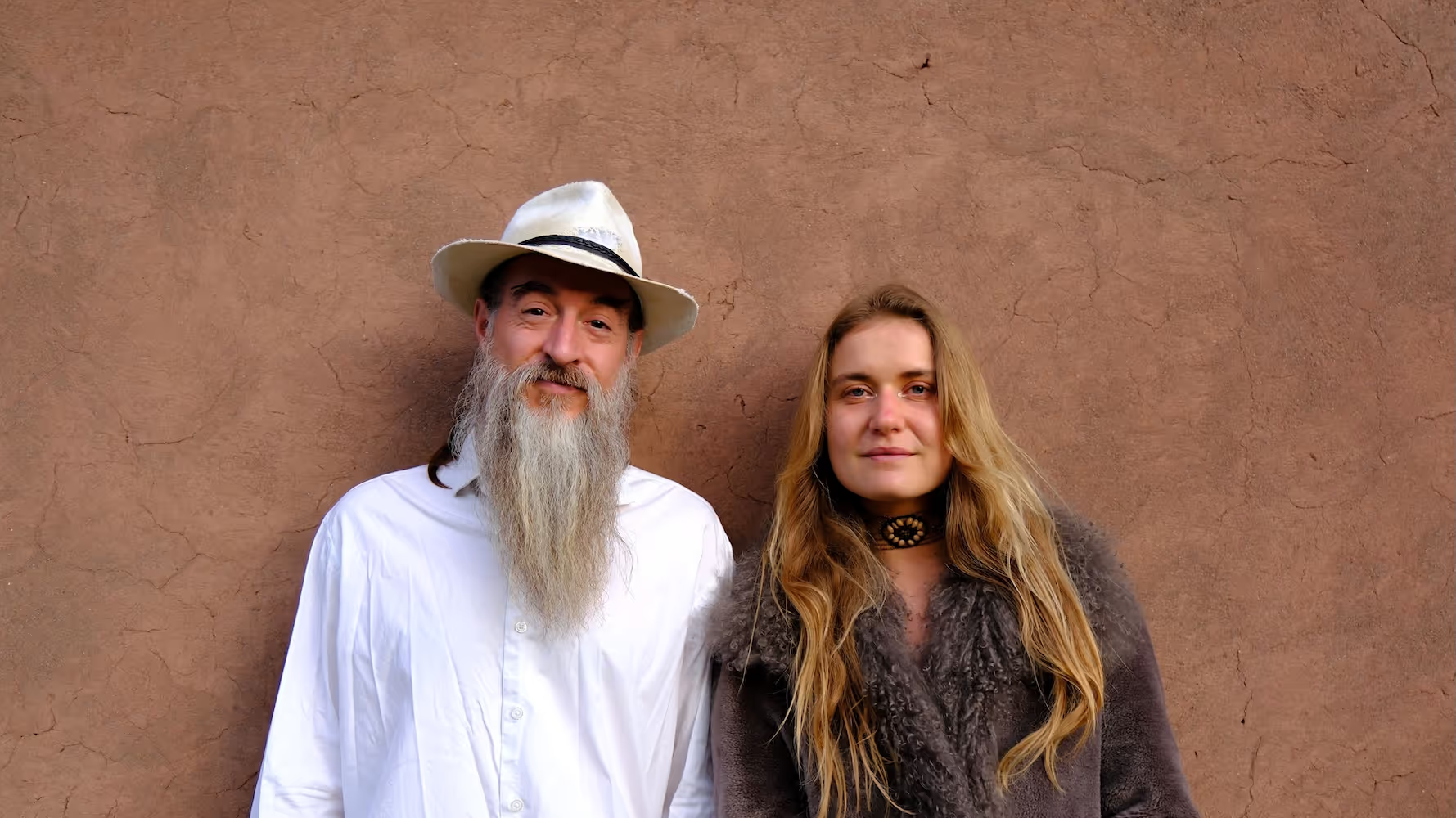
Joshua Levi Ian Gentzke, Ph.D., is a scholar of religion, writer, and musician whose work bridges mysticism, metaphysics, and contemporary cultural critique. He received his Ph.D. in Modern Religious Thought, Ethics, and Philosophy from Stanford University, with additional MAs at Stanford and the University of Amsterdam. A Fulbright Scholar to the Netherlands, he has published with Cambridge University Press, Harvard’s Center for the Study of World Religions, and Routledge, and has taught and lectured widely on religion, philosophy, and art. His scholarship engages apophatic theology, comparative mysticism, and Western esotericism, with particular attention to how metaphysical frameworks shape ethical and ecological life. He is also an internationally recognized musician and the creator of the multimedia project New Wilderness Gospel. He is a co-founder of the CCC Project, where he mentors young writers in cultivating imagination as a transformative mode of engagement with the world.
Barbara Helen Miller, Ph.D., is a member of the International Association for Analytical Psychology and maintains a private practice. She is an independent researcher affiliated with the Research Group Circumpolar Cultures and serves as training supervisor for the Tbilisi-Georgian Group for Analytical Psychology. She lectures internationally in both anthropology and analytical psychology, and her publications bring analytical psychology and shamanism into sustained dialogue. Her work includes edited volumes and contributions to Routledge, University of Alberta Press, and Sidestone Press, as well as articles in the Jung Journal. Her research spans circumpolar and Sámi healing traditions, embodied countertransference, active imagination, and the intersections of indigenous knowledge with depth psychology.
Steven Herrmann, Ph.D., MFT, is a member of the International Association for Analytical Psychology and training analyst of the C.G. Jung Institute of San Francisco. He has an analytic practice in Montclair, Oakland, and is the author of many papers and 10 books, including Vocational Dreams: Calling Archetypes and Nuclear Symbols, Meister Eckhart and C.G. Jung: On the Vocation of the Self, published as companion volumes in 2024, and his most recent publication, Murray Stein: Individuation, Transformation, and the Ways to the Self in Jungian Psychology published by Routledge in 2026. Steven can be contacted at: sbherrmann@comcast.net.
Event Description References
Campbell, Joseph (1976). The Masks of God: Creative Mythology. Penguin Books: New York.
Droogers, André (2006). Playful Religion - Challenges for the Study of Religion. Eburon: Delft.
Forshaw, Peter (2025) Death and Rebirth in Alchemy, in On Death: Perspectives on Endings and Eternities, edited by Elias Linden, 2025.
Gaillard, Christian (2006) The Arts. In Renos Papadopoulos (ed)
The Handbook of Jungian Psychology (pp. 324-376). New York: Routledge.
Goodwyn, Erik MD, (2024) The Innate Story Code https://authors.elsevier.com/sd/article/S0303-2647(24)00170-9
Izutsu, Toshihiko (2016/1984). Sufism &Taoism – A Comparative Study of Key Philosophical Concepts. University of California Press: Berkeley – Los Angeles – London.
Jung, C.G. (1958) Answer to Job, in Collected Works, Volume 11 (Bollingen Series XX), trans. R.F.C. Hull: eds. H. Read, M. Fordham, and G. Adler, Princeton: Princeton University Press.
Jung, C.G. (1966) “Psychology and Literature” in CW 15...
Jung, C. G. (2009). In edited and introduced by Sonu Shandasani, The Red Book – Liber Novus. W.W. Norton & Company: New York – London.
Miller, B.H. (2007). Connecting and Correcting – A Case Study of Sami Healers in Porsanger. CNWS Publications: Leiden.
Neumann, E. (1956) Amor and Psyche, (Bollingen Series LIV), trans. R. Manheim, Princeton: Princeton University Press.
Traversi, Bruno (2019/2). The Spontaneous Body and the Far East in W. Pauli and C.G. Jung. In Hanneton Sylvain & Andrieu Bernard (Eds), The Activation of Living Body. Emersions, Hybridations, Remediation, Intellectica, 71, (pp.67-78), DOI: 10.3406/intel.2019.1919.
Getting There
Address
House with the Heads
Keizersgracht 123, 1015 CJ Amsterdam
Public Transport
A fifteen-minute walk from Amsterdam Central Station. Prefer public transport? Take trams 13 or 17, or bus 170, 172, or 174 to the Westermarkt stop. From there, walk back a short distance, turn left onto Keizersgracht, and you will find us on your right after 300 meters.
Bike
Amsterdam is best explored on two wheels, and the EFM is no exception. Ample bike parking is available along the Keizersgracht.
Car
Parking in the area is paid (~ €8,05 per hour), and spaces can be difficult to find. The nearest parking garages are Q-park Nieuwendijk at Nieuwezijds Kolk 18 (650 meters), Q-park Bijenkorf at Beursstraat 15 (950 meters), and Q-park Europarking at Marnixstraat 250 (1,300 meters). You can also park at a P+R location and travel into the centre by public transport.
Upcoming Events
From immersive cultural experiences to distinguished academic gatherings, the Embassy of the Free Mind offers a diverse agenda open to all curious minds.
.avif)
.avif)
.avif)
Become a Member
Become part of a living community dedicated to free inquiry and the extraordinary legacy of the Bibliotheca Philosophica Hermetica.
Join our community
Unlimited museum entry
Seasonal culture & community event invitations
From
/ year
.svg)

.avif)