

.svg)
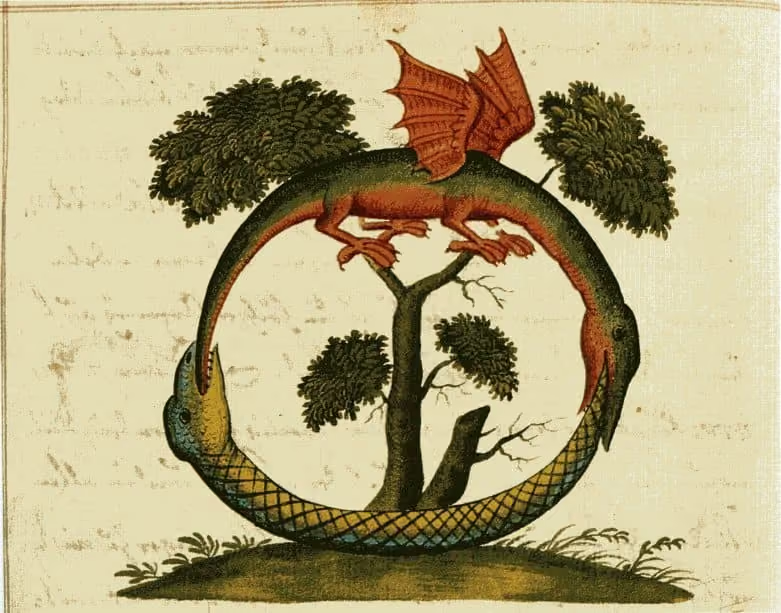
'Ouroboros Dragon', from the alchemical manuscript 'Clavis Artis', 1738.


Fairytales, Myths, Dreams, Alchemy and Process Theology viewed as archetypal narratives
Directors: Dr Paul Dijstelberge and Dr Barbara H. Miller
C. G. Jung approaches the process of mediating, transitioning, and transforming inner experience through a dialectic found, among others, in “active imagination” and his Red Book. The dialectic may include other narratives (myths and fairy tales) from the analyst’s repertoire, which are held in mind during and after the session and comprise the analyst’s associative thinking.
The theme for 2026-2027 is Joint Attention, which works with the affective core of the Self to embody creation myths.
C.G. Jung suggested “active imagination” to his final training patients; this was to facilitate independence and continue their individuation process. We can see affinity with Plotinus' Imagination and find an example in Jung's Red Book.
The central theme of The Red Book is Jung's relationship with “soul”, that is, overcoming the contemporary malaise of spiritual alienation. Jung employs the “alchemical” process and “individuation” interchangeably.
The metaphysical process is known in the psychology of the unconscious as the individuation process. In so far as this process, as a rule, runs its course unconsciously as it has done from time immemorial, it means no more than that the acorn becomes an oak, the calf a cow, and the child an adult.
But if the individuation process is made conscious, consciousness must confront the unconscious and a balance between the opposites must be found. Because this is not possible through logic, one depends on symbols that make the irrational union of opposites possible. The unconscious produces them spontaneously, and the conscious mind amplifies them. (Jung, 1958 par. 755)
The first alchemist we know by name is Zosimos, an Egyptian of Panopolis (c. 300 CE), who wrote Concerning the Art. Thirteenth-century alchemists also called their work “Art” and refer to the Grail Legend and the philosopher’s stone. Contained in the Grail Legend is a treasure hard to attain. Psychologist and pupil of Jung, Erich Neumann suggested that the "treasure hard to attain" is the creative/transformative word from the soul, coming from the affective core of the Self.
Such a word from the soul can happen when the ego connects with what is bigger than itself and is contained in what supports it. For C.G. Jung this support points to the Self and is what releases the ego from its prison in the complex, the Self being the affective core itself. Jung in “Psychology and Literature” calls the works of Dante, Goethe, Nietzsche or Blake, “visionary” - as opposed to those he calls “psychological.”
These works resist comprehension in that “the proliferation of monstrous, daemonic, grotesque, and perverse figures” in the work appear as a “frightening revelation of abysses” . Commenting that we have a vigorous defence against the anguish and chaos of the “night,” of that which we evidently cannot control.
With Jung we come to understand that this “structural unconscious”, as well as being highly emotional, is more than personal and that “a whole era is confronted by things unwanted and unknown that are obsessive and menacing”. But, as observed by Gaillard, such engagement could become “vivifying and compensatory”.
How shall we vivify and compensate? We follow Jung’s engagement: “We realise when we let a work of art act upon us as it acted upon the artist… we must allow it to shape us as it shaped him”.
Our theme for 2026-2027 is Joint Attention, which works with the affective core of the Self to form creation myths. Joint attention is the shared focus of two individuals on an object, event, or scene, often involving eye contact, gesturing (like pointing) and emotional sharing.
This social-cognitive model of joint attention proposes that, as infants monitor and represent their own goal-related intentional activity, they also monitor and represent the goal-related behavior of others.
Program Details:
Fairytale Salon (1st and 3rd Saturday of the month from 14.00 - 16.30)
Symposium Joint Attention (Saturday 15 May 2027)
Schedule 2026-2027:
with host Barbara Helen Miller PhD and invited guests.
- Saturday 14:00-16:30, 5 September 2026 (with Dr Miller: Wizard of Oz and Jung’s psychological types]
- Saturday 14:00-16:30, 19 September 2026 (with Dr. Miller: Prince Lindworm - Norwegian Folktale)
- Saturday 14:00-18:30, 3 October 2026
- Saturday 14:00-16:30, 17 October 2026
- Saturday 14:00-16:30, 7 November 2026 (with Margot Brouwer: Sterrenstof zijn wij | Dutch presentation)
- Saturday 14:00-16:30, 21 November 2026
- Saturday 14:00-16:30, 5 December 2026 (with Nicolette Ruigewaard: Initiation – Eleusinian Mysteries)
- Saturday 14:00-16:30, 19 December 2026
- Saturday 14:00-16:30, 16 January 2027
- Saturday 14:00-16:30, 6 February 2027
- Saturday 14:00-16:30, 20 February 2027
- Saturday 14:00-16:30, 6 March 2027
- Saturday 14:00-16:30, 20 March 2027
- Saturday 14:00-16:30, 3 April 2027
- Saturday 14:00-16:30, 17 April 2027 (with Kitty Woud: Williams James and the Boundaries of Consciousness - On Survival After Death)
- Saturday 14:00-16:30, 1 May 2027 (with Jurgen C. Jongkind: Exploring Arthur M. Young’s Theory of Process as Practice)
- Saturday 10:30-17:00, 15 May 2027 | Symposium Joint Attention, Self’s Affective Core
- Saturday 14:00-16:30, 5 June 2027
- Saturday 14:00-16:30, 19 June 2027
Barbara Helen Miller, PhD, is a psychoanalyst (C. G. Jung) in private practice, a member of the International Association for Analytical Psychology, and a training analyst for IAAP in Tbilisi, Georgia; she is also an anthropologist in co-operation with the Research Group Circumpolar Cultures, and her research is a case study on Sámi healers in Porsanger, Norway. Many of her publications attempt to bring analytical psychology and shamanism into fruitful dialogue.
Paul Dijstelberge PhD is a former associate professor for the History of the Book at the University and a specialist in 16th century history.
Buy Tickets
Getting There
Address
House with the Heads
Keizersgracht 123, 1015 CJ Amsterdam
Public Transport
A fifteen-minute walk from Amsterdam Central Station. Prefer public transport? Take trams 13 or 17, or bus 170, 172, or 174 to the Westermarkt stop. From there, walk back a short distance, turn left onto Keizersgracht, and you will find us on your right after 300 meters.
Bike
Amsterdam is best explored on two wheels, and the EFM is no exception. Ample bike parking is available along the Keizersgracht.
Car
Parking in the area is paid (~ €8,05 per hour), and spaces can be difficult to find. The nearest parking garages are Q-park Nieuwendijk at Nieuwezijds Kolk 18 (650 meters), Q-park Bijenkorf at Beursstraat 15 (950 meters), and Q-park Europarking at Marnixstraat 250 (1,300 meters). You can also park at a P+R location and travel into the centre by public transport.
Upcoming Events
From immersive cultural experiences to distinguished academic gatherings, the Embassy of the Free Mind offers a diverse agenda open to all curious minds.
.avif)
.avif)
.png)
Become a Member
Become part of a living community dedicated to free inquiry and the extraordinary legacy of the Bibliotheca Philosophica Hermetica.
Join our community
Unlimited museum entry
Seasonal culture & community event invitations
From
/ year
.svg)

.avif)