

.svg)
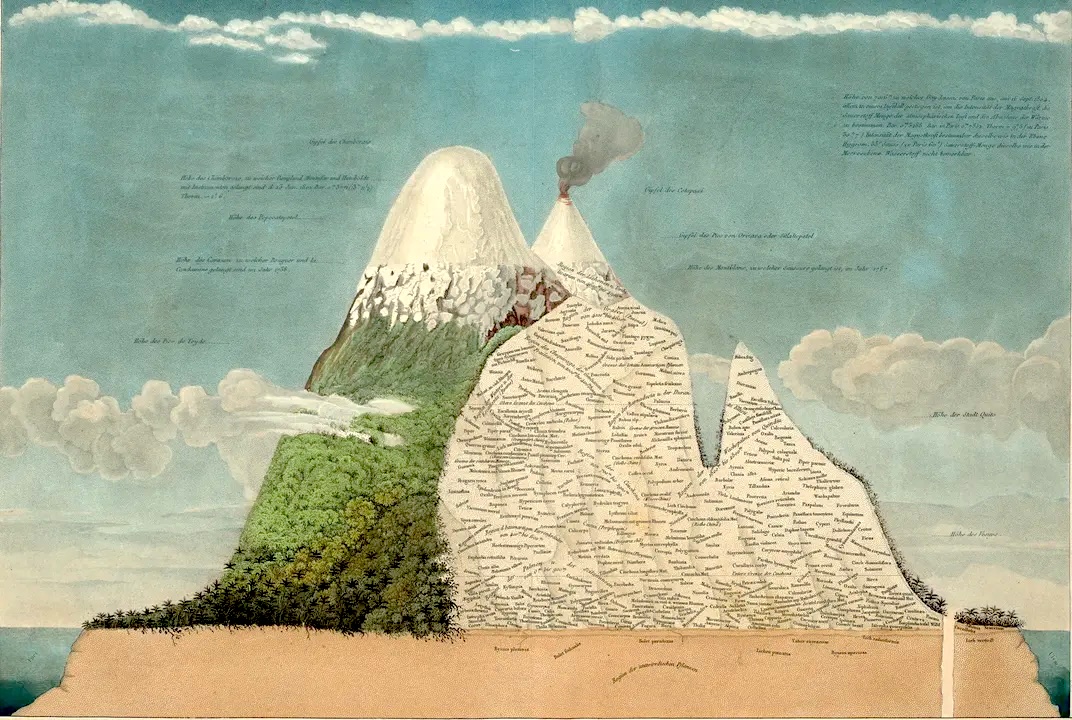
'Geographie der Pflanzen in den Tropen-Ländern', Alexander von Humboldt, 1807, Tübingen.
A participatory seminar and field laboratory in Hermetic philosophy and the practice of belonging to a living cosmos.
We know more about nature than almost any generation before us. We can describe ecosystems, map climate change, analyze the human psyche and measure the loss of biodiversity in extraordinary detail. And yet many of us struggle to experience ourselves as part of the living world, or know how to live in conviviality. Nature has become something we look at, manage, protect or consume. The self seems to exist somewhere inside us, separate from the world outside. Meaning becomes something humans create and project onto a universe assumed to be silent. But what if this separation is not simply a fact of existence? What if it is also a way of seeing and being in the world, one that can be examined, challenged and transformed?
Being Nature is a six-part exploration of another possibility: that we inhabit a living world in which mind, body, place and more-than-human life participate in one another, and that we can learn to perceive and embody this participation again. Rather than studying this idea from mere theory or history, we will be experimenting with it through our own experiences and practice.
Philosophy as Practice
Across six Saturday gatherings, a small group will explore a lineage of thinkers who ask how meaning and ecology are known through direct experience. We begin with the Hermetic and Neoplatonic image of the cosmos as alive and interconnected, then trace this thread through Dionysius, Ficino, Goethe, von Humboldt, Næss, and Kimmerer. What connects them is the possibility that certain things can only become known through relationship, embodiment, and participation, not observation alone.
Each gathering pairs short readings with practice. Expect to closely observe a natural phenomenon in the spirit of Goethe, notice how the body shapes perception, test old contemplative techniques in a modern setting, or design your own practice for entering into relationship with a place. Sources range from Western philosophy and contemplative tradition to phenomenology, ecology, and regenerative practice.
Guiding questions for the course:
- How does attention change what becomes perceptible?
- What separates looking at a landscape from entering into relationship with it?
- How do we get to know a Genius Loci?
- Can a forest, animal, river, or mountain become more than an object of interpretation, without abandoning critical thought?
- What would it mean to find our own place in the web of life?
Underneath all of this sits one question: how do we learn to participate consciously in a living world?
From the Seminar Room into the Field
One of our six gatherings takes place outdoors, where the landscape itself becomes both teacher and subject of inquiry. This field encounter will take place somewhere in the Netherlands; the exact location will be chosen together with the group, depending on their interests and availability.
Your Own Inquiry
Being Nature is also a laboratory for your own investigation. Over the six weeks, each participant develops a small personal inquiry and practice, an experiment, because insight means nothing without experience. It might concern a particular place, a relationship, an artistic practice, a ceremonial or ritual practice, or an experiment in changing how you apprehend the world around you.
You do not need to arrive with a finished idea. Your inquiry develops as the course unfolds: you experiment between sessions, bring observations back to the group, and learn from the experiments of others. By the final gathering, each participant shares something that has emerged, not necessarily an answer, but a practice, insight, or changed way of seeing.
What You Will Explore
Over six weeks we move through three intertwined capacities:
- Perceiving. How habits, concepts, and expectations shape what we notice. We experiment with attention and phenomenological observation, encountering phenomena before explaining them.
- Relating. What changes when we understand ourselves not as isolated observers but as beings constituted through relationships with other people, organisms, places, and worlds.
- Participating. How knowledge changes when we enter into the processes we seek to understand. Here philosophy meets practice, embodiment, ecology, and the question of how we actually live.
The aim is to investigate what becomes possible when rigorous thought, embodied experience, and direct encounter with the living world are allowed to inform one another.
Who Is This For?
Being Nature is for people who sense that our ecological crisis is also a crisis of being, meaning, and relationship. It may appeal to thinkers, makers, ecologists, educators, practitioners, researchers, and people working with landscape, culture, or community. It is equally open to those whose interest is personal: anyone looking for a richer relationship with nature and a deeper sense of belonging. No previous knowledge of Hermetic philosophy is required, only openness to wonder.
About the Teacher
Dr. Thieu Besselink is a philosopher, geographer, educator and regenerative practitioner. For more than fifteen years he has taught practical philosophy and regenerative development at Utrecht University. He founded The Learning Lab, the Townmaking Institute and the Academy of Place, each in their own way strengthening how people, communities and landscapes develop the capacity for life. His work seeks to bridge the inner landscape of experience, worldview and transformation and the outer landscape of practical application and collective action. He works with communities, governments, farmers, artists, universities and other organisations on regenerative landscape development, collective learning, and the relationship between and spend many years learning from indigenous communities in the Andes and Amazon.
Format
Seminar | Field Laboratory | In Person
Dates & Time
Saturdays from 10:00 to 14:00, including lunch.
- Remembering the living world | April 3
- Place and Genius Loci | April 10
- Field encounter with the natural | April 17
- Perception as participation | April 24
- The ability to respond. Regeneration | May 1
- Sharing the work | May 8
Language
The seminar will be conducted in English.
Price & Admission
€450, including five lunches and complimentary tea. Travel and meal expenses during the field encounter are not included.
Sign Up
.avif)

Become a Member
Become part of a living community dedicated to free inquiry and the extraordinary legacy of the Bibliotheca Philosophica Hermetica.
Join our community
Unlimited museum entry
Seasonal culture & community event invitations
From
/ year
.svg)

.avif)